
Introduction To Generative AI-
The Game-Changing Revolutionary Technology That Is Changing The Way We Create Content. Generative AI, which makes various forms of content out of nothing.
Consider telling a computer to paint you a sunset never seen, to write you a poem in the style of Shakespeare, or to make you a video of a dragon dancing (in your backyard). Sounds like magic? Welcome to Generative AI – the technology that is literally making something out of nothing and is transforming how we think about artificial intelligence.
We are in a time when AI is going to be used by 378 million people by 2025, and 92% of students have already experimented with generative tools. The punchline is, however, that the vast majority of people have no idea what is going on behind the curtain when ChatGPT is churning out their essay or DALL-E is churning out their idealized profile picture.
It is not another technology fad. It is the backbone of a $244 billion industry that is helping employees save 1.75 hours per day and creating 34 million images per day. It is no longer a choice whether you are a student, business owner or a mere human interested in the future; learning about Generative AI is now a necessity.
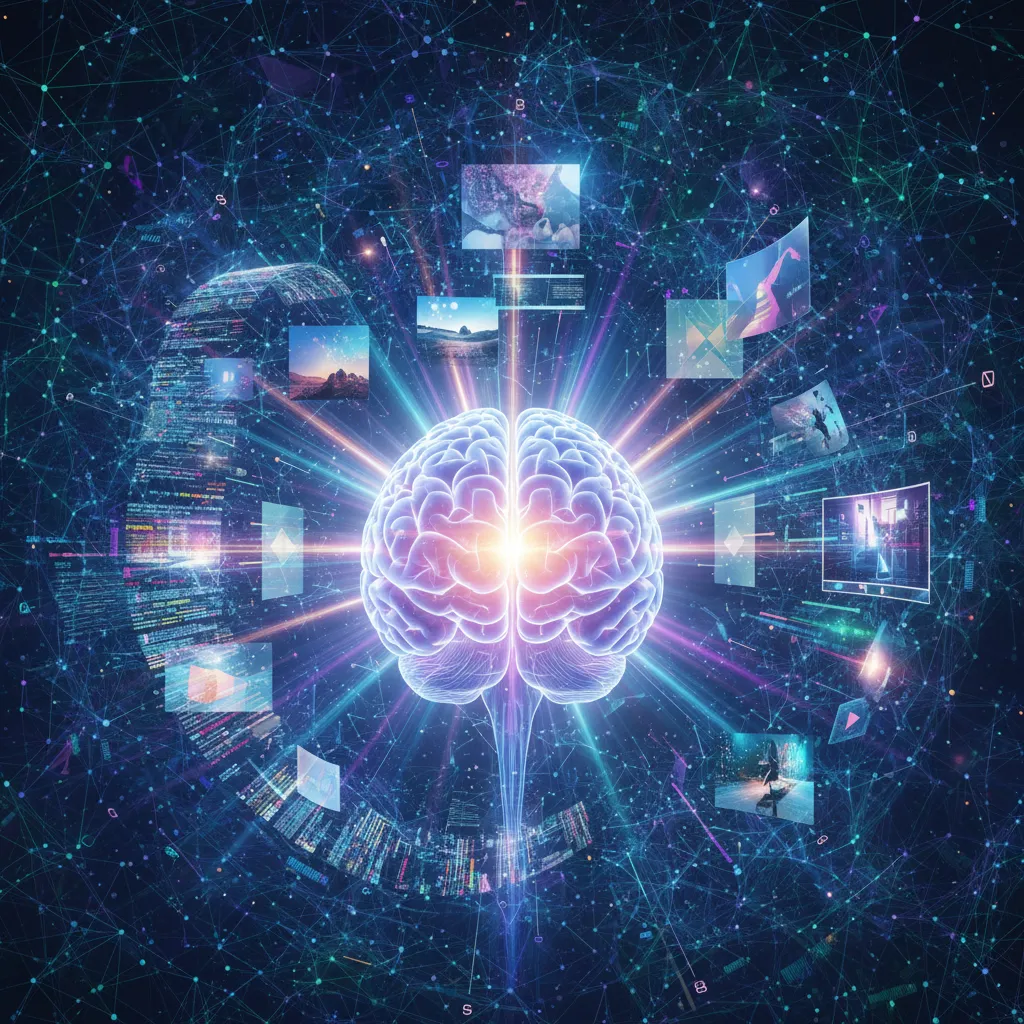
So What Is Generative AI?
We shall divide it into human terms. Generative Artificial Intelligence is basically a form of AI that does not necessarily analyze or categorize the available data – it generates completely new content. Consider it as the difference between a film critic who criticizes movies and the film director who is making the movies.
Generative AI does not simply say to you that this email is spam or that this image is a cat, but rather, it says to you that it will write you an email or that it will produce an entirely new image of a cat in a space suit. It is the inventive relative of AI.
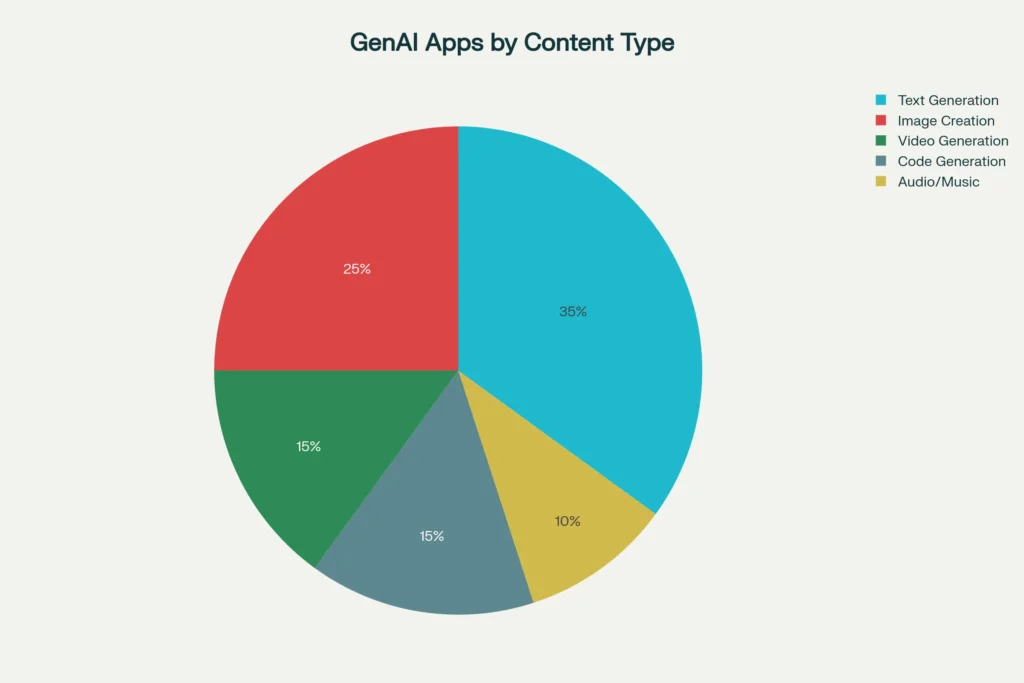
This magic works by using advanced neural networks to analyze vast amounts of existing material – books, images, videos, code – and get to know the patterns, structures and relationships among that data. Then when you provide it with some input, it proceeds to create something completely new using those acquired patterns, but by the same rules, but has never been before.
The Nothing Becomes Something
This is where things are interesting. Generative AI does not archive or replicate existing content. Rather, it studies the nature of things, how sentences run, how colours are combined in pictures, how stories are built, and recreates those elements in new combinations.
When you say it should make a golden retriever surfing in space, it is not imitating a photograph. It is merging its knowledge of golden retrievers, surfing pose, space setting, and visual composition to make something that will not only work, but one that is totally unique.
What Does Generative AI Exactly Do?
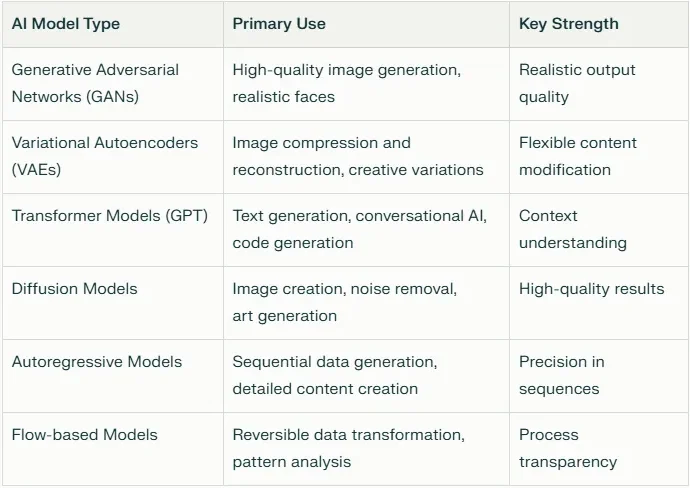
Generative AI model types:
The technology of Generative AI may be complicated but the idea behind it is rather simple. Imagine that you are teaching a person to cook, but you do not make him/her cook anything; you make him/her taste a thousand different dishes, comprehend how to mix the ingredients, and comprehend the flavor combinations. They would eventually be in a position to develop new recipes that are very tasty despite never having cooked such specific foods before.
The Training Process
Generative AI consists of three important steps:
Data Ingestion: The AI model receives massive amounts of data – millions of web pages of text, or millions of images on the internet, or hours and hours of video media. This is not random window shopping; it is the analysis of patterns, structures, and relationships in the data in a systematic manner.
Pattern Recognition: Through training, the model determines the relationship between elements. In writing, it is taught that there are words that follow, that paragraphs are organised, that there are specific features of writing styles. In the case of images, it knows the way shapes, colors and compositions interact.
Generative Capability: The model is able to sample what it has learned to produce novel content once it is trained. Giving a prompt tells it what to expect next, basing its training on their training, step by step.
The Neural Network Magic
Neural networks – computer systems that are modeled after the way the human brain processes information – are the core of Generative AI. These networks have layers of interconnected nodes which process and transform data, cumulatively developing into understanding of simple patterns up to complex concepts.
The innovation was transformer architectures – the “T” in GPT represents the word Transformer – the architecture is excellent in contextual and relationship analysis in sequential data. This is the reason why the current AI is capable of sustaining consistent conversations or producing long-form text that does not go off-topic.
Generative AI Model Types
There is no such thing as a generative AI equal. Various kinds of models are more proficient in various tasks, such as specialized tools in various jobs.
Generative Adversarial Networks (GANs): Imagine that GANs are an art forger who decides to challenge an art detective. The two AI systems are mutually exclusive – one of them creates content (the “generator”) and the other attempts to identify fakes (the “discriminator”). It is through this competition that both improve and the end result is the creation of incredibly realistic output.
Best on: High-quality image generation, realistic human faces, style transfer.
Variational Autoencoders (VAEs): VAEs are a creative compression algorithm. They try to reduce data to a simplified form and rebuild it with minor differences, which can be creatively altered, preserving fundamental features.
Best when used: Image editing, creation of variations of existing content, manipulating styles.
Transformer Models (Like GPT): These entities are the giants in conversational AI and text generation. They are good at context-based learning in long sequences and are therefore efficient in writing, coding, and in complicated rational thinking.
Best use: Text generation, chatbots, code-generation, translation.
Diffusion Models: Think about starting with random noise and creating a masterpiece. The diffusion models are trained to undo a process of adding noise, to generate high-quality images via pure randomness.
Best in: Image generation, art generation, photo-realistic content.
Autoregressive Models: Such models will construct content bit by bit, never forgetting what has already been constructed. They are storytellers and they make a sentence out of all the things they said before.
Best on: Sequential material, text generation, music composition.
Informative Applications: Generative AI Is Driving

Business professionals leveraging generative AI for productivity
Generative AI applications in the industry are rapidly expanding more than people even thought they would. Now, we will examine how this technology is being put into service in the modern world.
Revolution in Content Creation
Marketing and Advertising: Companies are creating advertising variations in the thousands, personalized email messages, and social media content with AI. Marketers can now experiment with dozens of approaches in a cost-effective and fast way, rather than paying whole creative teams on a campaign-by-campaign basis.
Writing and Journalism: Producing first drafts and writing data-driven reports, AI is becoming a writing assistant that does not suffer writer-block. News companies are churning out sports news, financial news, and even breaking news stories with the help of AI.
Visual Content: The 34 million images that are produced every day by AI are not really a joke. Artificial intelligence is used in product photography, marketing images and even architectural drawings by businesses.
Business Process Change
Customer Service: AI chatbots are able to respond to complex inquiries around the clock, and reply to customers in personal ways that feel human. Companies have seen a lot of improvements in response times and customer satisfaction.
Code Generation: AI is used to write code, debug it, and optimize it, which is much faster than traditional software development. As an example, GitHub Copilot assists programmers with proposing whole functions and error detection.
Data Analysis: AI is able to provide insights on the enormous volumes of data, produce reports and even predict business strategies through pattern recognition.
Creative Industries Change
Entertainment: AI is becoming a key creative tool, whether by providing background music to a video or recreating whole virtual worlds to play games.
Education: Dynamic education, automatic generation of quizzes and unique explanations based on the type of learning are transforming education.
Healthcare: AI is used to create treatment plans, medical reports, and can even be used to discover drugs by simulating molecular interactions.
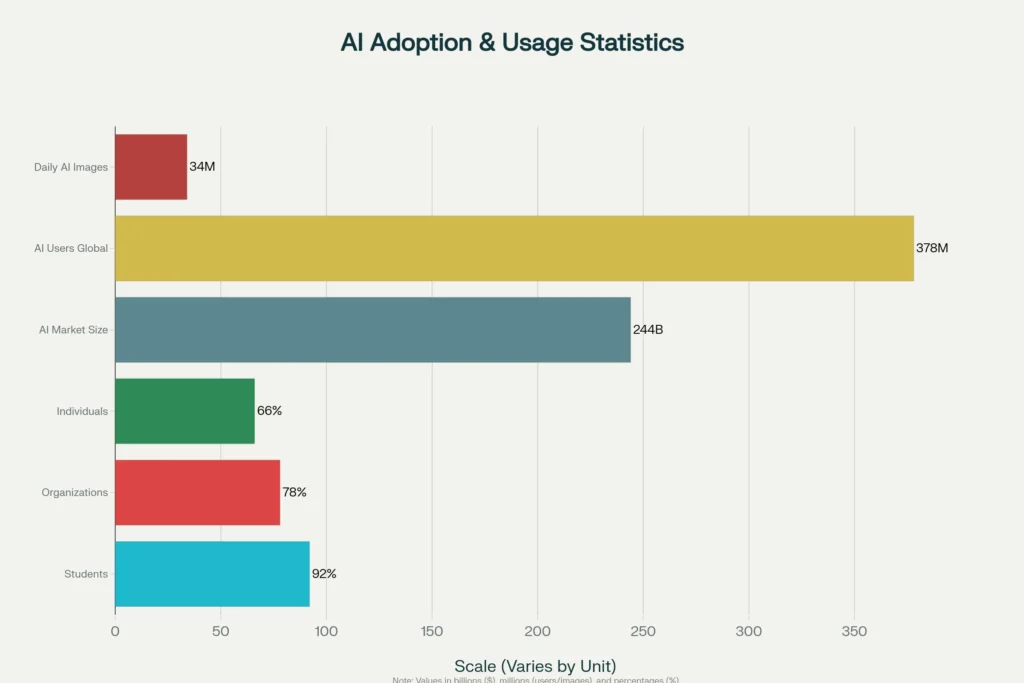
Key Generative AI Adoption Statistics for 2025
The Important Statistics of Generative AI Adoptions by 2025
The Business Impact: Why It’s Not An Ignorable Issue to Companies
These figures are a miracle. Companies that apply AI mention that their productivity increased in ways that not even several years ago appeared impossible.
Productivity and Efficiency
Workers who use Generative AI save an average of 1.75 hours per day – that is equivalent to an extra full day of work per week. However, it is not only about saving time, but also about releasing human creativity to do more valuable work.
Real-world impact:
In financial services, the reduction of costs is at least 10% per year.
There is a reduction in content creation time in marketing departments by 40-60%.
Response time of customer services gets enhanced by 50 percent.
Competitive Advantage
The first movers in terms of Generative AI are benefiting enormously. They’re able to:
Develop products quicker with the help of AI.
Deliver individual customer experience at scale.
Make AI-generated insights into data-driven decisions.
Lower costs of operation and enhance quality.
Market Development and Investment
The Generative AI market is expected to increase to an estimated $ 51.8 billion by 2028, compared to $ 7.9 billion in 2021 – a whopping 57.9 per cent yearly growth rate. This is no speculative investment, but is motivated by tangible, quantifiable business results.
The Strengths and Weaknesses
Risks and Opportunities in Generative AI
However, to be frank enough, Generative AI is not flawless. It has one thing in common with any strong technology: it presents serious challenges that savvy organisations are learning to handle.
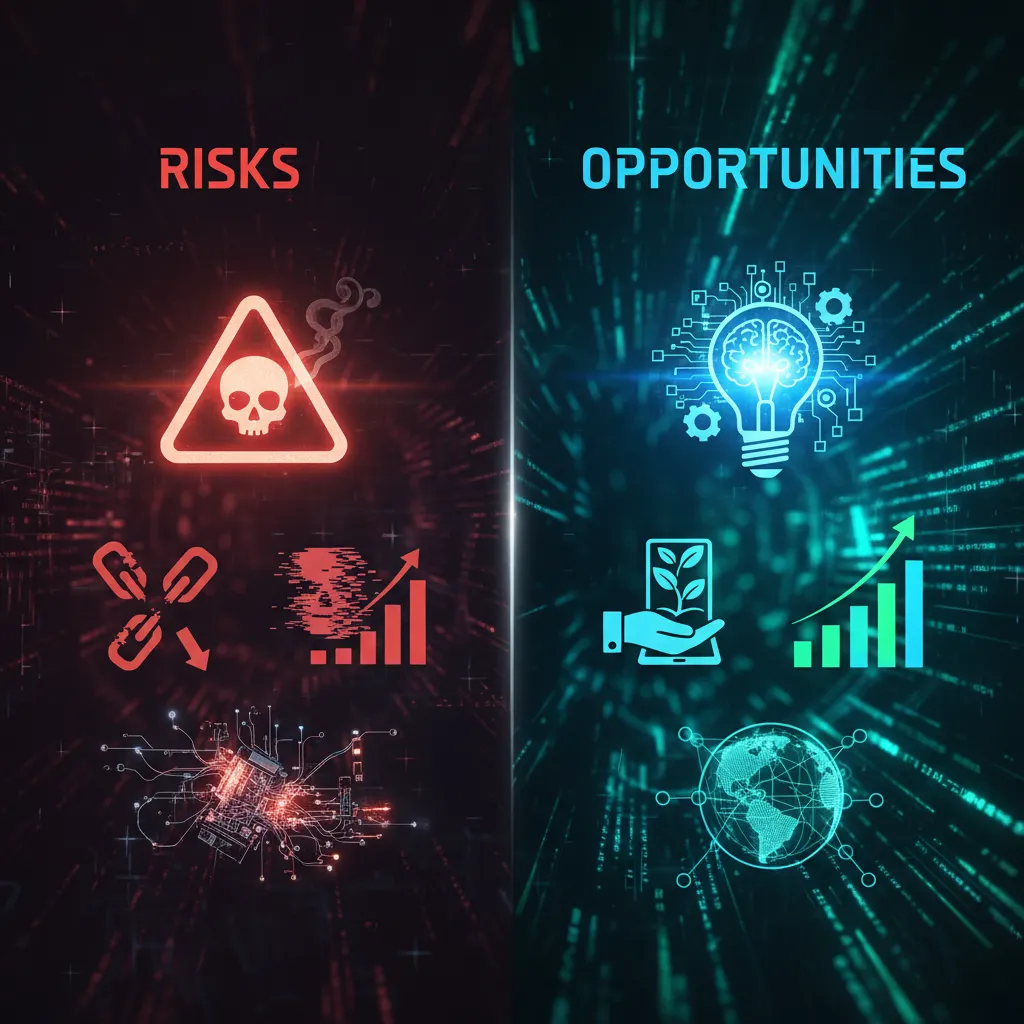
Balancing risks and opportunities in generative AI
Accuracy and Reliability
The AI can create false information with full authority – a process that is known as hallucination. This is of special concern to such domains as healthcare, finance, or legal services when precision is paramount.
Mitigation strategies:
Having human oversight in the formulation of crucial decisions.
To base AI answers on verified data, retrieval-augmented generation (RAG) can be used.
Periodical auditing and verification of AI results.
Bias and Fairness
The AI models have the potential to reproduce or enhance the existing biases already in the training data. This may cause injustice in employment, borrowing, content control, and other vital applications.
Key considerations:
Diverse training datasets.
Frequent bias testing and correction.
Multicultural development teams.
Data Privacy and Security
Generative AI needs large volumes of data, which is a concern in terms of privacy protection and data security. Firms need to strike a balance between AI technology and legal regulations and customer confidence.
Critical factors:
Strong data governance regulations.
Regulatory compliance such as HIPAA and GDPR.
Good data management and storage measures.
Copyright and Intellectual Property
Neural networks that are trained on copyright materials bring up complicated issues of ownership and fair use. Companies have to go through these legal grey areas.
Environmental Impact
Large AI models are very expensive to run and train in terms of computing resources and energy. This brings up sustainability issues that have to be tackled by responsible organizations.
Training Data: The Keystone to AI Success
The learning process of Generative AI is important to any person who works with such systems.
Data Requirements
The quality and quantity of training data are directly related to the performance of AI. Here’s what you need to know:
Minimum requirements:
Basic fine-tuning requires 32 or more prompt-completion pairs.
Millions of cases of strong performance.
Limited, representative data to eliminate bias.
Quality over quantity:
Good quality, clean data tends to give better outcomes, compared to huge volumes of noisy data. Data preparation includes:
Cleaning and deduplication.
Correct formatting and labelling.
Validation and testing.
Data Preparation Process
Collection and Integration: Collecting appropriate data from different sources – databases, documents, user interactions.
Preprocessing: Preparing, standardizing, and formatting data to be used by AI.
Validation: Testing the quality of data and verifying it to the training requirements.
The Future Trends: What the Future Will Bring
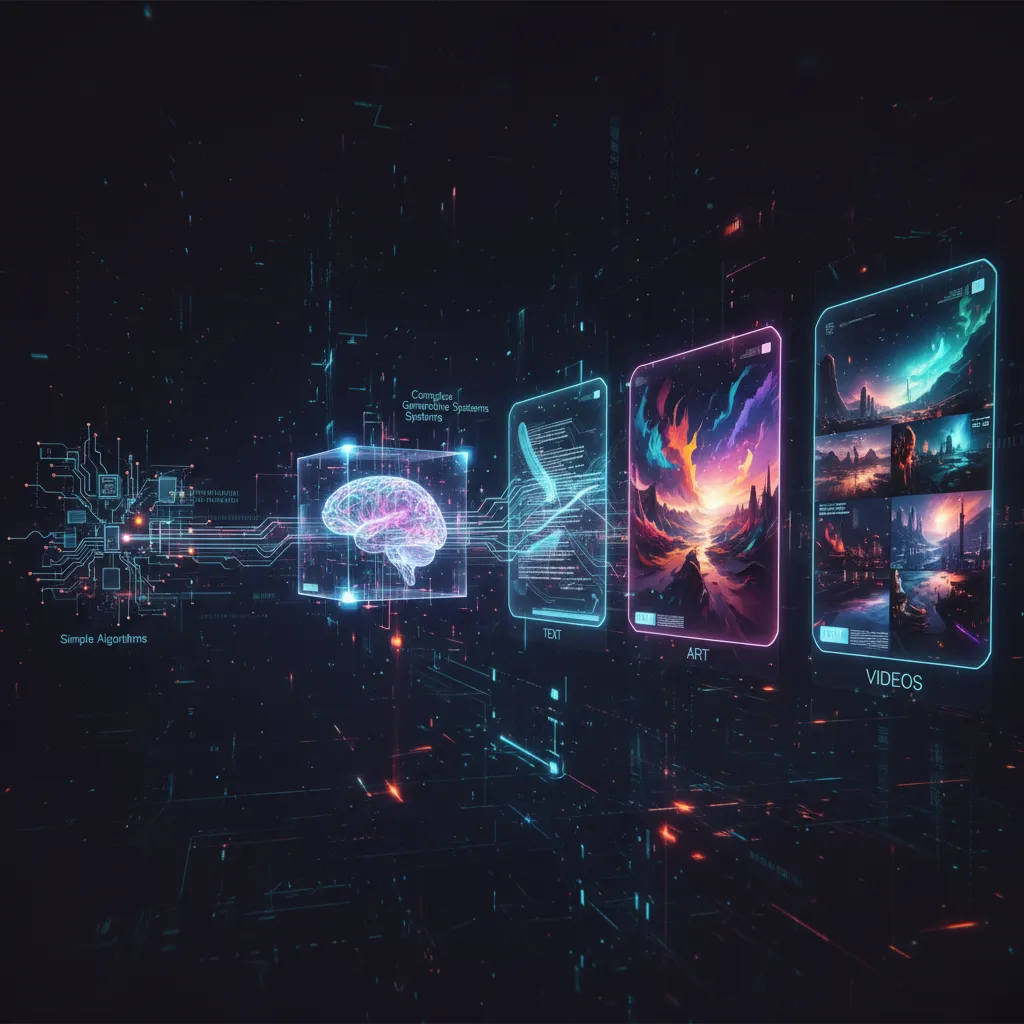
The evolution and future of generative AI technology
The future of Generative AI is coming sooner than most of the predictions thought. These are the major trends that are defining the next wave.
- Hyper-Personalisation: AI will develop personalised experiences for individual users depending on their likes and preferences, behavior and context. Think of learning or seeing marketing content that can change based on your learning style in real-time, or marketing messages that were created just as though they were meant to be used by you.
Multi-Modal AI: The future will not be text or images; it will be AI that will effortlessly operate, as a unified entity, with text, images, video, audio, and code all at the same time. Models such as Google Gemini already demonstrate what can be achieved once AI comprehends both different kinds of data simultaneously.
Autonomous Creative Systems: We are headed toward AI that is capable of taking full creative processes – from concept to production. This involves AI film directors composing movies, AI composers composing symphonies and AI architects building buildings.
Real-Time Collaboration: AI assistants will turn into real-time collaborative partners, who work with humans in both creative and analytical work.
Industry Specialized Models: We will witness AI models that are specifically trained in healthcare, finance, legal, and other professional fields, which have the expertise of the domain-specific tasks.
Getting Started: A Comprehensive Guide to Practical Steps That an Individual and Business Can Undertake
For Individuals:
Get experimenting: Use tools such as ChatGPT, DALL-E or Midjourney to familiarize oneself with capabilities.
Learn prompt engineering: Learn how to interact with AI.
Define applications: Discover where AI can be useful in your working or creativity.
Keep up with the developments and best practices in AI.
For Businesses:
Determine preparedness: Test your data infrastructure and staffing.
Begin small: Pilot projects with established goals and performance indicators.
Invest in training: Have all your team know what you can and cannot do.
Build governance: Develop policies on the use of AI and risk management.
Scale: Design architecture to be able to expand with your AI adoption.
The End: The Adoption of the Creative Revolution
Generative AI is not only a technological breakthrough, but a new approach to the creation, employment, and resolution of problems. We are now seeing the rise of a new creative economy because of the 34 million images created each and every day and the billions of dollars of economic value being created.
The organizations and individuals that know and adopt this technology at an early stage will have a lot to gain. Success, however, needs more than adoption alone; it needs an implementation that is thoughtful, moral and one that is learnt continuously.
As we have observed all the way up to this point, Generative AI is already revolutionizing industries, increasing human creativity, and introducing opportunities we are barely yet to realize. It is not about whether AI is going to affect your field, but rather about how soon you will be able to adjust to take advantage of its opportunities as you mitigate its risks.
The future to come is of people who can be able to cooperate with AI effectively and use it as a potent means of enhancing human imagination and intelligence. It can be content creation, business issues being solved, or creativity dealing, but in any case, with Generative AI, you have an opportunity to do more than it never appeared possible.
The revolution has begun. The question is: will you be ready to be a part of it?
FAQ’s
1. Does generative AI really produce new content or is it merely a copying machine?
Generative AI constructs truly new content by finding patterns and structures of existing data, and combining these pieces in new ways. It does not save or replicate original works but hears and knows how to relate to each other and creates new combinations. Imagine that it is a cook who studies cooking tricks and taste palettes, and invents new ones – the tricks are familiar but each dish is fresh.
2. It depends on how much data you want to use to train a custom AI model.
Data requirements are quite different according to your application. To perform any basic fine-tuning, you would need at least 32 pairs of prompt-completion, although thousands of great-quality examples usually are necessary to cement strong performance. It is all about quality more than quantity – smaller, clean, varied, representative data is often more effective than large volumes of confusing information.
3. Small businesses can make use of generative AI or does it belong to tech giants?
Generative AI can certainly be of benefit to small businesses. Numerous means are now affordable and available, starting with content creation platforms, or chatbots to assist customers. Larger organizations are not as likely to implement and adjust as quickly as small businesses. The trick is to begin with certain applications in which AI can be immediately useful, such as content generation or automating customer service.
4. Which are the most significant risks where businesses should be careful with generative AI?
The risks are mainly artificial intelligence hallucinations (wrong information being conveyed with a sense of authority), data privacy, a possible bias in the results, and intellectual property issues. The savvy companies address them by means of human control, sound data management, frequent auditing, and explicit policy of use. The idea is not to avoid AI but use it in a responsible manner.
5. Will artificial intelligence become a substitute to human creativity and employment?
Instead of replacement, augmentation and cooperation are being witnessed. Generative AI is good at regular work, first drafts, and creative inspiration, so it leaves the human brain to work on more advanced strategy, emotional intelligence, and problem solving. Other categories of jobs are being created, such as prompt engineer and artificial intelligence trainers, and made to add AI collaboration skills to the existing jobs.
Pingback: Sora and RunwayML The Ultimate Comparison in 2025: AI Video Tools. - Bing Info
Pingback: The Best Free AI Tools for Beginners in 2025 : A Complete Guide to Learning AI. - Bing Info
Pingback: How to Automate Your Life: AI with Email, Scheduling, and Summarising. - Bing Info