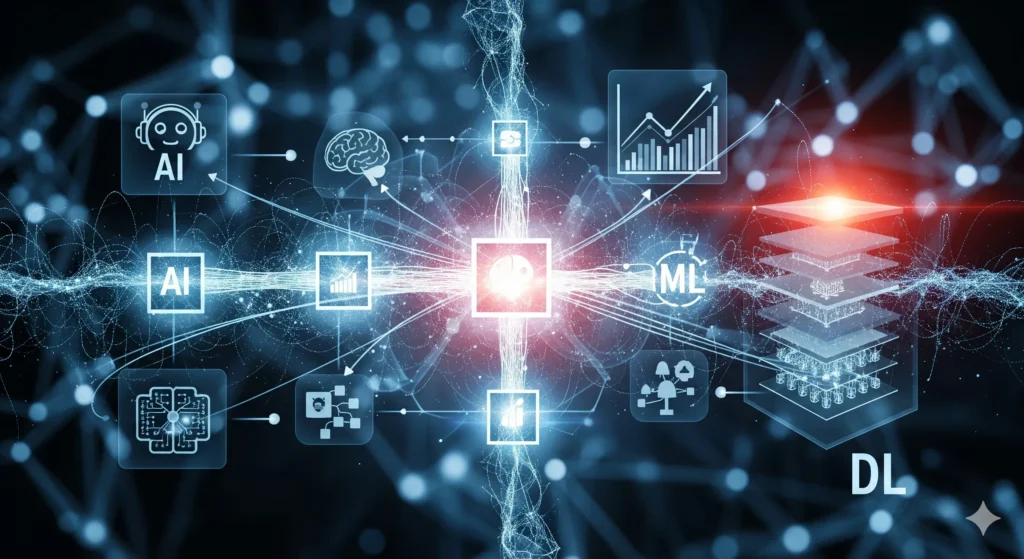
Introduction: The Age of AI ML DL—Why Clarity Matters
“Artificial Intelligence vs. Machine Learning vs. Deep Learning” can seem confusing, especially for beginners. As we move into the era of AI vs. ML vs. DL, these distinctions are influencing technology careers and everyday products—from voice assistants to medical diagnostics.
In this guide, discover how Artificial Intelligence, Machine learning , and Deep learning form the foundation of today’s fastest-growing technologies. By addressing common questions like “AI vs. machine learning vs deep learning: which is better”, and highlighting the differences between machine learning and deep learning with examples, this post will help clarify confusion.

AI: The Overarching System
Artificial Intelligence is at the center of automation and thinking software. It covers everything from rules-based expert systems to advanced analytics that mimic human-like decisions. AI continues to evolve—from early chess
engines to modern Artificial Intelligence-driven predictions in ridesharing apps and smart city planning.
Machine Learning: Learning Without Explicit Programming
ML is a part of Artificial Intelligence that focuses on adaptation. Unlike traditional Artificial Intelligence, machine learning systems get better as they process more data. This makes ML ideal for dynamic applications such as recommendation engines, fraud detection, and virtual personal assistants.
Deep Learning: Complexity Unlocked with Neural Networks
Deep Learning, a more specialised branch of ML, imitates how the human brain learns. It uses layered neural networks to tackle complex tasks that involve large amounts of data, such as face recognition, speech-to-text, and autonomous vehicles. DL excels in high-volume, high-dimensional, or unstructured data scenarios, like medical imaging and driverless cars.
Difference Between AI ML and DL (Tabular Form for Clarity)
| Aspect | Artificial Intelligence | Machine Learning | Deep Learning |
|---|---|---|---|
| Scope | Broadest, includes all intelligent systems | Subset of AI, data-driven learning | Subset of ML using layered neural networks |
| Learning Method | Logic, rules, reasoning | Data-driven adaptation | Deep neural network feature learning |
| Data Needs | Ranges from minimal to moderate | Moderate, mostly structured | High, especially unstructured data |
| Hardware | Low to moderate | Moderate | High (often needs GPUs/TPUs) |
| Examples | Chess engine, chatbots, autopilot | Email spam filter, language prediction | Self-driving cars, voice assistants, image captioning |
| Human Intervention | Often required | Some (feature selection, tweaking) | Minimal—automated feature discovery |
| Focus | Performing human-like tasks | Improving with data | Handling complex, nonlinear, big data problems |
| Best For | Any intelligent automation | Data-based predictions, classification | Vision, speech, text, sequential data issues |
| Efficiency | Varies | Can be less efficient on unstructured data | Highly efficient for high-volume tasks |
Artificial Intelligence vs. Machine Learning vs. Deep Learning: Which Is Better?
This is one of the most frequently asked questions. The ideal approach depends on the task:
- Artificial Intelligence is best for rule-based automation and strategic planning.
- Machine Learning is most effective when you have structured historical data and clear business goals (like credit scoring or email filtering).
- Deep Learning excels with large, complex, and unstructured datasets—such as vision, speech, text, and generative tasks like art or video creation.
Artificial Intelligence vs Machine Learning vs Deep Learning Example: Real-World Scenarios
- AI in Action: Google Maps uses AI-powered predictions for traffic and route planning.
- ML Example: Netflix suggests movies by learning your preferences from past views and ratings.
- Deep Learning Example: Face ID on iPhones employs deep convolutional neural networks to recognise users and enable secure access—even if you have a beard or wear glasses.
Deep Learning vs. Machine Learning: When Does DL Outperform ML?
- Deep Learning can identify complex, non-linear relationships in datasets and process high-dimensional, unstructured data (like medical images or video).
- Machine Learning performs best in well-defined, structured scenarios—such as financial predictions, anomaly detection, or text classification with moderate data.
- Personal Experience: In a healthcare AI project, ML techniques (using random forests and SVMs) struggled to classify subtle tumour features accurately. A deep learning model (CNN) achieved better accuracy and identified challenging cases that radiologists missed. This shift was significant, offering life-changing potential for patients and illustrating how model selection should align with the complexity of the data and ethical considerations.
Deep Learning vs Neural Network: What’s the Subtle Distinction?
A neural network is the basic mathematical model in ML that learns patterns by simulating interconnected neurons. Deep learning simply means these networks are “deep”—consisting of many layers, allowing for the detection of complex patterns that shallow (2-3 layer) neural networks cannot uncover.
Diagram

Imagine three concentric circles:
- The largest, outer circle represents AI.
- Inside that is ML.
- The innermost circle is DL.
This visual illustrates the subset relationship often highlighted in the differences between AI, ML, and DL.
Project Distribution in 2025: Where Are Artificial Intelligence, ML, and DL Used Most?
Deep learning is now leading in project share due to advancements in computation and the surge of unstructured data sources.
Key Insights & 2025 Trends
As of 2025, over half of enterprise projects utilize deep learning, especially for imaging, language, and pattern recognition—mainly due to the availability of GPUs and extensive data streams.
- ML remains essential for business analytics, real-time fraud detection, and medium-scale user personalisation.
- Traditional AI (rules-based, simpler systems) is still used in legacy and resource-limited settings, such as logistics or basic automation.
- Low-code platforms and explainable AI developments are making it easier for non-coders to implement impactful models after brief training.
Difference Between Machine Learning and Deep Learning (With Examples)
- ML: Suitable for small dataset tasks like price prediction, spam classification, and churn analysis.
- DL: Best for tasks like medical diagnosis (image classification), driverless cars (real-time object detection), and voice assistants (natural language processing).
- Example PDF Resource: Many universities and enterprise forums provide downloadable resources on the “difference between machine learning and deep learning”—available on top data science websites.
Conclusion: Mastering AI vs. ML vs. DL—A Roadmap for 2025 and Beyond
Recognize the basic differences: Artificial Intelligence is the broad vision, ML is the practical engine, and DL is the cutting-edge method for handling scale and complexity.
- Deciding between Artificial Intelligencevs machine learning vs deep learning involves considering problem complexity, data availability, hardware resources, and future goals.
- Stay involved! The field of Artificial Intelligence, ML, and DL is fast-changing—new tools, libraries, and solutions are continually being developed for both coders and non-technical users.
Call to Action
Share your thoughts in the comments: which of these techniques has changed your workflow or industry?
Pingback: The Different Types of AI in 2025-26