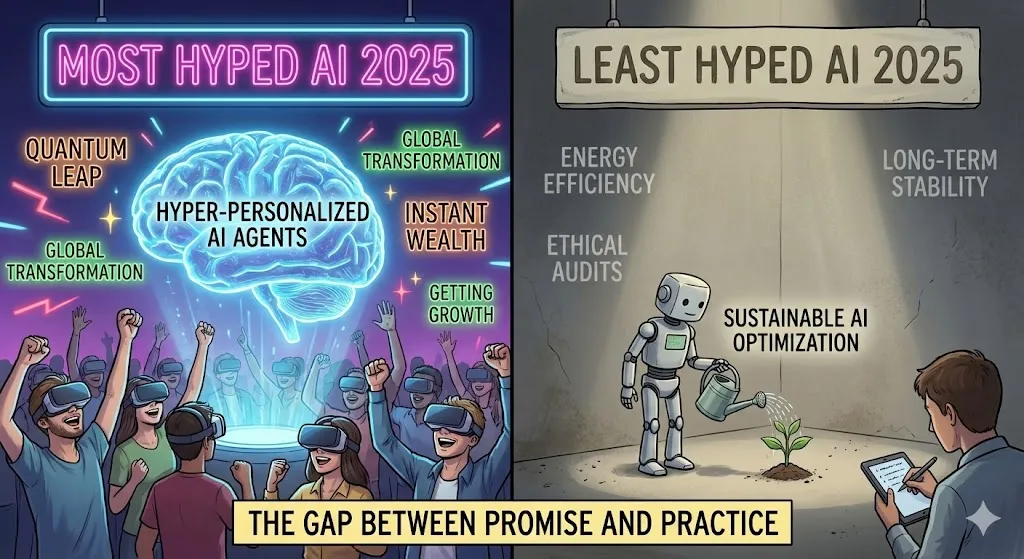
The AI Trend That Got the Most Hype in 2025 (and the One That Got the Least)
When we look back on 2025, we’ll probably laugh at how we all went crazy over some AI trends that promised to change everything but only made small changes. AI is definitely a game changer; I’m not saying it isn’t. But there’s a big difference between what the hype machine says and what really happens in real businesses, on real projects, with real people using these tools. Let’s talk about that space.
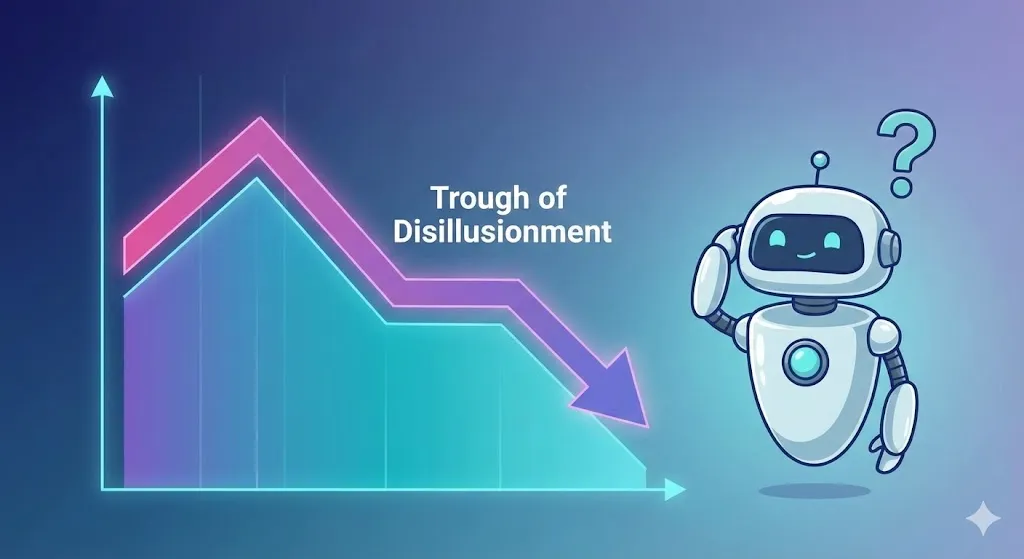
📉 The Trough of Disillusionment: Agentic AI
The truth is that 2025 has been a year of disappointment. After the ChatGPT gold rush in 2023 and the “AI will replace everyone” panic in 2024, we’ve finally reached what I call the “Trough of Disillusionment.” That’s good for you. That’s where real new ideas come from. That’s when we stop chasing headlines and start making things that work.
The most overhyped trend is agentic AI, which means agents without ROI. Agentic AI would be the one trend that took up more air than it needed in 2025. And I say this as someone who really thinks autonomous agents will be important. Just not this year, and probably not with the timelines or return on investment that everyone is expecting.
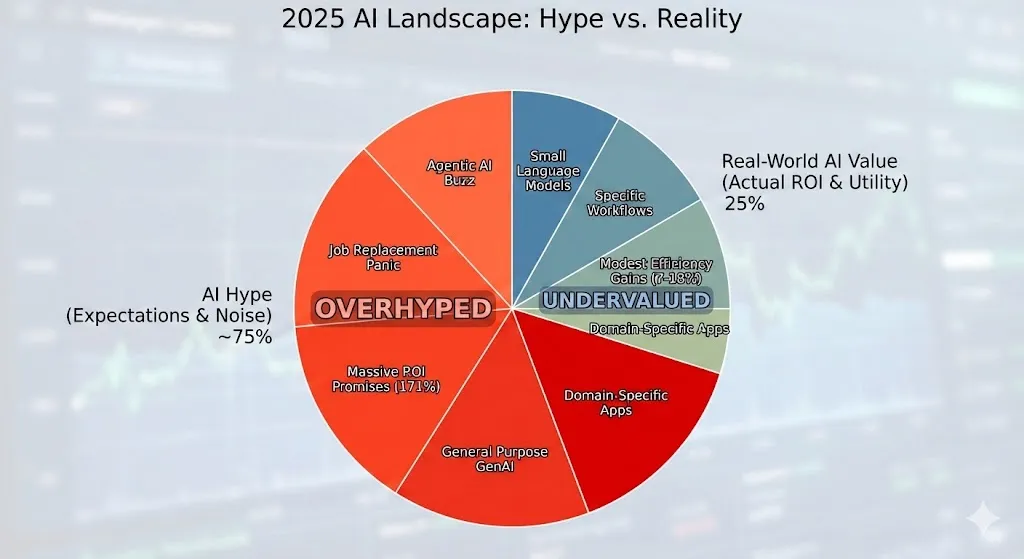
Gartner put agentic AI at the top of its list of trends for 2025. McKinsey called it the next big thing. Salesforce changed its name to “Agentforce.” Venture capitalists put billions into startups that focused on agents. The story was simple and exciting: autonomous AI agents would take care of complicated workflows, make decisions on their own, and let whole teams focus on strategic work.
The numbers on paper looked great. A PagerDuty survey found that 62% of businesses expect agentic AI to give them more than 100% ROI. The average expected return is a shocking 171%. The executives were completely sure. The stage was set.
Then reality hit. The problem isn’t the technology; it’s the way people set expectations. In 2026, the agents that will matter will be built quietly by teams that set realistic goals.
The Second Big Offender: The “Revolutionary” Power of Generative AI
Let me be clear: generative AI is really helpful. It writes good emails, summarizes documents, helps developers with code, and writes marketing copy faster than a person could. These are real improvements in productivity. But let’s talk about what it hasn’t done: it hasn’t changed the way businesses work at their core. It hasn’t gotten rid of whole types of jobs.
A GoTo study found that 62% of workers think AI has been way too hyped up. Most workers know they’re not using AI tools to their full potential, and the promises of transformation haven’t come true. The real value is still there, but it’s not as high as the headlines said it was. The uncomfortable truth is that the most common uses of generative AI in 2025 are the same ones we could have imagined in 2022: chatbots, email help, code generation, and summarizing documents.
💼 The Job Replacement Panic: A Nuanced Reality
I want to be careful with this one because it has made millions of people very anxious, and I think the way it has been framed is irresponsible. The story: “AI is taking jobs away from people at an alarming rate. Millions of jobs will be lost. Get ready for mass unemployment.”
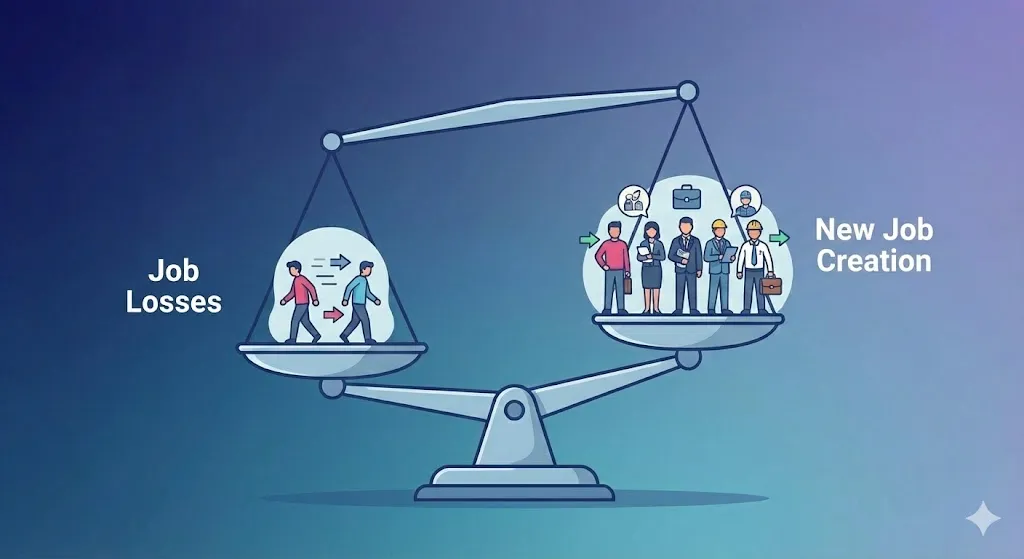
The Truth: AI is taking jobs away from people. AI was directly responsible for 77,999 tech jobs in 2025 alone. That’s true. That hurts.

But here’s what the news won’t tell you: The Net Employment Effect. AI is expected to take away 92 million jobs by 2030, but it is also expected to create 170 million new ones during that time. The end result isn’t the end of jobs; it’s change. The issue is that these new jobs might not be in the same places or with the same requirements.
✨ What Was Way Too Underhyped: The Technologies That Really Matter
Now, I’d like to talk about some AI trends that aren’t getting enough attention. These are the technologies that are quietly fixing real problems and making real money.
Small Language Models (SLMs): If generative AI is a mansion that needs its own power plant, small language models are like an apartment that runs on a battery. SLMs give speed, price, privacy, sustainability, and specialization.
AI-Augmented Human Workflows: Using AI to improve people instead of replacing them is the least exciting but most useful way to integrate AI.
The Invisible Infrastructure of Synthetic Data: This is important for analytics and privacy.
Domain-Specific AI Applications: The real value is being created in specialized apps for industries like healthcare, video, and business.
❓ Questions Everyone is Asking: FAQ
Q1: Is it still worth it to invest in AI? Yes, but invest in specific use cases with measurable success.
Q2: What will work in 2026? Systems made for certain problems that are very precise.
Q3: Is AI really taking jobs away? Yes, in some areas, but the overall effect is net job creation.
Q4: What AI trend should we care about? Small language models and AI that works with more than one type of language.
Q5: How can we tell the difference between hype and promise? Ask for a working pilot with measurable ROI.