Introduction Of The Ethics of Generative Art
Imagine the following: you feed an AI-based tool with a basic query and in a few seconds it generates a stunning digital masterpiece fit to be displayed in any gallery. But what is the million-dollar question–that is, in some instances, the million-dollar question–who is the owner of that creation? The artist, who created prompt? The artificial intelligence corporation that developed the algorithm? The system, which was trained by the thousands of artists? Or perhaps, nobody at all?
It is the beginning of one of the most interesting and controversial debates of our technological era. With generative AI taking up a creative space, it is compelling us to reevaluate all that we think about authorship, creativity, and intellectual copyright. 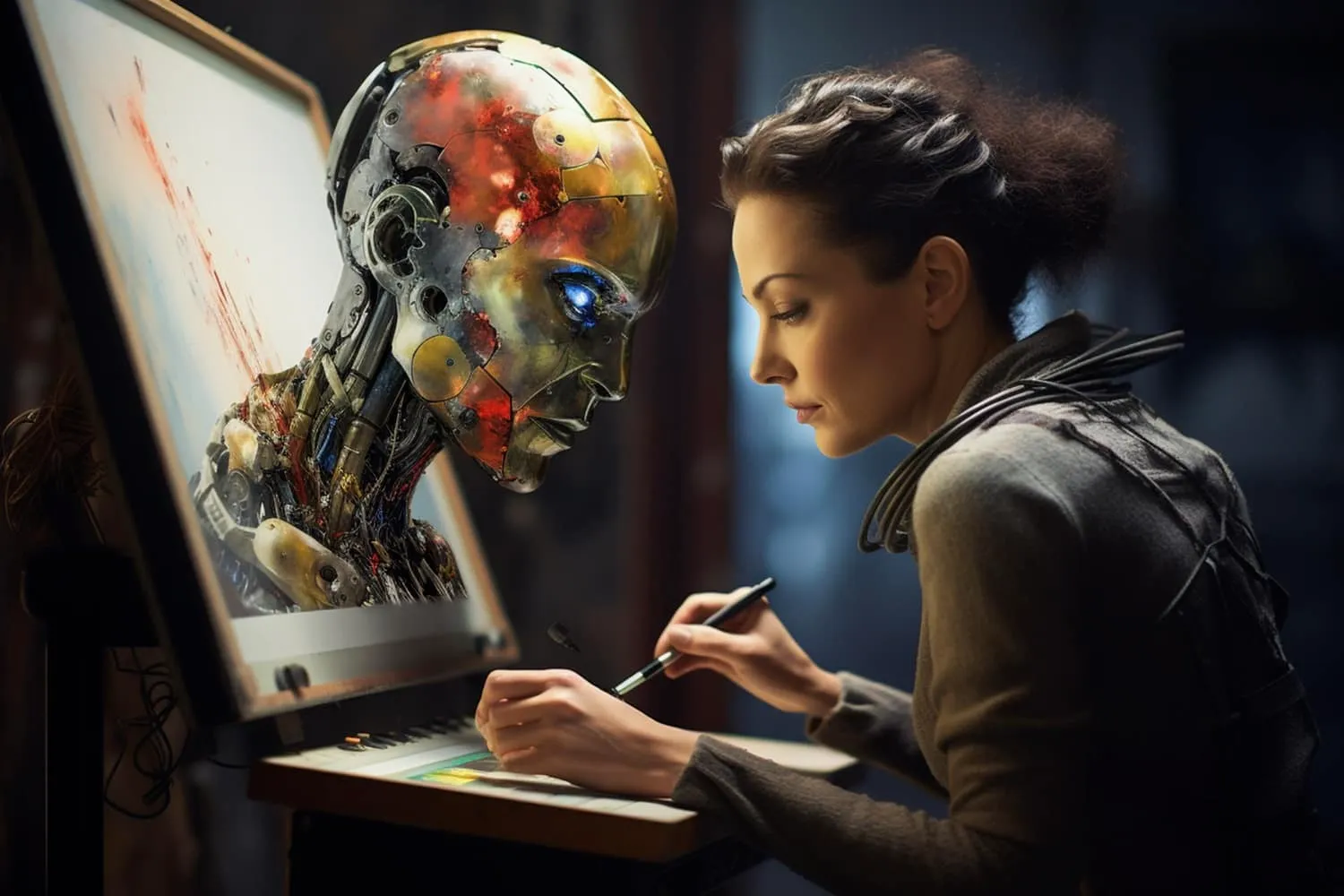
Digital artist producing generative artwork inspired by AI, and based on a drawing tablet, of a robotic head. Source: Nailsahota
The New Creative Revolution: The Machines as Artists.
Generative AI art is a seismic change to visual content creation and consumption. In contrast to conventional digital art tools, where the human hand and will are needed behind each brushstroke, generative AI systems such as DALL-E, Midjourney, and Stable Diffusion are capable of creating convincing-looking work with complex appearance without requiring the use of human skill or the human will behind each pixel. These systems read through huge amounts of data with millions of existing works, learn patterns of works, styles, and techniques, and then create completely new images.
The effect of the technology is already tremendous. According to recent research, AI-assisted artists create 1.25 the number of works as compared to their conventional peers and get more audience attention. Nevertheless, there is a problematic fact behind this productivity boom the majority of artists are deeply worried about their employment stability because of AI development.
The artistic community is at cross-roads. Some see AI as an effective partner that makes human creativity more creative, whereas others perceive it as a life-threatening force to the existence of art people. This is not merely a philosophical tension–this is being rewritten in some courtrooms of the globe, where the definition of creativity and ownership is being redefined.
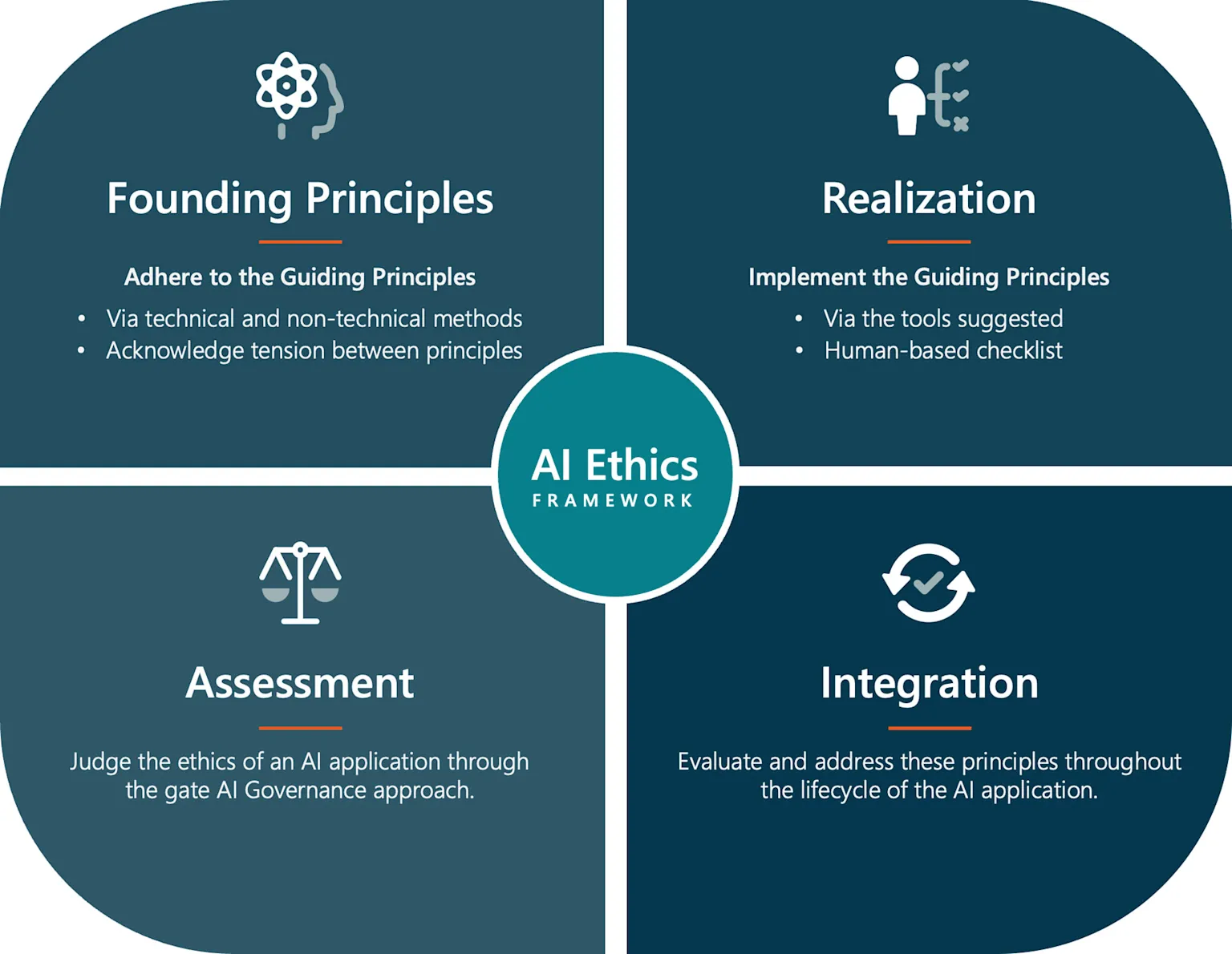
AI ethics framework describing ethics foundations, realisation, evaluation and assimilation of responsible AI operations. Source:MnpDigital
The Legal Battlefield: Existing Structures and Case Law.
The Human Authorship Prerequisite.
The essence of the modern copyrighting remains as crystal clear as the fact that only humans can be authors. The U.S. Copyright Office has long-held this view, and in the most recent case to strengthen this opinion has been Thaler v., decided in March 2025 by the D.C. Circuit Court of Appeals. Perlmutter.
The long-term struggle of Dr. Stephen Thaler to have his copyright on work produced by his “Creativity Machine” is an unequivocal demonstration of the fact that AI systems are not considered as authors in the existing legislation. The court decided that the text of the Copyright Act read as a whole is most appropriately interpreted to declare humanity as a pre-requisite to authorship.
However, this is where it becomes interesting, as the ruling does not prohibit human beings to gain copyright protection of works made with the help of AI. The main difference is in the amount of human creative activity and control over the end output.
The Training Data Dilemma
Although it is not possible to have AI as an author, a more complicated question is the way in which these systems are trained. Generative AI models are mostly created based on enormous amounts of information that is scraped off the internet, and they are not always created under the explicit consent of original creators. The practice has been in a gray area that is yet to be tapped by courts.
The report released by the U.S. Copyright Office in May 2025 on generative AI training offers essential information, as it implies that certain applications of copyrighted materials to train AI can be considered fair use, whereas others will not. The consideration relies on such factors as transformativeness, commercial purpose, and commercial impact on the market to a great extent.
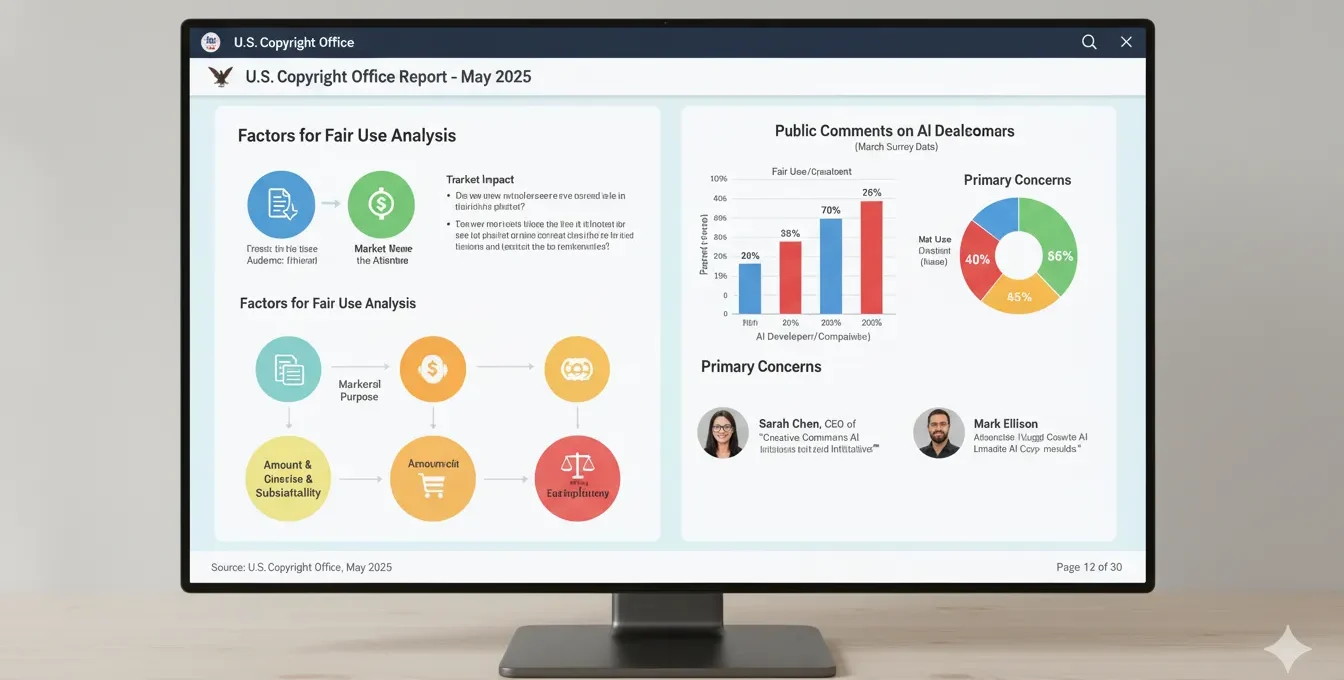
Trusted Site Data Screen Shot With Sources : U.S. Copyright Office Report on Generative AI Training (May 2025)
Fight Back Artists: The Andersen Case.
Artists Sarah Andersen, Kelly McKernan, and Karla Ortiz sued Stability AI, Midjourney, and DeviantArt in a class-action suit in 2023, alleging that the three companies violated all three prongs of the Lanham Act as well as the Fourteenth Amendment in their pursuit of AI art generation. A significant step in the case was made in August 2024, when the U.S. District Judge William Orrick authorized the infringement claims to move forward since the AI companies could have enabled the copying of the copyrighted content.
The case is also important as it concerns the LAION dataset that is 5 billion images collected online and utilized to train various AI systems. This case has the potential to change the course of history by setting several groundbreaking precedents that would guide the interpretation of the connection between AI innovation and intellectual property rights in court.
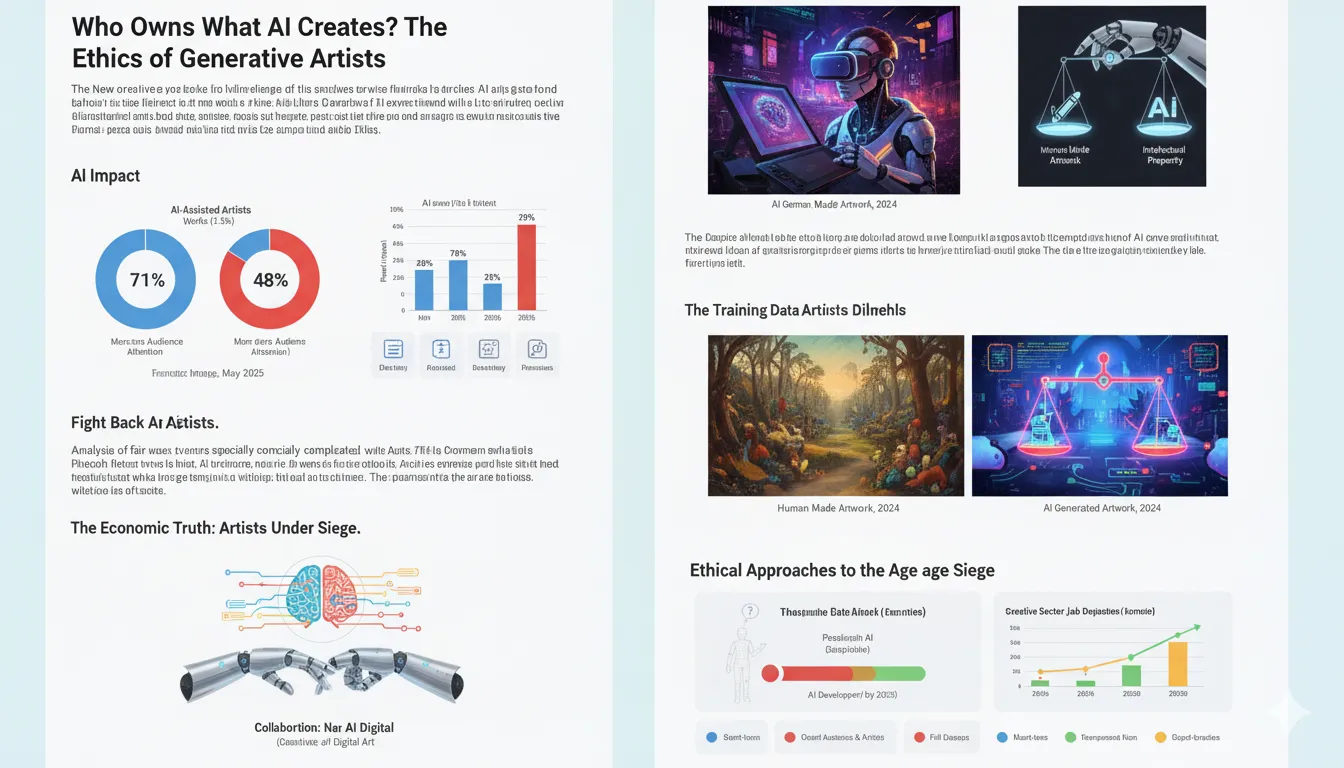
The hands of a robotic hand with a digital scale of justice, which is a representation of AI ethics and intellectual property rights.
The Fair Use Doctrine Under Fire.
The fair use has emerged as the major defense to AI companies against copyright problems. Nonetheless, the application of the doctrine to generative AI is not resolved. Two popular arguments in the Copyright Office 2025 report are explicitly dismissed, namely that AI training is transformative and that AI learning is comparable to human learning.
The recent judicial rulings are an indication of a subtle treatment. Two major decisions in 2025 in favor of tech firms favored the debate that AI training is transformative fair use in case the purpose of the output is a purpose of the public interest. Nevertheless, such decisions were arrived at via various legal avenues meaning that the legal environment is yet to stabilize.
Analysis of fair use is especially complicated when the following issues are in question:
Transformativeness: The courts will have to determine whether AI-generated content has a different use as compared to the training material. A model that has been trained to generate content that has a common aim of impressing a specific audience can be at best, slightly transformative.
Market Impact: This has been termed by the Supreme Court to be the most important factor in the fair use analysis. Fair use is doubtful when the output of AI is directly competing with original work in the same market.
Commercial vs. Non-commercial Use: Commercial character of the majority of AI art platforms works against protection of fair use, but does not bind the decision.
The Human Element: What Is Making Art Human?
The controversy surrounding the ownership of AI art makes us reevaluate the basic questions of creativity. What is human creativeness special? Is it of our emotional experience, our cultural context, our fallible yet significant interpretation of the surrounding world?
The report produced by the Copyright Office (2025) is rather an interesting interpretation of this difference. It is in contention that the equilibrium of copyright law on the promotion of creativity and innovation presupposes that human beings only maintain a flawed impression of the works they have observed through their own personalized perceptions. In its turn, AI allows creating flawless copies that can analyze the works almost immediately.
The basic assumptions of the intellectual property law are challenged with this technological ability. An AI system that is able to deconstruct and reconstruct works of art in the millions, does it step over the border between inspiration and reproduction?
The Spectrum of Human Involvement.
Present laws identify different levels of human intervention in artistic work with AI assistance:
AI-Only: No copyright protection. It is under the public domain.
Assisted by AI: Copyright protection can be provided to manmade elements. The protection is being determined by the degree of human creativity control.
AI as Tool: Classical copyright protection is implemented in case AI is used as a complex tool under human instructions, just like using Photoshop or other digital art programs.
It is difficult to create boundaries between these categories. To what extent is human intervention necessary? What is meant by creative control? The following decade of AI art litigation will probably be characterized by these questions.
Table: Spectrum of Human Involvement in AI Art – Copyright Implications
| Level of Human Involvement | Copyright Protection | Key Factor | Example |
| AI-Only | None | No human input | AI generates image from a simple prompt. |
| Assisted by AI | Partial/Hybrid | Degree of creative control | Human curates, edits, or significantly modifies AI output. |
| AI as Tool | Full | AI used like software | Human directs AI for specific tasks within their creative workflow. |
The World View: A Patchwork of Worldviews.
The United States has been the only country to have stringent human authorship criteria; nevertheless, other jurisdictions are considering alternative methods of ownership of AI-generated content.
European Union: The Framework of AI Acts.
The EU comprehensive AI Act, which became effective in August 2025, also uses a different approach by addressing transparency and risk control instead of ownership. The Act demands general-purpose AI models providers to:
Offer clarity in terms of source of training data.
Institute copyright-related protection.
Evaluate and reduce systemic risks of highly competent models.
This regulatory structure is a more active version of regulating AI art generation, which may have an impact on international standards.
UNESCO’s Global Standards
In 2021, UNESCO introduced a Recommendation on the Ethics of Artificial Intelligence consisting of a general framework embraced by 194 member states. Although legally non-binding, it sets standards of transparency, fairness and human control that continue to shape national policies and companies practices.
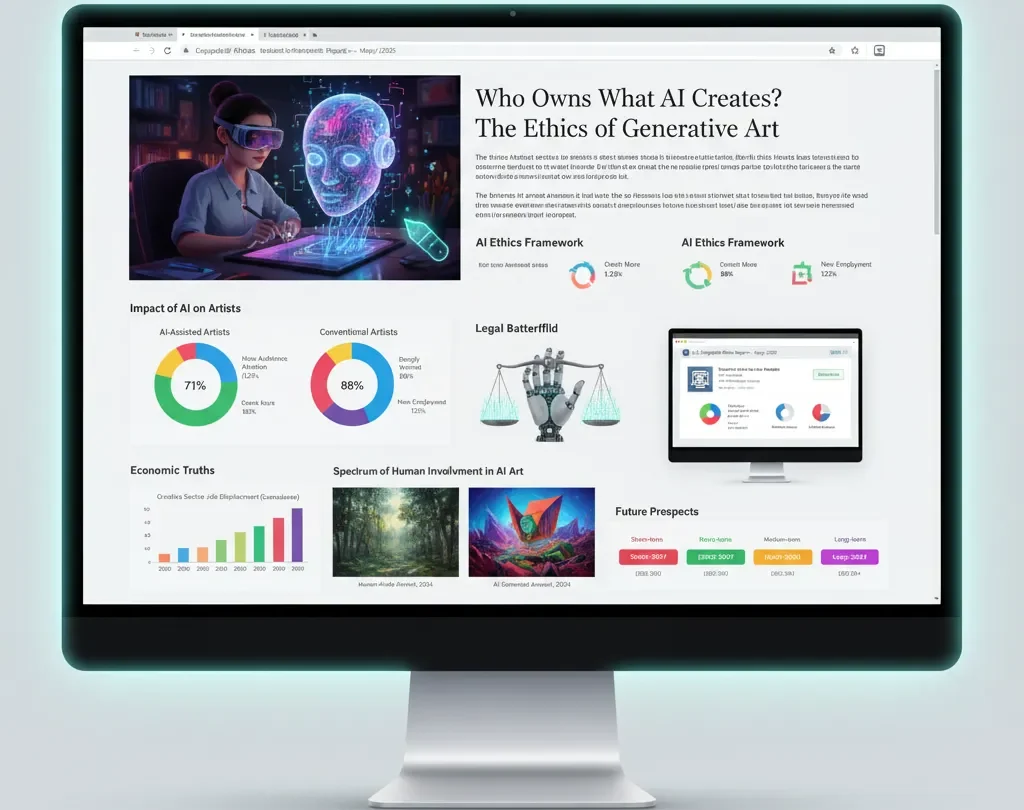
Increased attention to the intellectual property concepts with a focus on digital content copyright and AI readiness in the business in 2025.
The Economic Truth: Artists Under Siege.
The legal ambiguity of AI art ownership takes place in a background of actual economic turmoil to creative practitioners. The numbers are frightening: concept artists, illustrators and designers are experiencing a high rate of job displacement since firms are choosing AI generated content instead of human-created work.
The results of this economic pressure are reflected in a number of ways:
Job Compression: A job that had to be performed by several artists can now be done by an individual with AI tools.
Market Saturation: The creative markets might be saturated with the everlasting ability of AI to generate content, which lowers the ability of human artists to earn.
Entry-Level Opportunities: One of the traditional stepping stones of young artists, junior roles, is vanishing due to AI being used to perform simple creative assignments.
Nevertheless, there are certain artists who are making it in this new terrain. Online art community research indicates that artists who thoughtfully adopt AI tools can expand their production and receive more attention and capture followers and still maintain their creative capacity.
Ethical Approaches to the Age of AI Art.
With the legal systems having trouble keeping up with technological progress, morals become important to negotiate in this new creative environment.
The Principle of Attribution.
Attribution and compensation of training data is one of the new ethical standards that are emerging. Firms such as Bria and Shutterstock are leading by example in developing so-called responsibly sourced AI models, which are known to royalty to artists whose work has been incorporated into AI training. It is a strategy that recognises the worth of human creativity and allows the development of AI.
Transparency and Consent
Ethical AI art creation requires more and more transparency on the source of training data and permission of its original creators. A step towards this transparency is the AI Act template of the EU that mandates disclosure of the training content.
Creative Displacement Anxiety.
Scientists have managed to name a novel psychological phenomenon Creative Displacement Anxiety (CDA) which is a term used to describe the anxiety that artists develop facing AI competition. To solve this, legal solutions are only part of the solution, but also support systems to enable artists to live and survive with the AI technology.
The Future Prospect: New Solutions and Approaches.
The legal and ethical confusion that is presently in existence will not continue indefinitely. There are a number of solutions underway to solve the problem of AI art ownership:
Hybrid Authorship Models
New frameworks based on acknowledgement of collaborative human-AI authorship and preserving human control of the creative process are more actively proposed by legal scholars. Such models would offer copyright in case of works in which human beings have a significant control of exercising the creative will of AI tools.
Cryptocurrency and Provenance Tracking.
The use of technology such as provenance tracking based on blockchain technologies would allow creating clear chains of creation and ownership of AI-assisted artworks. These systems might have the ability to differentiate between the pieces that are created by humans by themselves, projects assisted by AI, and works created by AI entirely.
Revenue Sharing and licensing.
The most likely near-term solution can be holistic licensing systems where artists are paid in the event that their work is used to train AI. The licensing of AI companies with Getty Images and Shutterstock is an indication of this model.
Professional Standards and Certification
Organizations in the industry are coming up with ethical professional standards in creating AI artworks, such as disclosure rules and quality assurance measures. These criteria may assist in defining the market distinction between various varieties of AI-assisted creativeness.
Disruption in the Industry: Getty-Stability Showdown.
The case of Getty Images vs. Stability AI indicates that the legal battle in the field of AI art ownership is a high stakes case. Getty CEO Craig Peters disclosed that the firm is already spending millions and millions of dollars suing Stability AI in a court of law. Starting as a large-scale copyright case, the case has taken a new dimension.
In June 2025, Getty published the withdrawal of its primary copyright claims against Stability AI, citing challenges in evidence and the inability to have expert witnesses. The case now centres more around infringement of trademarks, passing off and secondary infringement of copyright – a considerable narrowing of the case, which can indicate the challenges of the direct infringement of copyright in AI training cases.
This change indicates a trend in the larger industry: instead of relying on the unpredictable court rulings, large content firms are progressively selling their image libraries to AI vendors. The latest merger between Getty and Shutterstock that has formed a 3.7 billion powerhouse is such an approach.
The Community Creative Response.
Artists are not just mere casualties of this change. A good number are in the process of devising ways to secure their labor and adjust to the world that will be dominated by AI.
Technical Solutions
Such tools as Glaze created by the University of Chicago researchers enable artists to perform mathematical alterations to their work that are mathematically less useful to an AI but which leave the work unaffected to human eyes. These adversarial methods are a type of digital self-defence against unwanted training of AI.
Legal Organizing
The case with Andersen shows how great the collective action is. The ability to organise as a class has enabled the artists to have a stronger legal challenge than an individual artist could. The case can promote such collective action elsewhere.
Market Differentiation
Other artists are finding a successful way to stand out their creations by focusing on what AI cannot achieve: individual experience, culture, authenticity of emotions, and tangible manufacturing. This authenticity premium can be further enhanced as the content produced by AI is widespread.
Further down the Road: The Future of Creative Ownership.
Legal precedent, market forces, and technological innovation are the three primary factors that are likely to solve the ethics of generative art ownership, and not just one.
Short term (2025-2027): High-profile court ruling in trials such as Andersen v. The AI of stability will be the first precedent. The Copyright Office can provide further instructions on whether or not a piece of work is AI-assisted.
Medium-term (2027-2030): New legislation in Congress may be required to define how copyright law applies to AI-generated material. It becomes critical to the international harmonisation of standards by such organisations as WIPO.
Long-term (2030+): New intellectual property frameworks specifically dedicated to the AI-human collaboration can be created, which could comprise new types of protection, specifically dedicated to AI-generated works.
The transformation will not occur at once, but already. Artists, technologists, lawyers, and policymakers are joining forces and developing structures that will allow innovation and creative rights to coexist with economic opportunity and artistic integrity.
Conclusion
The majority of people engaged in the creative sector are finding it difficult to navigate the new creative landscape.The question Who owns what AI makes? There is no easy answer to it–and that is just what makes it so significant. Such ambiguity is the manifestation of the radical change that is happening at the junction of technology and creativity.
The existing legal frameworks offer certain clarity: AI cannot be an author, humans own copyright to work that they create with the help of AI, and the legality of AI training on the copyrighted material will be decided by the analysis of fair use. However, there are unanswered questions and many unsatisfied stakeholders by these rules.
The way forward involves working together with all the stakeholders. The artists should be safeguarded and compensated on their contributions to the development of AI. The technology businesses require distinct stipulations that allow innovation. There must be structures in society which foster creativity and at the same time offer equitable accessibility to cultural products.
Above all, we should not forget that behind any court case and moral system, we will find human authors whose careers and identity as artists are in jeopardy. The problems that we come up with are not only supposed to help in technological advancement but also human prosperity.
It is not merely a question of the law or technology, as the ethics of generative art ownership is concerned with the future of human creativity in the age of intelligent machines. The actions of the current generation will define the way of creative expression in the future.
Want to learn more about the AI art revolution? Send this article to other creators, discuss the topic of AI ethics with your community, or understand how these legal changes could impact your personal creative practice. The history of art is being penned down now and all voices are relevant in this key discussion.
FAQ’s
May I copyright the artwork I produced through the use of AI software such as Midjourney or DALL-E?
It will be based on your degree of creativity. This would mean that under the current U.S. law the copyright would not be safeguarded in case you just typed in a prompt and used the AI output in its original form. Nevertheless, when you have rendered meaningful creative guidance, have made high-level alterations, or have incorporated AI-created details to a bigger human-created composition you might be in a position to copyright the human-created details. It is important to show that there is a significant human creativity and control over the final piece of work.
So what should AI-generated art, which will not be copyrightable, be? The property of all?
Yes, those pieces of art which are entirely the work of AI and not created by a human being belong to the public domain, and anyone can use them, alter them, or commercially use without authorization. This sets an intriguing contradiction between the fact that the most sophisticated AI art can be made freely accessible to everyone, and that human-made or AI-aided works continue to have traditional copyrights.
Do the AI companies have a legal obligation to compensate artists who had their work utilized to educate their systems?
No such legal obligation exists currently in most jurisdictions, however, this is being litigated. Ai companies usually exercise fair use in using training data, but a number of big cases dispute that argument. Others of the companies are voluntarily implementing an ethical licensing process, paying the artists to train the use of the data, but this is an exception rather than the norm.
What should I do to ensure that my work of art is not used to teach AI without my consent?
A number of strategies are dawning: such technical solutions as Glaze can transform your images into less valuable training data to AI, but still show them to human eyes. Legal solutions are provided by strict licensing conditions that forbid the use of AI training, yet it is difficult to enforce them. Also being investigated by some artists is collective action and a more powerful legal protection.
Will AI human artists become completely obsolete?
Although AI is bringing massive disruption in the creative sectors, it is not going to be completely replaced. Studies demonstrate that AI contributes to the creativity of individuals and decreases novelty among individuals, indicating that people are still needed to be genuinely creative in their expressions. A good number of artists are managing to adapt successfully by engaging AI as an instrument but focusing on distinctly human aspects of art by making it emotional, culturally relevant, and personally resonant. It is not possible that the future will be human-AI cooperation as opposed to human replacement.