
Introduction to Why Data Is More Important Than Your AI Model
In today’s competitive world, the saying, “Data is more important than your AI model,” is more true than ever. Even though new models get a lot of attention, the quality, relevance, and depth of the data are what really matter for the success and longevity of any AI project. This article talks about why data is more important than models, shares personal and professional views, answers popular industry questions, and gives useful tips for both new and experienced tech professionals.
The Main Point: Why Your AI Model Isn’t as Important as Your Data
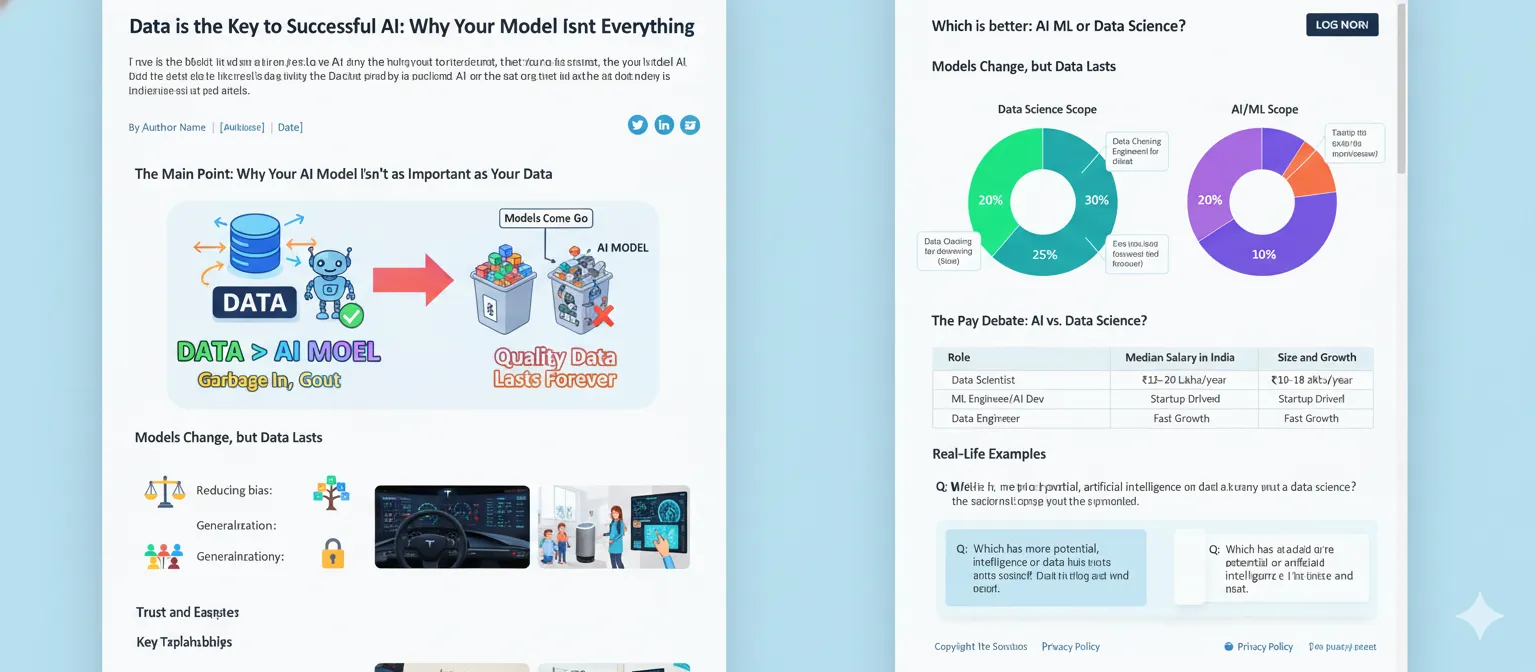
If your data isn’t good enough, the complexity of your underlying model—whether it’s a simple logistic regression or a cutting-edge transformer—doesn’t matter as much as you might think. The saying “garbage in, garbage out” sums up the idea that models are only as smart as the data you give them. Poor data quality, not model choice, has almost always been the reason why machine learning systems have failed or not worked as well as they should have
Models Change, but Data Lasts
AI models are like fashion: what was “must-have” last year quickly goes out of style as new frameworks and architectures come out. Quality data, on the other hand, never goes out of style. The data of a business is what sets it apart from its competitors, not the most recent change to an LLM or convolutional neural network. Google, Amazon, and Tesla all became leaders not just by making their algorithms smarter, but also by gathering, organizing, and using huge, high-quality datasets. It is easy to get and protect models, but robust datasets are much harder to get and protect.
“Which is better: AI, ML or Data Science?” —The Truth
“Which has more scope: data science or artificial intelligence?” is a question that many students and professionals ask. Both fields are related, but data science is often the basis for everything that AI builds on. The main job of data science is to get insights from data, clean it up, label it, and get it ready for AI to use later. When you pick a field to specialize in, keep in mind that even the best AI is useless without good, reliable data. So, studying data science opens up a lot of career options that will last
The Data–Model Tradeoff: Which is more important, accuracy, performance, or foundation?
Another common argument is: “Which is more important: how well the model works or how accurate it is?” This is usually a mistake. One measure is accuracy, and another is performance, which looks at how a model works in real-life situations, such as its speed, ability to scale, and ability to apply to other situations. But if your data is wrong, neither of these matters. In real life, a simpler model with great data usually does better than a complicated model that was trained on data that was noisy or biased.
My Experience: Clean Data and Simple Models Win
In client projects that involved finding SEO content, even simple classifiers did much better than complex neural networks that had been trained on hastily scraped data when they were given a lot of high-quality labeled data for website text. Data cleaning, feature engineering, and making sure the data is relevant to the domain were always the “secret sauce.” This is similar to what Kaggle Grandmasters say all the time: 80% of winning solutions are about preparing the data, not building fancy models.
The Pay Debate: AI vs. Data Science
The “data science vs. artificial intelligence” rivalry is often fueled by salary trends. Recent salary surveys show that data scientists’ median salaries are competitive with those of ML engineers. In fact, they can be even higher for leadership roles because they are in charge of data pipelines, analytics teams, and setting up the organization for future AI projects. Specializing in data governance, compliance, and analytics can lead to unique high-paying jobs.
| Role | Median Salary in India (2025 est.) | Size and Growth |
| Data Scientist | ₹12–20 Lakhs a year | A lot of demand for analytics. |
| ML Engineer/AI Dev | ₹10–18 Lakhs a year | Demand from new businesses |
| Data Engineer | ₹14–22 Lakhs per year | Fast rise, core to AI |
“Why Is Data Important in AI?”—Key Takeaways
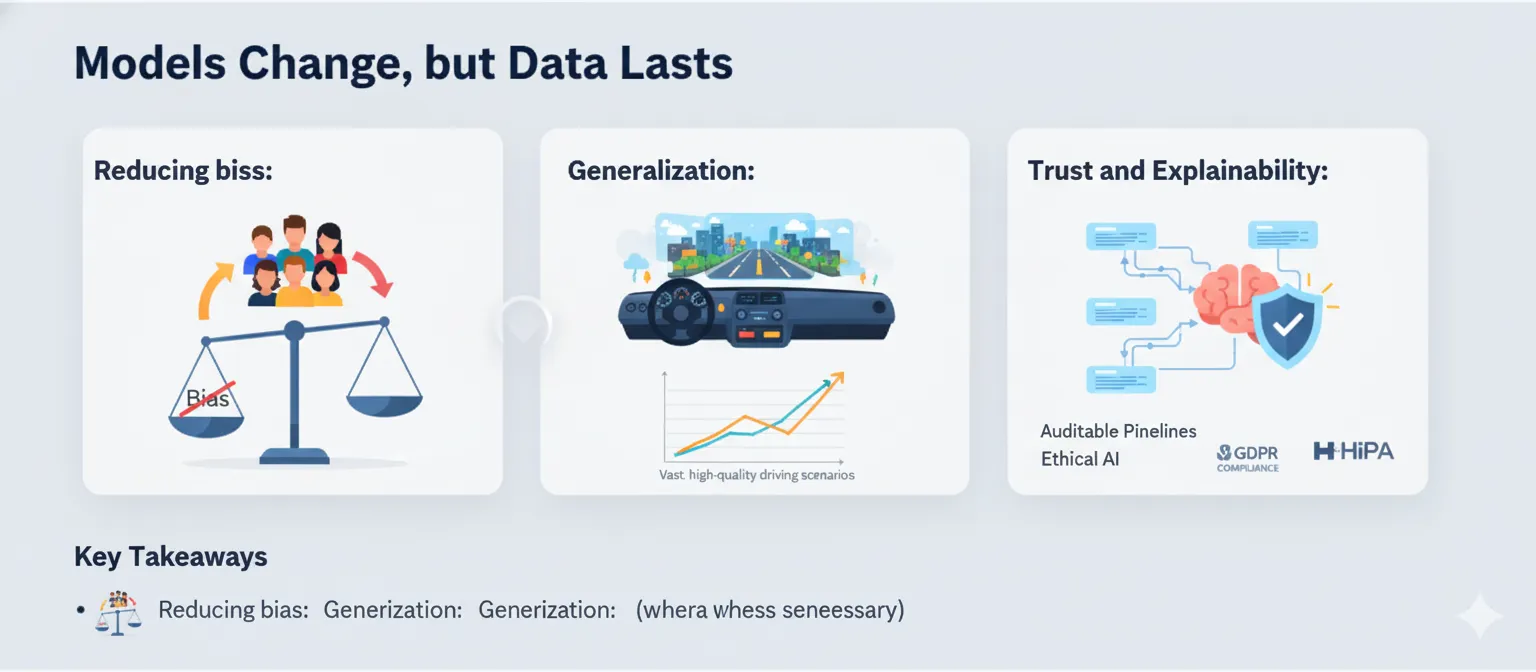
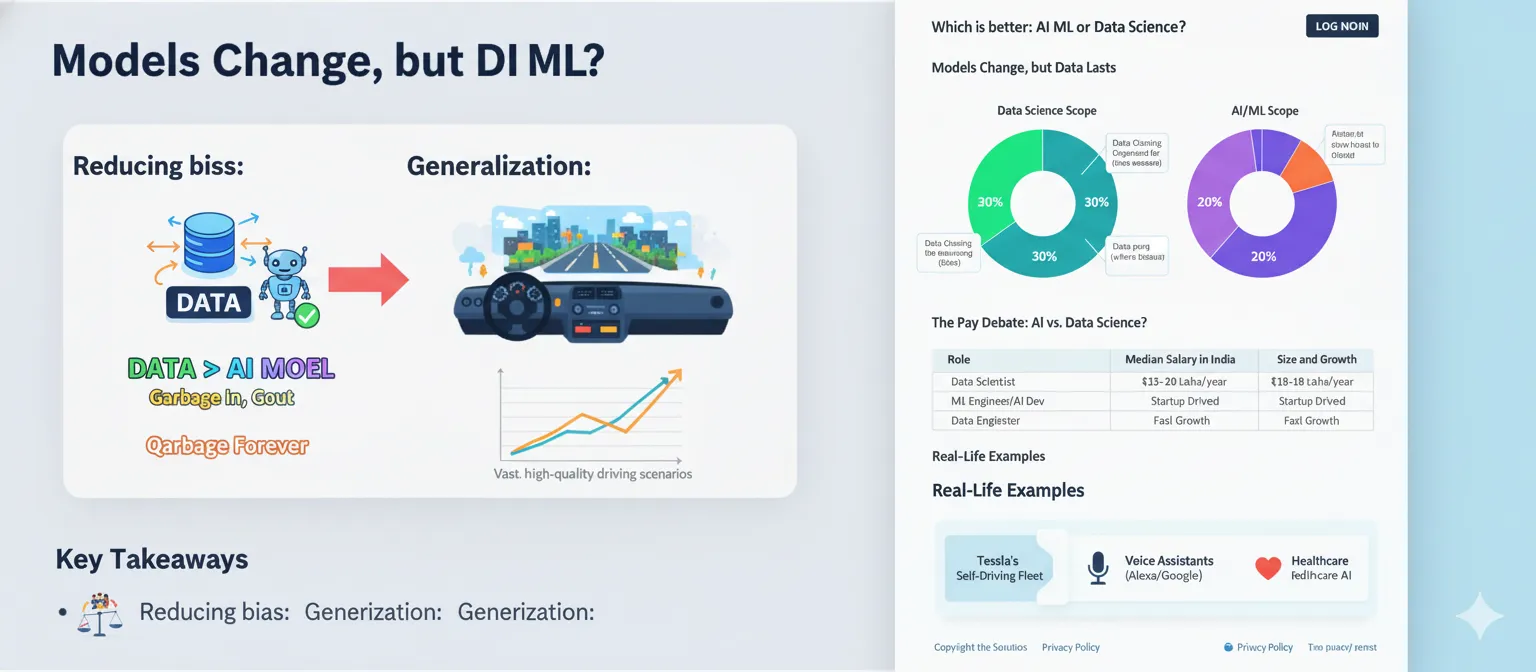
Reducing bias: Data variety and coverage help prevent bias, which even the best models can’t fix if the data is not balanced.
Generalization: Models can only do well on new, unseen scenarios if they have a lot of different, representative data.
Trust and Explainability: In fields like healthcare and finance, where compliance with rules is very important, data pipelines that can be audited and are well-documented make systems more open and honest.
Real-Life Examples: The Competitive Edge of Data That Lasts
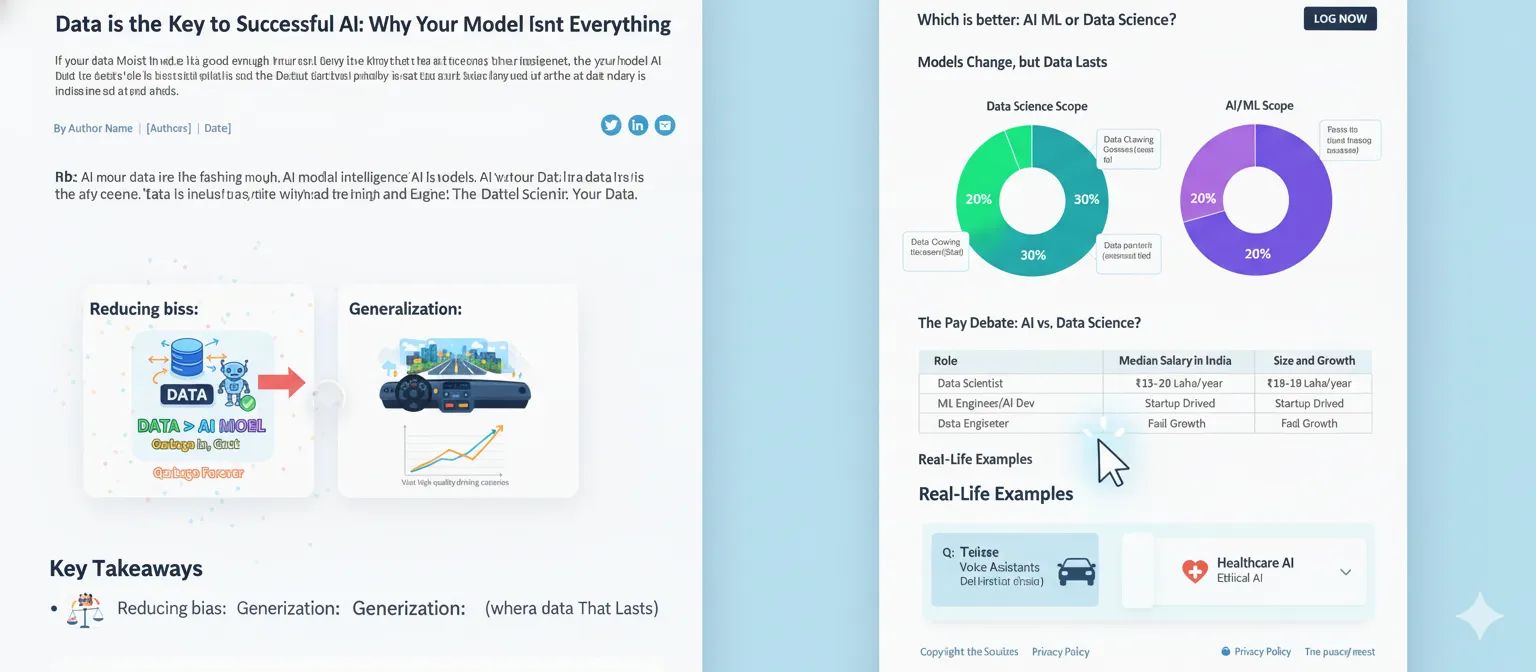
The Self-Driving Fleet of Tesla: The technology is great, but the real benefit comes from having millions of miles of proprietary, correctly labeled driving data.
Voice Assistants: Amazon Alexa and Google Assistant didn’t just get better because of smarter deep learning. They also learned from a wider range of audio samples in different languages, accents, and settings.
Healthcare AI: Strong patient data allows for earlier diagnoses and tailored care, which is better than models that learn from small or noisy data.
Why You Should Focus on Data Analytics in Your AI Journey
It’s easy to see why data analytics is important in AI: it helps you understand your data, find holes in it, and keep an eye on how changes in data distribution affect how models work. For people who want to get a degree in artificial intelligence and data science, data analytics skills help them connect the dots between how technology can help businesses and how it can change the world.
What should you focus on when it comes to courses and degrees?
Modern courses, whether they are called “artificial intelligence and data science” or “AI and ML,” should always put the important steps of preparing, wrangling, and validating data first. Students who want to go to college should look for programs that focus on real-world data projects, ethics in data handling, and working with people from other fields. If you don’t have a data-driven curriculum, you shouldn’t expect much in the way of real-world results.
The Chain Is Only as Strong as Its Weakest Link: Why Data Models Are Important
A “data model” is a clear way to show how data is related and how business logic works. It affects how AI systems can think about the world. It makes sure that the data is consistent, easy to understand, and efficient. This shows even more that the choice, structure, and management of data are the most important parts of any successful AI application.
Conversations and hot takes in the business world
AI and ML are only as good as the data they use: Anyone who has done real-world deployments will agree with this.
Why is data more important than models? Models can be changed or improved as better architectures come out, but getting or rebuilding important, proprietary data is very hard and expensive.
What is the best choice for you: AI, data science, or cybersecurity? These areas don’t have to be separate, but for most businesses, good data is what makes both AI development and strong cybersecurity systems work. Data science skills help you understand threats, reduce bias, and make things more resilient, not just in AI but in any situation where you use analytics or security.
A Personal Point of View: What I Learned from AI Blogging and Making Web Tools
Over the years, I’ve made AI-related content and useful web tools:
Not only did new topics bring in blog traffic, but using real data to improve posts for certain keywords also helped, which supports the idea that “data is more important than model.”
No matter how complex the model was, using off-the-shelf models or custom-labeled site data always led to the latter performing better when trying out automations or AI text classifiers.
Reader feedback and site analytics (user data!) constantly changed the direction of the content, showing that actionable, changing data is the key to successful product and content strategies.
Useful Advice: Put Data First in Your AI Projects
Start collecting data early: Make sure your design projects start collecting relevant, complete data.
Obsess Over Data Quality: Automated tools for cleaning, labeling, and deduplication save you a lot of time and trouble later on.
Work with domain experts: They can show you important details that algorithms miss.
Set up monitoring and feedback loops: production systems need to be able to find and fix data drift and changes in scenarios.
Use Simple Baselines: Use easy-to-understand models to find problems with the data before moving on to more complicated ones.
Conclusion: “Data Is More Important Than Your Data” is a rule for modern AI.
In a time when AI news stories are everywhere, the quiet truth is that the most important thing you can do is curate, understand, and protect high-quality data. Models come and go, but having proprietary, useful, and well-managed data is your “unfair advantage.” “Data is more important than your data” should be your guiding light, whether you’re a student choosing your path, an engineer building the next killer app, or a business leader. Your AI dreams will come true.
FAQ’s
Q: Which has more potential, artificial intelligence or data science?
A: Data science often builds a more stable base because it leads to many different jobs and powers the AI pipeline.
Q: Which pays more: AI or data science?
A: Salaries are about the same, but leaders in data science may make more because they are in charge of important data operations.
Q: In your opinion, which is more important: model accuracy or model performance?
A: Without clean and representative data, neither matters; focus on your data pipeline first.
Q: What is the point of data analytics in AI?
A: Analytics makes it clear what your data contains, points out gaps, protects against bias, and checks that your model is still healthy.


Pingback: The Feature Store: The Secret to Consistent AI Performance - Bing Info
Pingback: Edge AI: Running Models on Phones and IoT Devices - Bing Info