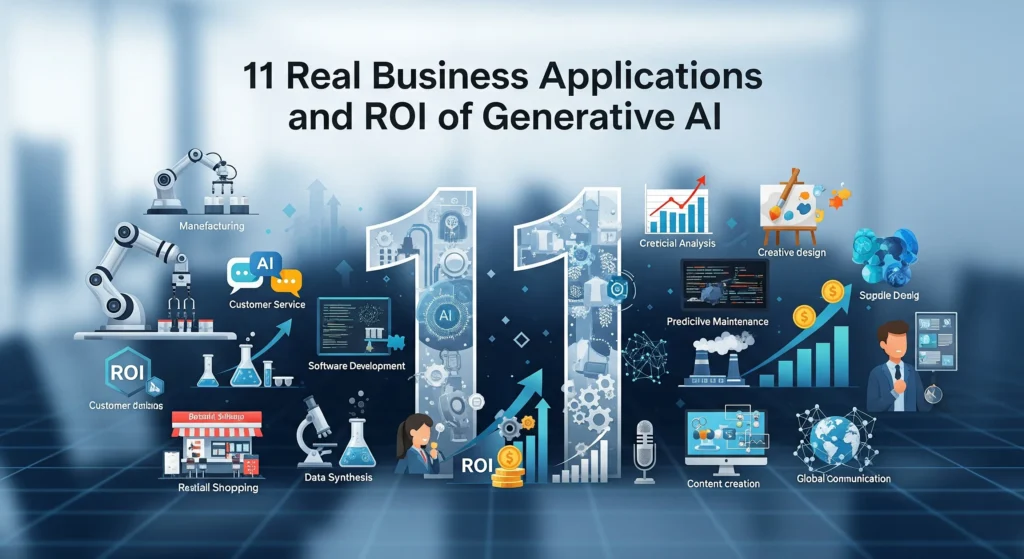
Introduction:11 Real Business Applications and ROI of Generative AI
Contemporary business leaders who use AI in the work environment: Believe that generative AI is only usable to make funny memes or create art? Think again. While everyone discusses ChatGPT writing poetry or DALL-E making ridiculous images, the real magic happens when companies apply this technology to practical solutions for actual problems. We’re talking about innovations that save millions of dollars, accelerate processes that previously took weeks, and assist companies in making smarter choices.
The most insane thing about this is that 78% of organizations already apply AI in at least one business operation, and this figure increased by 55% in a year. It’s not a slow march; it’s a stampede to accept AI. The only problem is, at this point, the vast majority still believe that AI is only for entertainment.
We are going to subdivide 11+ serious business applications of generative AI that are changing industries today in this post. You will learn how companies achieve 451% ROI on AI implementations, what applications provide the most significant bang for your buck, and why neglecting these opportunities may leave you in the dust of your competitors.

Modern business professionals are leveraging AI technology in the workplace
1. Customer Support: The Real Deal.
Think of the last time you made a phone call to customer service. Did you get lost in phone tree hell? Oh, that is all a thing of the past.
The most popular business use of generative AI, with 35% of enterprise AI projects including customer support automation, is the top business application of generative AI. However, that is not the chatbot of your grandpa which provides you with the same three useless answers. We are speaking of AI that knows your context, your history, and, in fact, solves your problem.
Take Bank of America’s Erica. This virtual assistant has served more than 1 billion customers and minimized call center load by 17%. It offers not only 24/7 customer experience but also cost savings.
Implementation of AI chatbots reduced customer service costs by 25% and heightened customer satisfaction rates by 10 percent at American Express. Their system is not only responsive to questions but also anticipates what customers require before they even inquire.
The secret sauce? The retrieval-augmented generation (RAG) technique is utilized by current AI customer service tools to retrieve real-time data from company databases, so they are not simply generating anything.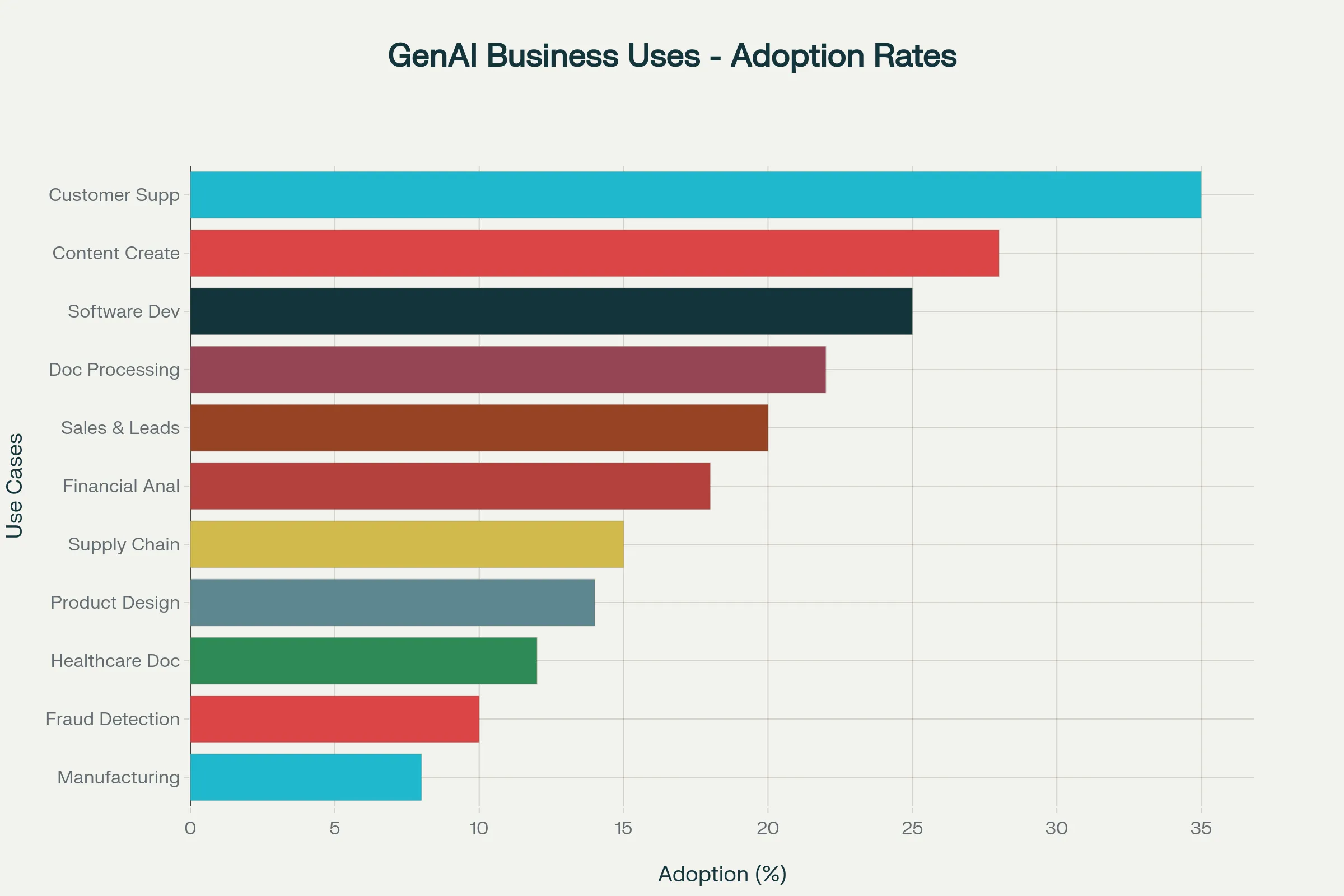 Top 11 business use cases for generative AI showing current adoption rates across industries
2. Scalable Content Creation.
Production was also a huge bottleneck. You would take hours to write blog posts, social media updates, product descriptions, and marketing scripts. Now? AI is able to generate good content at a rate that is faster than your writer’s block.
Sustained usage rate of MERGE, a marketing agency, was 89% over three months and client work turnaround time was reduced by 33%. They are making AI write strategy reports, project briefs, and creative work, which would otherwise take their staff days to create.
But it’s not just about speed. Croud is a global media agency and employs AI in deep research, data analysis, and strategy planning. Tasks that previously required several handoffs can now be performed in isolation, allowing employees to concentrate on creative and strategic priorities.
The point is that nowadays, generative AI does not simply generate some content on its own. It gets to know your brand voice, understands your audience, and produces personalised content on a large scale. It is such that you have a writing team that does not sleep and cannot run out of ideas.
3. Efforts in the field of software development are known as Software Development on steroids.
It is at this point that technology businesses become of great interest. The AI software coding assistants known as GitHub Copilot are transforming the way software is developed. We are referring to AI that is capable of writing code, fixing bugs, and even creating complete software modules.

Financial professional using AI for data analysis and reporting
AI-based data analysis and reporting in financial professional practice.
It is now possible to have rapid software development. The AI tools are capable of creating code snippets on-the-fly, proposing optimization, and assisting developers in concentrating on solving challenging issues rather than creating boilerplate code.
In a conversation with one of the developers we interviewed, they said, “ChatGPT is my preferred tool wherein I understand a complex and over-architected legacy code and provide clarity and structure to the troublesome projects.” It is not unseating developers; rather, it is making them superhuman.
The productivity increases are nuts. A 40 percent higher development pace of companies with AI coding assistants is reported. That is not only time-saving, that is also delivers products to the market quicker and being ahead of the pack.
4. Making Sense of Document Processing.
And remember how much time it used to take to scour out a single scrap of information in contracts, policies, and reports? Those days are over.
JPMorgan COiN (Contract Intelligence) processes data in a single contract in a few seconds – thousands of contracts took lawyers hundreds of hours to go through. We are speaking of weeks of manual analysis to a quick analysis.
Through AI document processing, Contraktor saved 75% of time on contract analysis. They are now able to read through, extract pertinent data, as well as tag important clauses automatically.
This isn’t just about speed. Intelligent document processing detects information that human beings overlook and removes cross-reviewing errors, as well as redirecting costly professional time towards more valuable activities.
5. Sales and Lead generation that actually work.
AI is helping sales teams write hyper-personalised outreach messages, develop tailored proposals, and find the hottest leads. It is as though your sales assistant does not rest and is perfectly aware of what that prospect wishes to hear.
The sales conversions of ACI Corporation increased to 6.5 per cent after the introduction of AI in their sales processes (ACI Corporation less than 5 per cent). Better still, they increased their share in qualified leads to 64.1%, as compared to 45.5%.
11x.ai uses special AI agents to conduct research on leads, write messages, manage follow-ups, and update CRM. Their customers will be able to start SDR campaigns within days rather than weeks.
The magic lies in the fact that AI analyzes customer behavior, purchasing, and interaction history, to write messages that actually work. It is individualization in large quantities – something that is not easy when doing it by hand.
6. Future Financial Analysis.
Finance teams are embracing the use of generative AI to make more precise forecasts, produce reports, and detect trends unnoticed by humans.
Medical practitioner applying AI in the treatment of patients.
PayPal offers AI in fraud detection and risk management, and this has led to a loss reduction of 11%. Their deep learning models are able to adjust to evolving patterns of fraud in 2-3 weeks rather than months.
Financial AI is not simply about numbers crunching. It is about creating insights on complex data sets, forecasting market trends, and enabling executives to make sounder decisions using real-time data analysis.
Business organizations that have implemented AI in financial modeling make more accurate predictions and generate reports faster, and hence enable leadership to shift swiftly as market conditions evolve.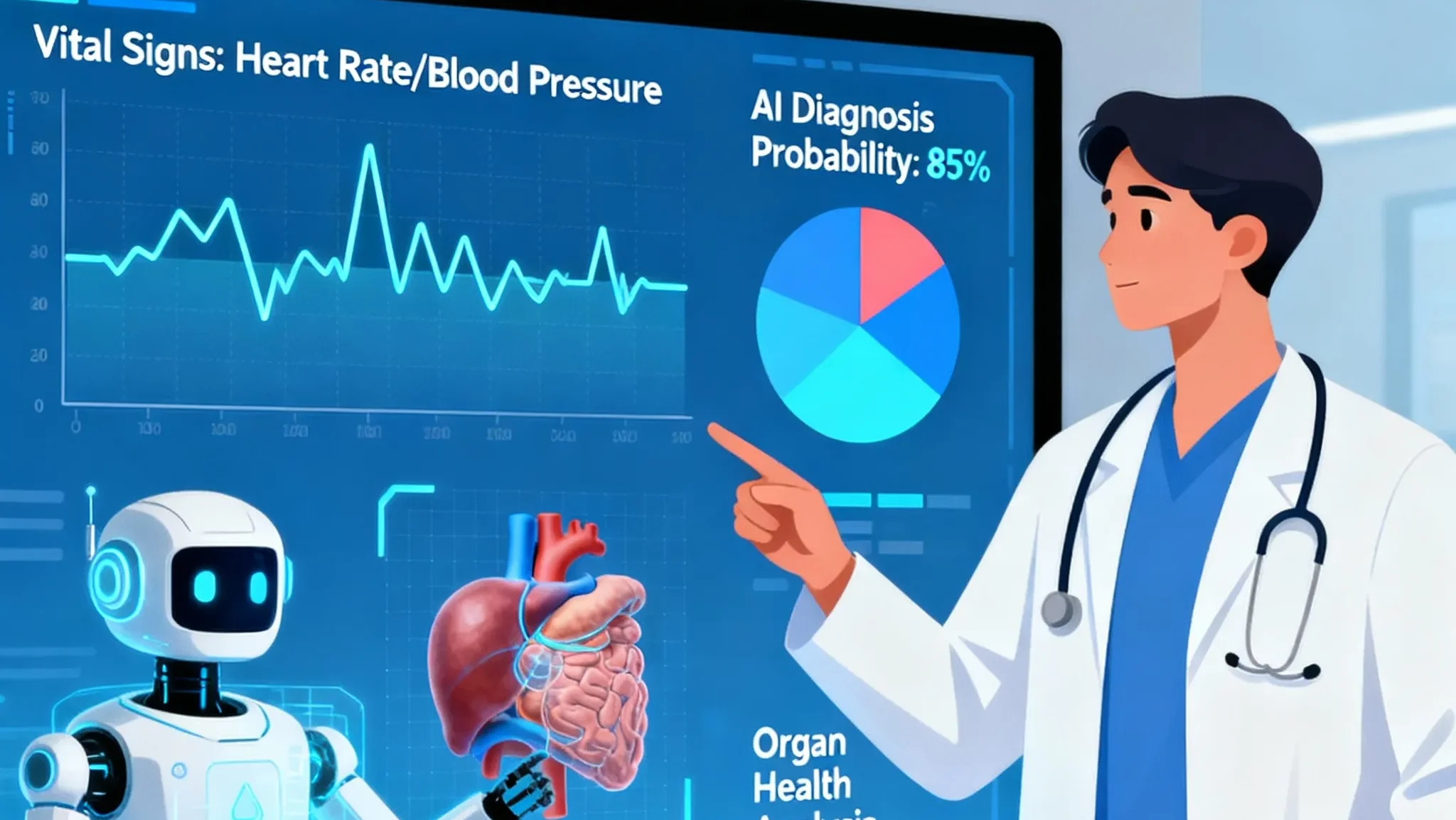
7. Millions of Dollars in Supply Chain Optimization.
General Mills is applying AI to optimize transportation and logistics, saving over $20 million since fiscal year 2024. They measure shipments between their plants and warehouses over 5,000 daily with their AI models to optimize routes and lower expenses.
AI in the supply chain is not only about transporting boxes in a streamlined way. It is concerned with forecasting changes in demand, disruption possibilities, and automatic adjustment of stocks. With AI-based supply chain optimization, Unilever saved 10% inventory expenses and 7% transportation expenses.
The true strength lies in the fact that AI can process large datasets – weather patterns, market trends, historical demand, supplier performance, etc. – and produce actionable recommendations in real-time.
8. Product Design and Development Revolution.
 Artificial intelligence and automation in the industry.
In product development and manufacturing, AI is producing numerous design variants, which companies use to test product variations and to refine a prototype more effectively. This speeds up the design process, saves time to market, and saves money used in physical prototyping.
Digital twin technology with AI enables manufacturers to model product behavior at the stage that nothing is built on. Business entities are able to conduct tests on thousands of possibilities virtually, finding out possible problems and perfecting designs without having to go through costly trial and error.
The auto sector is at the forefront where AI is being used to come up with new engine parts to the full vehicle platform. The result? Increased innovation, products that are tested and optimized prior to coming to the factory floor.
9. Healthcare Documentation and Diagnosis.
One of the most radical changes in healthcare with generative AI is taking place. Mass General implemented AI, which automates documentation and updates in EHR, which cut documentation time by 60 percent and raised face time between physicians and patients.
Mayo Clinic collaborated with Cerebras Systems to create AI models that would analyze genomic data of more than 100,000 patients. The models are able to predict how individuals respond to therapies, thus they allow a more individualized approach to therapy.
Artificial intelligence in the medical field is not merely time-saving, but lives are being saved. Automated normal documentation and support in a diagnostic process will enable doctors to concentrate on their greatest job of attending to the patients.
10. Fraud Protection and Detection.
Financial institutions are simulating frauds with the help of AI and enhancing detection models. Using AI to create synthetic data of fraud, it becomes possible to teach AI-based detection algorithms to detect suspicious activity with unbelievable precision.
AI-driven enhanced cybersecurity is capable of identifying anomalies and zero-day malware in real-time to mitigate the effects of breaches and enhance threat coverage. This is particularly imperative because cyber threats are becoming more advanced.
The key advantage? The AI-based system of fraud detection continuously learns and evolves, keeping pace with changing criminal strategies, not following previously familiar patterns only.
11. The Optimization of the manufacturing processes.
The AI-powered automation enabled Siemens to streamline the manufacturing organization and arrangement and saved the manufacturing time by 15 percent and the manufacturing cost by 12 percent. They also realized a 99.5% on-time delivery rate.
Production of AI does not stop at merely automation. It is about predictive maintenance, which involves avoidance of equipment failures before they occur, quality assurance, which involves detection of defects in real time and inventory optimization, the provision of the right materials at the right moment.
Walmart used AI-based robots to observe shelf stock and initiate restocking actions, leading to a 35% decrease in surplus inventory and a 15% enhancement in accuracy of inventory.
The ROI Reality Check
This is what differentiates successful implementations of AI from costly experiments: the measurement of results. There is a significant improvement in the results of those companies that monitor ROI:
AstraZeneca has cut drug discovery time by 70 percent with the help of AI.
H&M had obtained 70% independent query resolution and 25% conversion rates.
The user of Salesforce Einstein GPT was 40 percent faster and had a 28 per cent increase in campaign click-through rates.
The mean implementation of enterprise AI returns 1.7x ROI, yet the most successful companies achieve significantly greater returns by pursuing high-impact use cases and measuring it all.
What’s Next for Business AI?
The generative AI market is projected to hit $1.3 trillion by the year 2032, and this is projected to grow by a compound annual growth rate of 42%. However, size is not all but strategy implementation.
Ninety-two percent of organisations have generative AI investments in three years, yet only a quarter of them provide anticipated ROI. The difference? Smart companies begin with particular use cases, quantify outcomes, and scale what is working.
The future is with the businesses that view AI as a strategic benefit, and not cool technology. Be it automation of customer service or streamlining supply chains or speeding up product development, the point is that it is time to begin and learn quickly.
Key Takeaways:
Automation of customer service has the most penetration of AI at 35 per cent of enterprise projects.
Best AI systems deliver 451 per cent ROI to companies.
Three out of four organisations have already adopted AI in one of their business operations.
The trick to success is achieved through concentration on particular use cases that are quantifiable.
The AI market is growing at a rate of 42 per cent/year, projected to reach $1.3 trillion by 2032.
Frequently Asked Questions
What do you consider the most lucrative business uses of generative AI?
The highest ROI is demonstrated in the automation of customer support, creation of content, and software development. Bank of America and American Express companies record cost savings of 17-25 per cent with enhanced customer satisfaction.
What is the shortest time for businesses to get ROI through the implementation of generative AI?
Proper AI applications can be profitable after 3-6 months. Firms that have a high AI preparedness base realise a positive ROI 45 times quicker than their rivals.
What are the most suitable industries for generative AI?
The greatest impact is on healthcare, financial services, manufacturing, and retail. The extra value generated by the application of generative AI in the banking industry alone would be in the range of $200-340 billion every year.
How are generative AI and conventional business automation different?
Classical automation is based on preset rules, whereas generative AI develops new products and ideas. It is capable of performing complex and creative tasks, which traditional automation is not.
What are the ways companies can guarantee the successful implementation of AI beyond the pilot phase?
Success needs to have a definition of use cases, measurable results, appropriate training, and ongoing enhancement. Fewer than 16 per cent of businesses implement AI on the scale of their enterprises; however, even those who do enjoy the greatest returns.
Concepts to consider: Since you are a specialist in the development of AI tools and web-based solutions, you can consider the creation of AI-based content generation tools designed to assist Indian businesses that seek to automate their marketing processes. Your experience in JavaScript, combined with knowledge of SEO optimization, might lead to useful solutions for the emerging Indian AI market, particularly those related to creating multilingual content or assisting businesses with meeting the specifics of benchmarking to local laws by processing documents automatically.


Pingback: The Future of Search: How Advanced AI is Creating a Better Alternative to Google with Answer Engines - Bing Info