Introduction
Artificial intelligence is not only changing the face of technology but it is literally redesigning the way we live, work, and think about the future. However, the problem is that when everyone is discussing the issue of the AI taking over the jobs or ending world hunger, the truth is much more complex.
By 2025, AI will have eliminated 85 million jobs across the world but will have also generated 97 million jobs. It is not merely a statistic, but that is the narrative of our near future. So
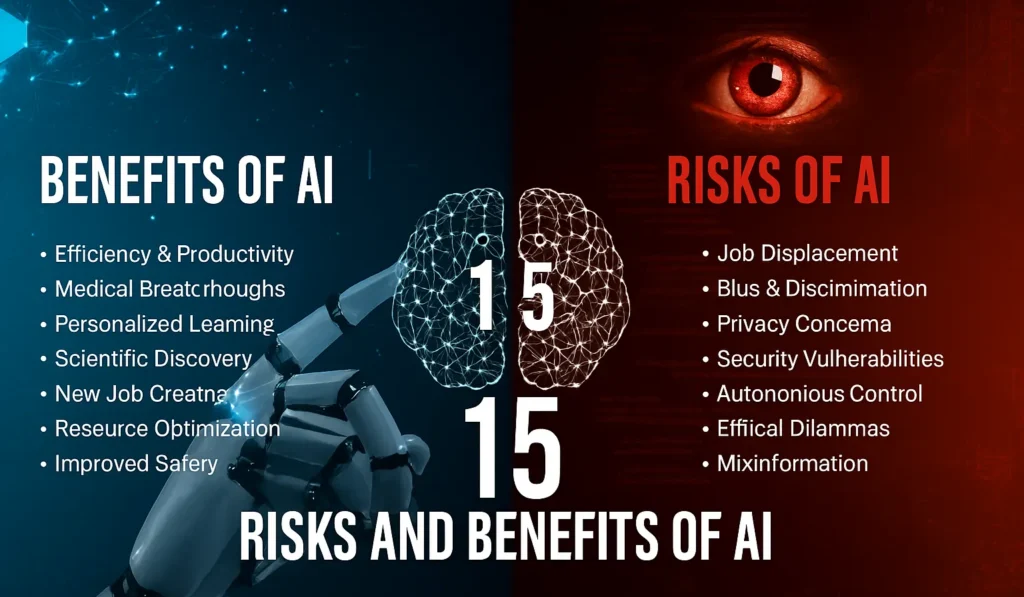
15 Risks and Benefits of AI

(A compelling visual infographic here could show two bars: one for “85M Jobs Eliminated” and a slightly larger one for “97M Jobs Created,” with icons representing different industries.)
Image Source: amazonaws
The AI Revolution: Why It is Important to Comprehend Risks and Benefits now
We shall begin with a reality check. AI is no longer a sci-fi fantasy, and 14 percent of the entire workforce has already been supplanted by AI, and by reading this, you are likely to have already encountered AI numerous times today, whether in the form of your morning Google search, or your Netflix suggestion last night.
The debate on AI tends to be polarized between the ideals of AI being used to fix all the problems or the nightmare scenarios of robot conquest. But the truth? It is a bit chaotic, complex, and occurring at a pace that most people are not even aware of.
The statistics are a very powerful narrative: although one in every three jobs in the U.S. today is potentially automated by 2030, the birth of new industries through AI is also happening. Ethics officers of AI to human-AI teamwork specialists, we are seeing the emergence of a new kind of job category that did not exist five years ago.

Image Source: alcimed
The 15 Horizon Risks of AI: What Experts Can’t Sleep On
1. Loss of Jobs and Disruption of the Economy
Massive Job Displacement
The reality of the situation is as follows: the rate of 6-7 percent of the US workforce may be displaced in the event of the broad implementation of AI. The twist is however that it is not only blue-collar jobs that are under threat these days. Unemployment rates of recent college graduate in tech are 5.8% in March 2025- the highest in more than four years.
- The most vulnerable? By 2025, customer service workers will be automatized by 80 percent, and by 2027, 7.5 million jobs will all be eliminated by data entry workers.
- Worse still: 77 percent of new AI jobs demand master degrees, which leaves a huge gap in skills that will not be easily addressed.
The Growing Skills Divide
Because it is easy to get an AI job? Think again. Although by 2025, it is projected that there will be 97 million new jobs related to AI, the demands are high. 49 percent of the US Gen Z job seekers think AI has undermined the college education they have, and they are not alone.
Multifaceted Amplification of Economic Inequality
Women are also over-represented in the AI automation, of 58.87 million women in the US workforce, 58.87 million are in a job that is highly vulnerable to AI automation in comparison to 48.62 million men. It is not merely a matter of numbers, but rather concern the core fairness in the distribution of the economic impact of AI.
2. Ethical and Social Disasters
Artificial intelligence favoritism and institutional discrimination
This is no longer theory. The AI recruitment tool at Amazon was programmed to downgrade applications with the word “women.” The algorithm of the COMPAS, which was applied in US courts, falsely identified twice the number of black offenders (45) as whites (23) as recidivists.
Worse still: AI systems identify women four times as frequently as men as “home, family,” 2024 study results suggest; resume-screening AI systems tend to pick up white male names more frequently than the identical resumes of Black or female names.
Invasion of Privacy on an Unprecedented Level
The AI systems need large volumes of personal data in order to work. The result? Huge amounts of data gathered and can be misused way beyond the traditional privacy issues. The privacy consequences are enormous with facial recognition cameras tracking you everywhere you go and algorithm AI scanning your personal communications.
The Death of the Critical Thinking
This is a terrifying discovery made here: A.I. use lowers your ability to think critically. A study by Microsoft and Carnegie Mellon discovered that employees who placed the greatest believe in AI assistants believed less critically about the conclusions of such tools. Human excess reliance on AI is a threat to lose the way to think on our own and doubt information.

Image Source: techxplore
3. Security and Military Nightmares
Autonomous Weapons: Killer Robots
The autonomous weapons that are run by AI mark a new stage of development of warfare and are what analysts call a serious threat to international security. The systems are able to make life-or-death decisions without implying a human hand, and they are not science fiction, they are currently being created and rolled out.
The biggest concern? The AI systems cannot implement common sense or reason in accordance with the previous experience regarding the unexpected and new cases. This may cause disastrous errors in the fickle nature of war.
AI-Powered Cyberattacks
Cybercriminals do not stand still with the development of AI. They are exploiting AI to develop more advanced attacks such as deepfakes, phishing attacks that are automated, and advanced malware. Iranian hacker communities are already applying AI to create customized phishing messages that are nearly impossible to distinguish with official messages.
The Global AI Arms Race
Nations all over the planet are scrambling to gain control over AI military operations, establishing what researchers term a de facto arms race. This is not competition only in the field of national security it is also a competition on who possesses the future of war and power relations in the world.
4. Environmental Destruction
Massive Energy Consumption
The effect of AI on the environment is appalling. At present, the data centers take 4.4 percent of the U.S. electricity- this figure is likely to increase to three times by 2028. The emission of one large language model is 300,000 kg of CO2, which is the amount of emissions of five cars over a lifetime.
Carbon Emissions Acceleration
Already, AI infrastructure emits 1 percent of all the greenhouse gases globally and this is going to increase to 2 percent by the year 2026. In perspective: implementing ChatGPT into all Google searches would use 10 TWh of energy per year, or one and a half million European Union citizens using an average annual energy consumption.
The Growing E-Waste Crisis
By the year 2030, generative AI would potentially contain up to 5 million metric tons of e-waste. The ever-present necessity to update AI equipment results in an electronic garbage cycle that includes dangerous elements such as mercury and lead.
5. Human Dependency and Technical Failures
Hallucinations and Misinformation in AI
Artificial intelligence machines generate misleading or fake content on a regular basis, so called “hallucinations,” as researcher term it. These are not small inaccuracies, but it is reliable-sounding yet totally fake information that can confuse the user who does not verify the information provided by AI.
System Brittleness and Unpredictable Failures
The issue with AI systems is that they are brittle, i. e. they are unable to change and act as expected when fed data that they have never encountered. This unpredictability may be a life-threatening factor in such critical systems as healthcare or autonomous vehicles.
The Transparency Crisis
Most AI systems are “black box” and difficult to comprehend how the decisions are made and the developers can be held accountable. Such transparency destroys trust and renders rectification of issues and fairness impossible.

Image Source: mit
The 15 Revolutionary AI Advantages: Why the Future is Bright
1. Healthcare Revolution
Accurate Diagnosis that Saves Life
Medical diagnosis is being revolutionized by AI with outstandingly accurate diagnosis. The AI algorithms will be able to identify breast cancer in mammograms better than human radiologists and the AI-based tools will improve the diagnostic accuracy by processing complex medical data with high accuracy.
The effect is tangible: AI systems are able to work with large amounts of clinical data in seconds, identify hidden patterns and enhance the process of disease diagnosis in a broad spectrum of medical specialties. AI is turning healthcare into a more accurate and precise field of operation, whether it is the identification of diabetic foot ulcers or the prediction of wound healing.
Accelerated Drug Discovery
Pharmaceutical research and development efforts are accelerating drastically to use AI, which may shorten the time and cost of getting new medications in the market. There are machine learning algorithms, which can process large databases of molecular structures and make predictions about the compound that could be the most useful in a given situation.
Individualized treatment to achieve improved results
AI is relevant to personalized treatment because it uses patient information to provide an individualized treatment to the patient rather than using a generalized approach to treatment. This one to one treatment results in more successful therapies that have fewer side effects and in the end enhance patient outcomes and quality of life.
2. Increase in Productivity and Efficiency
Automation of Tasks That Unleash Human Potential
The intelligent automation of repetitive and time-consuming processes is one of the most immediate advantages of AI that could enable the employees to specialize in the more high level strategic processes. It is not only a question of efficiency, this is about freeing up the human creativity and problem solving capability to do something of more significance.
Improved Decision Making With Data
Artificial intelligence is capable of processing vast quantities of data within a short period of time to assist a company or individual in making a wise decision. In the logistics sector, AI is used to optimize the route of delivery, which saves time and fuel. In medicine, AI can help physicians by giving them insights on a more accurate diagnosis and treatment regimen.
24/7 Operations Without Fatigue
The AI systems are capable of working 24-hours round the clock and enhance productivity unlike humans. This real-time accessibility can be especially useful in essential applications such as the monitoring of infrastructure, the security system or emergency response services.

Image Source: infolks
3. Job Creation and Economic Growth
Outbursting Rise in New Classifications of jobs
Though AI will eliminate certain jobs, it will also open up new job categories such as prompt engineers, experts in the field of human-AI collaboration, and AI ethics officers. There are already 350,000 new occupations created due to AI. These are not merely jobs in technology, all industries enjoy these.
Huge Growth of the Job Market
The figures are astounding: 97 million new jobs associated with AI will be created all over the world by 2025. The global AI job opportunity rate in AI-related jobs is increasing by 26 percent annually between 2024-2025 and 53 percent of jobs created by AI have remote or hybrid work arrangements.
Not Replacement, Human Capability Enhancement
Studies indicate that augmentation of jobs affected by AI in the United States is 59 percent as opposed to jobs being eliminated. Increasingly AI is becoming a device that is used to boost human ability and not to override it absolutely.
4. Cybersecurity Strengthening
State-of-Art Threat Detection and Response
AI is a proactive approach to cybersecurity, as it is more accurate in identifying anomalies in network traffic compared to conventional approaches. These systems are able to foresee patterns of attack through historical analysis that assists organizations to put preventive measures before the threats become reality.
The Automated Incident Response
Gartner predicts that over 50 percent of SOC Level 1 analyst duties will be assumed by AI in 2028, such as event alert prioritization, event correlation, and elementary ticket resolution. This automation enables human analysts to be strategic in their inquiry and elaborate in their analysis of threats.
Active Intelligence of Security
AI makes it possible to have predictive security, which may predict and prevent cyber threats before they inflict damages. Machine learning systems have the capability to detect new patterns of attacks and respond to the threat by automatically updating the defenses.
5. Education and Research Development
Individualized Learning Which Adapts to each pupil
AI facilitates adaptable learning materials and tutoring platforms that adapt to personal learning styles and learning speed. This individualization is able to make the outcome of education dramatically better as it offers just the right amount of challenge and support to each student.
Innovation in the Short to mid-term
AI is also improving data analysis and scientific discovery of research data through the processing of large volumes of scientific research data and the discovery of patterns that would require years before being discovered by humans. In climatic studies, as well as space exploration, AI is driving a faster scientific discovery.
Equal Opportunity to Education and Resources
AI is also removing education impediments through better access to education and resources, especially in underserved groups. Quality education is becoming more accessible in the world through the use of language translation, adaptive interfaces, and intelligent tutoring systems.

Image Source: mroelectric
Real-Life Case Studies: The Impact of AI in the Present Day
An AI use in Medical Imaging: Success Case
According to Stanford HAI studies, even in an advanced clinical setting with successful training and integration, large language models may eventually be used to benefit patients. Radiologists are already having their cancers detected by AI systems earlier and more accurately than through conventional systems.
Cautionary Tale: Criminal Justice AI Bias
The case of COMPAS algorithm can be viewed as a dire alert concerning the bias of AI. The system, which has been used to predict recidivism in US courts, was highly racially biased, with a higher number of false positives being predicted among the Black defendants. The practical case illustrates the ability of AI to reinforce and multiply the existing biases in society. (Suggestion: Include a screenshot of a chart or data from a public report on the COMPAS algorithm here, with the source cited.)
Economic Effect: The Tech Industry Remodelling
In March 2025, the unemployment rate among college graduates has hit its highest in over four years, to 5.8 percent, mostly among younger tech workers. But in the same breath, Fortune 500 companies have introduced internal AI reskilling initiatives in 41 percent, and this shows how companies are keeping up with the AI transition.
The Strategic Balance: Navigating AI’s Two-Sided Nature
The study has shown that there is an evident trend: the effect of AI is not entirely negative or negative, but rather transformative in several ways that provide opportunities and challenges. Although by 2025, 85 million jobs will be lost, 97 million new positions will also be created at the same time, not only the replacement of jobs but the entire restructuring of the economy.
Main Advice on surviving the influence of AI
For Individuals:
- Learn the basics of AI and become familiar with how they operate.
- Pay attention to competencies that are complementary to AI.
- Be a life long learner and flexible.
For Organizations:
- Introduce AI ethical frameworks at the design phase.
- Invest in reskilling and development of employees.
- Ensure good governance and accountability.
For Society:
- Establish regulatory structures which create a balance between innovation and protection.
- Be proactive on issues of address bias and fairness.
- Make sure that there is fair distribution of the benefits of AI.

Image Source: screenapp
Future Outlook: The Future of Human-AI Cooperation
The evidence also indicates that the future lies not in AI or humans or their exclusive interactions, but in the successful human-AI cooperation. It has been found that AI is most effective when used to complement the human capabilities and not to fully take them over.
The question is not to halt the development of AI – this is impossible and undesirable. Rather, we must be deliberate in the way we design, implement and regulate AI systems to achieve the greatest good and lessen the dangers.
FAQ’s
1. Do you think AI will eliminate the majority of human jobs?
No, but it will transform them. Although it is believed that 30 percent of the existing positions in the U.S. will be automated by 2030, studies have indicated that AI is generating different forms of employment as the process destroys others. The point is the creation of the skills that are complementary to the AI capabilities.
2. What should we do to avoid AI discrimination and bias?
To combat AI bias, it is necessary to use a variety of training data, conduct audits of discriminative trends on a regular basis, measure fairness by demographics, and have ethics review boards composed of diverse people. The AI systems should be designed to be transparent and accountable.
3. Or is the environmental impact of AI that serious?
Yes. The environmental impact of AI is already huge and increasing at a significant rate. By 2028, the data centers would potentially take up to 6 percent of the total electricity in the country, and bringing large AI models to life produces emissions comparable to those of several cars throughout their lifespan. Nevertheless, AI may also be used to address the issues of the environment by optimizing and improving efficiency.
4. So dangerous are autonomous weapons?
Very dangerous. Autonomous weapons that are controlled by AI are a new dawn in war since the weapons are able to make deadly decisions without the involvement of the human element. The uncertainty of the AI systems when used in more complex situations makes them especially dangerous with a military situation use where an error can be disastrous.
5. Is AI capable of contributing to better healthcare outcomes?
Absolutely. AI has proven to be more accurate and fast in the analysis of medical images, which resulted in the timely detection of the disease and improved treatment results. In the field of diagnostic imaging, drug discovery, or any other life-saving endeavors, AI is already saving lives and enhancing medical services across the globe.
Pingback: How to Start Learning AI in 2025-26: Roadmap for Absolute Beginners - Bing Info