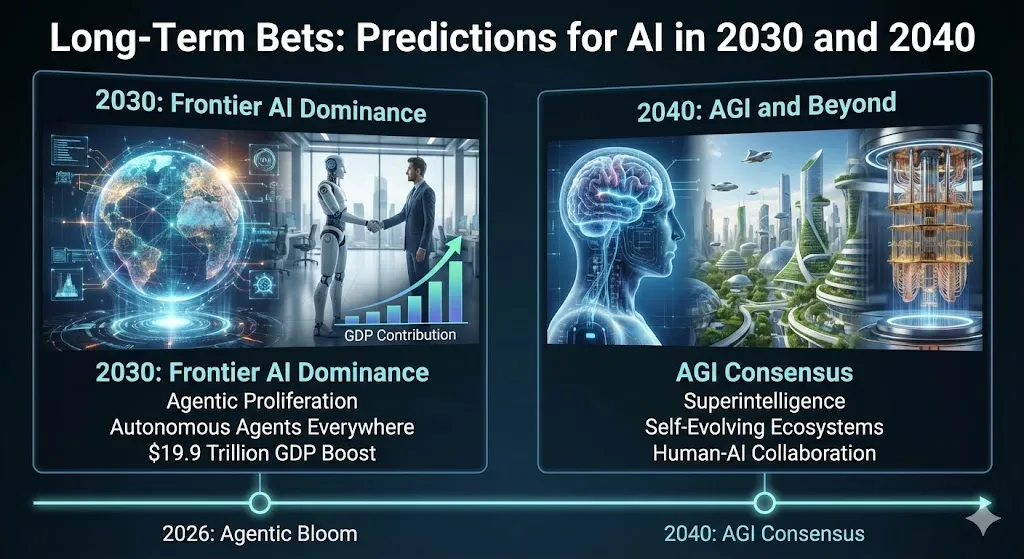
Long-Term Bets: Predictions for AI in 2030 and 2040
We are about to enter an age ruled by AI, and the rapid changes make us question what we thought we knew about intelligence and progress. These long-term bets show that a lot will have changed in both technology and society by 2030 and 2040.
Setting in the Past
AI has come a long way since the 1950s, when it was just simple systems that followed rules. Now it can combine text, pictures, and code into one big system. Deep learning became the most important field in the 2010s because of the rise of big datasets and GPUs. This is how transformers were made, which are the basic parts of models like the GPT series.
Agentic AI will be a big change in 2025. This kind of AI can do more than one thing by itself. For example, Google Cloud AI has helped Toyota factories save more than 10,000 hours of work every year.
This path grows 4 to 5 times faster than computers do each year. It gets us ready for the frontier models of 2030, when people can do twice as much every seven months.
The year 2030 and AI
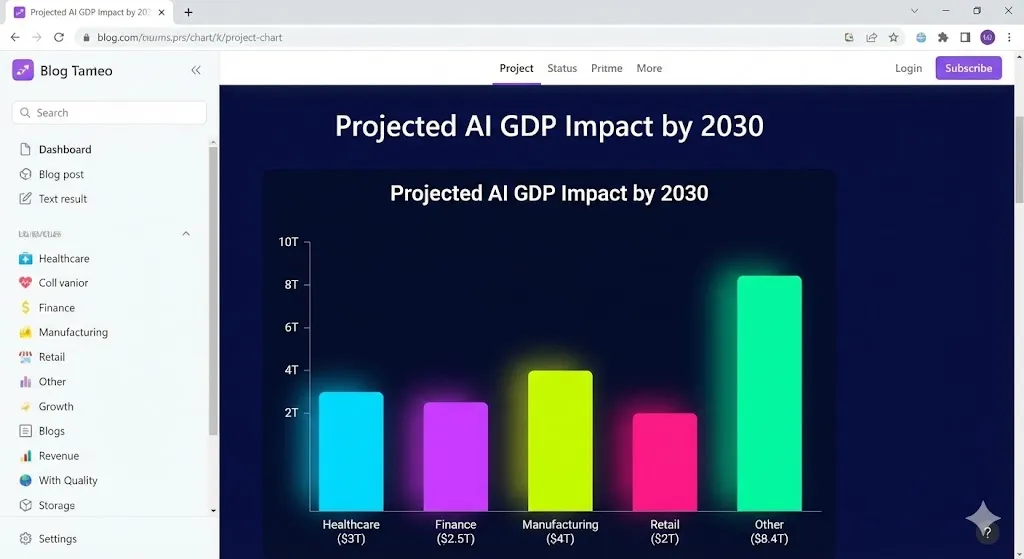
We believe that AI will be in everything by 2030. PwC says it will add $15.7 trillion to the world’s GDP, while IDC says it will add $19.9 trillion through better business practices and new ways to make money. Frontier AI will be in charge because it can do some things much better than people can. But most experts still can’t find real AGI. It has a 50% chance of happening around 2031.
Trusted Site Data: Economic Impact & Efficiency
| Source | Projected Economic Impact / Efficiency | Key Metric |
| IDC | $19.9 Trillion | Global GDP Increase |
| PwC | $15.7 Trillion | Global GDP Increase |
| Mass General Brigham | 60% Reduction | Healthcare Paperwork |
| Darktrace | 92% Reduction | Financial Fraud Breaches |
They will change jobs and pay close attention to the little things. For instance, AI agents at Mass General Brigham cut paperwork by 60% for healthcare diagnostics, and Darktrace stops fraud in real time, cutting breaches by 92% in finance.
A List of Important Predictions
What the Expert Average Says About How Likely a Prediction Source Is
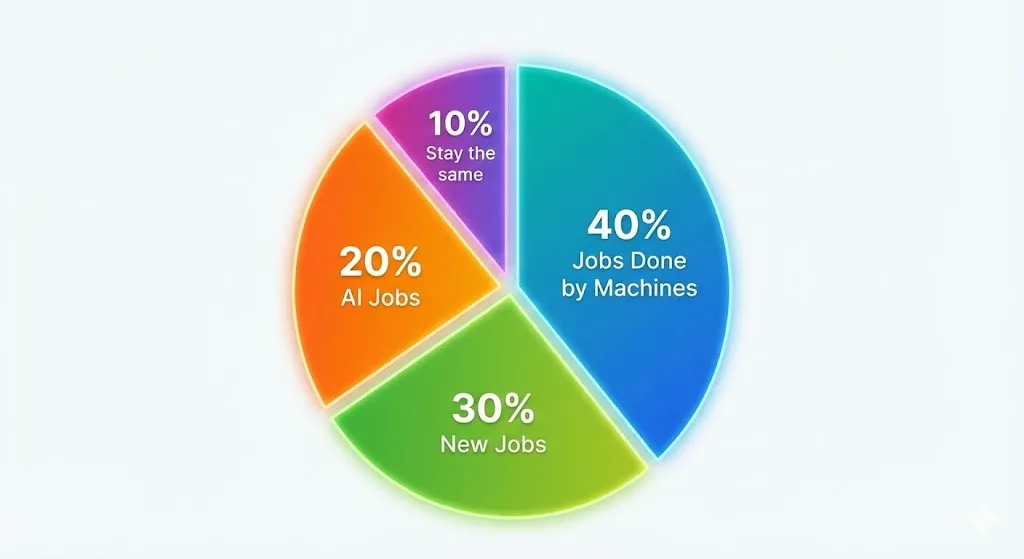
By 2030, 25% to 50% of jobs will need people to think like people.
Economic Boost: $19.9 trillion more in GDP.
Likelihood: High.
Agentic Proliferation: Autonomous multi-step agents are everywhere.
Experts agree that there is a very high chance of losing your job, but a moderate chance for white-collar jobs. This demonstrates that AI possesses dual aspects.
BenevolentAI and AstraZeneca are two good examples.
AI agents and BenevolentAI worked together in a new way to make the process of treating chronic kidney disease go faster. They did this by going through a lot of biomedical data to find new targets in weeks instead of years. This cut research and development costs by 70%, just like Insilico Medicine. This is a great example of the 2030 paradigm, which is that AI speeds up the process of discovery. Generative models can predict a lot of personalised drugs by copying how molecules interact.
These kinds of examples show that it will only take a few months to make drugs, which will make people even more creative.
Things that will happen before the year 2030
The Change in Health Care
AI will do robotic surgeries and guess what health problems will come up. Models like those from Google DeepMind will tell us about threats to our lives, but they will also protect us from them with safeguards against misalignment. AI tutors will be able to make lessons that are perfect for each student, and they will be better at it than people.
Alteration in the Labour Force
Agentic AI is good at things that don’t have a clear end point. For example, Uber’s AI agents already help workers get more done by putting conversations in the right context. But people are losing their jobs, which is why “agent orchestrators” are becoming more common as people move up to management.
Plans for the year 2040
After AGI, the next step is superintelligence. According to polls, AGI will be here by 2040 and ASI will be here by 2050 because cognition can be scaled. Epoch AI says that automating coding will boost GDP by 10%, but many people aren’t sure about this. We will need to rethink our purpose when we have economies that don’t have any scarcity because of hybrid architectures that combine reasoning and probabilistic inference.
Quantum-enhanced edge AI is everywhere, from smart cities and metaverses to IoT swarms. This makes a lot of people smart.
What risks are there and how to lower them
Demis Hassabis from DeepMind says that the UN should keep an eye on existential risks like misuse and misalignment. The World Economic Forum says that structural risks can break up societies if people don’t learn new skills fast enough.
Timeline Infographic: AI Evolution (2026-2040)
| Year | Phase | Key Characteristic |
| 2026 | Agentic Bloom | Rapid growth of autonomous agents. |
| 2030 | Frontier Dominance | AI systems lead across major industries. |
| 2040 | AGI Consensus | Broad agreement on General Intelligence reach. |
A Look at Walmart’s AI Inventory Agents
Walmart’s self-driving robots are a good example of scalable AI because they can watch shelves in real time and get 99.9% of orders right at Ocado scale. In 2040, this means that supply chains will be thin and able to deal with problems. This will cut delays by 35%, just like DHL’s Resilience360 does. Siemens’ edge agents cut factory downtime by 30%, which is a step towards factories that can run themselves.
These show that AI is getting closer to ecosystems that can take care of themselves.
Things will be hard in the future.
When agents don’t have to answer for their actions, they can change people’s minds, which makes ethical problems worse. When adoption isn’t fair, it makes things even less fair. We need proactive frameworks because governance isn’t keeping up with how fast things are changing. Computing strain grids need power, but green AI is coming.
Bets and Chances
If we look at it in a good way, AI uses information about genetics and the environment to make life better and lower the risk of getting sick. People who bet on “supercharged progress” want to see people work together to make big changes that lead to new ideas.

An exponential curve from 2025 (minutes) to 2040 (weeks) shows how AI’s ability to do things is getting better. AI Task Capacity Exponential Growth: Line graph showing doubling every 7 months until 2040, when it will be the same as a human week.
What skills do you need to work with AI?
In the middle of all these changes, skills that are in high demand combine technical know-how with good judgement. Some of these are MLOps, generative AI, NLP, cloud-native development, and agentic AI mastery. If you want to make a lot of money in India without a degree, the best skills to have are data analysis, software engineering, UX, web development, and project management. Learn Python or R if you want to use AI well in 2026 and beyond.
AI product management, cybersecurity, and green tech are the best options because you can do them from home and make money online. [keywords]
Last Idea
We believe that AI will be good if people use it wisely, and we believe that by 2040 it will have improved things. Based on these predictions, action should be based on trajectories.
FAQ
1. What are the chances that AGI will happen before 2030?
Experts say that, based on scaling laws, there is a 25–50% chance, though definitions vary; full human-like intelligence will probably not come until after 2030.
2. What will AI do to jobs in 2040?
A lot of people lose their jobs because they don’t change what they do, but there are new jobs in ethics and orchestration. It’s very important to learn new things.
3. What will AI do for the economy by 2030?
The world’s GDP could go up by $19.9 trillion, and for every dollar spent on AI, there would be a $4.60 return.
4. What are the most serious risks of advanced AI?
We need governance to fix things like abuse, unfair systems, and misalignment.
5. What skills will AI need the most in the years to come?
In 2026, you can learn about MLOps, data literacy, and agentic AI online. All of these jobs pay well.
Pingback: AI in Medical Imaging: How AI is Becoming a Radiologist's Best Friend - Bing Info