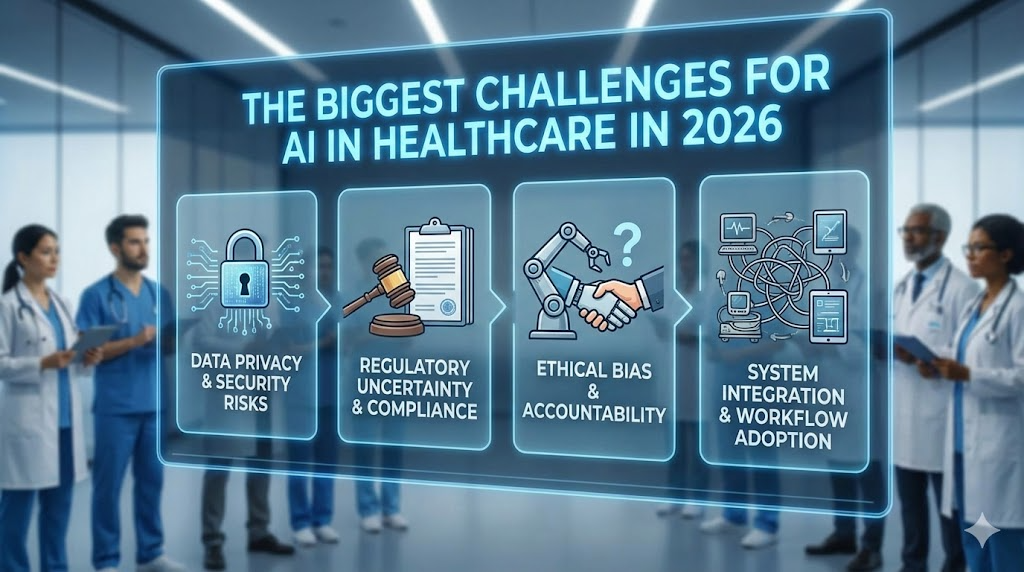
The Biggest Challenges for AI in Healthcare in 2026 AI has gone from being tested in small groups to being used all the time in hospitals, clinics, insurance companies, and digital health platforms. By early 2026, about 88% of health systems will be using AI for things like optimizing the revenue cycle, ambient clinical documentation, and radiology triage models. But only about 17% of them say they have well-developed AI programs with a clear plan and rules for how to use them. The biggest problems for AI in healthcare in 2026 are starting to show up in the space between being ready and being used. This article systematically analyzes the challenges related to the implementation of artificial intelligence in healthcare, incorporating insights from a systematic review of barriers, recent mixed-methods studies on AI deployment, and practical case studies in radiology, sepsis prediction, and oncology. It also connects these problems to bigger trends in AI in digital health for 2026 and offers suggestions for best practices and future directions. A Short History: From Dartmouth to Digital Hospitals To understand the problems we have today, it helps to remember how new the field is. The 1950s were when AI became an official field of study. People often think of the 1956 Dartmouth Workshop as the beginning of AI as a field of study. In that decade, the phrase “artificial intelligence” was first used, early programs like the Logic Theorist were made, and the first attempts were made to make machines think like people. But healthcare has only recently begun to use it in a meaningful way. In the 1980s, expert systems were mostly used for diagnostics in a few fields, but they stayed in labs because there wasn’t enough data and computers weren’t powerful enough. The real turning point was in the 2010s and 2020s, when all three of these things came together: digitized health records, cloud computing, and deep learning. AI in digital health really took off. There are now computer vision tools for dermatology and radiology, predictive models for getting worse and going back to the hospital, and recommendation engines for oncology and managing chronic diseases. AI will play a big role in the healthcare industry by 2025–2026. AI has already changed: Imaging, such as radiology and pathology Running the hospital and making sure it has enough space Safety in drugstores and with drugs Cycle of money coming in and getting permission first Monitoring from a distance and virtual care Life sciences research and development and drug discovery But this time has made it painfully clear that making models that are right is the easy part. The hard part is figuring out how to use AI in healthcare in a way that is safe, fair, and on a large scale. What AI in Healthcare Will Be Like in 2026 Recent surveys and scoping reviews convey a consistent narrative: adoption rates are high, outcomes are positive in some areas, but structural challenges are widespread. A report from 2025 on 233 health systems, for example, found: Health System AI Readiness (2025–26) Metric Percentage (%) Organizations using AI in at least one part of business 88% Finance/Healthcare people using pilot or full AI solutions 71% Organizations reporting some AI governance structure ~70% Mature governance and a well-defined AI strategy 17% Ability to produce a full AI audit trail for regulators in 30 days 22% Enforced AI rules about model inventory and lineage 29% Note: Use a hover effect on the table rows to highlight the stark contrast between adoption (88%) and mature strategy (17%). A systematic review of the barriers to the incorporation of artificial intelligence in healthcare identifies six primary categories of challenges: ethical, technological, liability and regulatory, workforce, social, and patient safety. A more recent mixed-methods study added 12 more ideas to the AI implementation lifecycle: leadership, buy-in, change management, engagement, workflow, finance and human resources, legal, training, data, evaluation and monitoring, maintenance, and ethics. In 2026, the most important issues for AI in healthcare won’t be whether it can work in theory, but how to use, manage, and keep it safe in messy, real-world systems. 1. Concerns about data security, privacy, and rules Sensitive information that is divided up in a high-stakes situation There are a lot of rules about how healthcare data can be used because it is very private. The World Economic Forum says that digital and AI solutions don’t always work because data is spread out, there are strict rules, and there aren’t enough anonymized datasets available to train models. EHRs, imaging archives, lab systems, pharmacy platforms, and insurer databases all still store clinical information in different places, and the formats are often not compatible. Systematic reviews reveal several interconnected issues: Risk of privacy and re-identification: Even datasets that don’t have any identifying information can often be linked back to their original source, especially when they are combined with data from other sources. Cybersecurity: Hackers don’t just go after EHRs that are already in use; they also go after AI pipelines and model-training data. Uncertainty about regulations: Developers and hospitals have to follow rules that weren’t made with AI that learns all the time in mind. These laws cover things like HIPAA and GDPR, medical device regulation, data protection, and rules for specific industries. Data-sharing hesitance: Companies don’t want to share detailed data for AI training because it could hurt their business, their reputation, and the law. A recent study on the use of AI in health care found that people were hesitant to use it because they were worried about data security. Tracking, spyware, and the unauthorized secondary use of health data worried both doctors and patients. There are blind spots in training data in the real world. A big hospital system wants to make a model that can tell when someone with heart failure will need to go back to the hospital. Data scientists want five years’ worth of electronic health record (EHR) data. This data includes notes, lab results, imaging reports, and social