Bing Info

Tech Insights & Digital Innovation
Header Mobile Fix
ai-models

Why AI Models Fail: The Silent Problem of Model Drift

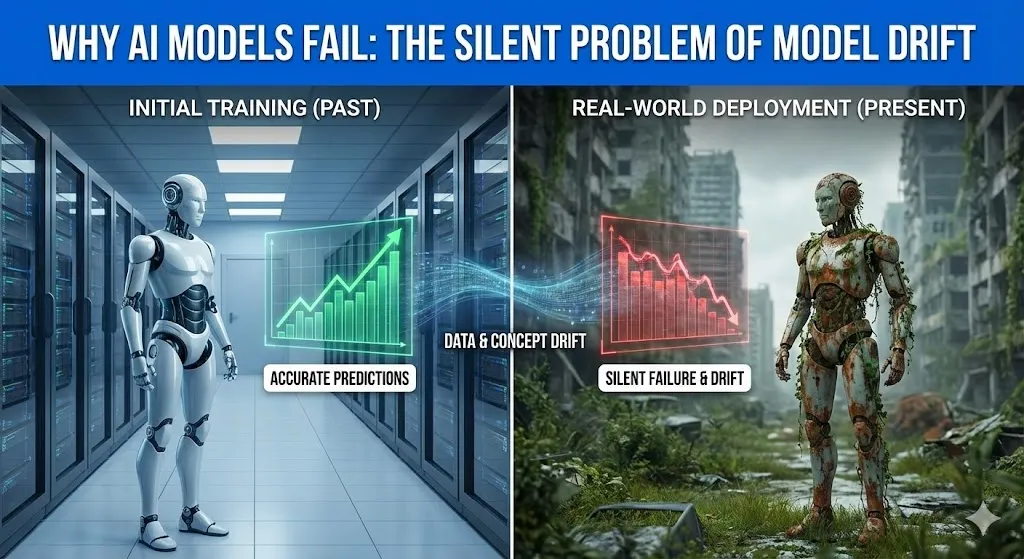
The Reason AI Models Fail: The Silent Problem of Model Drift   Have you ever heard one of these big-brained geniuses on about the future? I mean people such as Stephen Hawking. Later in his life he began to become extremely vocal about artificial intelligence. He cautioned that the invention of an actual thinking machine would be the worst or the best thing to have ever occurred to humankind. He was not concerned with evil, with killer robots like in the movies. His trepidation was over something less noisome: ability. What will occur once a machine becomes intelligent, quick enough to the point that its ambitions and ours simply cease to coincide anymore? It’s a big, scary thought. However, what would you say to the idea that the greatest danger to your AI as of now does not lie in the so-called superintelligence that will end up conquest of the world? It is a far more covert, subtler issue. That is why the majority of AI projects fizzle out and fail quietly. Artificial intelligence is not the most challenging aspect of creating the model. It is holding true to it because the world is evolving. Majority of AI systems fail not due to poor models, they fail due to the world they are trained on becoming not the world that they are applied to. This selfless issue is referred to as model drift. And it is noisily humiliating the AI performance in manufacturing systems all over. In this posting, we will deconstruct it all. We will discuss what model drift is, why it is a silent killer and examine one of the huge, real-life failures that cost a company more than half a billion dollars. It will all make sense to you by the end and what you can do about it. What is AI Model Drift? So What? Alright, we should abandon the technological lingo. Think about the whole semester of studying history in a cram study. You are well informed about the World War II the dates, the battles, the major personalities. You enter an exam when you are feeling confident, and then you realize that all the questions are regarding the social media trends of the 2020s. You’d fail, right? I am not saying you are dumb, but you have inherited studying the concept (WWII history) that is no longer required on the test (the world today). This is model drift in a nutshell. It is the inherent atrophy of a predictive capability on an AI model, due to the fact that the world it was trained on is no longer the same. Your model is yet to stop, still at work. It has not gone down or emitted error messages. And it is simply fading away, gradually becoming dumb. And this is a colossal issue as such silent failures make bad business decisions. A Data Drift versus a Concept Drift: The Two Villains Model drift is not a single bad thing, but rather a pair. Imagine them as two distinct forces that are just coming into your perfect world of the model and throwing everything off. These are the so-called data drift and concept drift. They are close but they confuse everything in their own peculiar way. Comparison Table: Data Drift vs. Concept Drift Feature Data Drift (Covariate Shift) Concept Drift Simple Analogy The nature of the music requests varies. The definition of the cool music varies. What Changes? The characteristics of the input data vary. The dependence between the input and the output varies. Example You have created a fashion recommendation AI that is mostly trained on the information of customers aged 30s and 40s. Then, one day your app is trending with teenagers. Input (age of the user, preference of style) is no longer the same. Your model is currently proposing blazers to Gen Z. Your artificial intelligence forecasts defaults on loans. It was conditioned to the time of low risk in a time of low unemployment. However, nowadays, even those employed have become defaulting (the idea of low risk has been transformed by the recession). There is the same input (employment status), but with a changed meaning to the prediction. Is the Model Wrong? Technically, no. It is merely manipulation of data that it has never encountered. Yes. Its main reasoning has become obsolete. These two tend to occur concurrently. To consider an example, the COVID-19 pandemic overturned the buying behavior of people in a single night (data drift) and changed their view of what they perceived as a necessary purchase (concept drift). Models used to detect fraud, as well as manage inventory, were flying blind. A Real-World Disaster: Trying to lose a Half-Billion of dollars to Model Drift at Zillow To find a more perfect and painful instance of model drift, go no farther than Zillow does. In 2018, Zillow introduced a program, the name of which was Zillow Offers. The idea was revolutionary. Their future values would involve using a strong AI model (the successor of their Zestimate) to estimate the future value of a home, purchase it directly off the seller, give it a few touch-ups, and sell it to someone at a profit. They were so sure that they are going to get billions. For a while, it worked. The real estate market was burning. Prices were only going up. The model was trained on this fact, and it learned a simple rule which is to buy houses, as tomorrow they will have a higher value. And then, the world changed. The housing market began to decelerate in the middle of 2021. However, the model of Zillow did not receive the memo. It was also conditioned on years of data of a hot market and proceeded to recommend the acquisition of homes at excessively high prices, which however, would remain the same way it had been. This is archetypal concept drift. The correlation of the attributes of a home and its future selling value was now to be

Why AI Models Fail: The Silent Problem of Model Drift Read More »

edge-ai

Edge AI: Running Models on Phones and IoT Devices

Edge AI: Using Phones and IoT Devices to Run Models Your phone will unlock as soon as it sees your face. Your smartwatch can tell when your heart is beating too fast and warn you before you even feel dizzy. A factory camera can find a broken item on the assembly line in less than a second. These devices aren’t asking the cloud for help; they’re making decisions on their own, right there and then. Welcome to the world of Edge AI, where AI isn’t just in a faraway data center; it’s also on your wrist, in your pocket, or watching your home. It’s quick, it’s private, and it changes how we use technology every day. You’re in the right place if you’ve ever wondered how your phone can hear you even when you’re not connected to the internet, or how a security camera can tell the difference between your cat and a burglar without sending the video to the cloud. We’re going to explain Edge AI in a way that everyone can understand, even if they don’t have a PhD. You’ll find out what it is, why it matters, how businesses are using it now, and what the future holds. You’ll understand why this technology is quietly changing everything from healthcare to smart cities by the end. 1. What is Edge AI, exactly? (And Why You Should Care) Let’s get started. Edge AI is a type of artificial intelligence that doesn’t use cloud servers to do the heavy lifting. Instead, it runs directly on devices like phones, smartwatches, security cameras, factory sensors, and cars. When you need help, traditional AI is like calling a very smart friend who lives far away. You tell them what’s wrong, wait for them to think about it, and then wait for their answer to come back. Edge AI is like having a smart friend who lives with you. They are always there when you need them, they answer right away, and your conversation stays private. The “edge” part is where data is made, which is at the edge of the network, near you. Your phone’s camera, your fitness tracker’s heart rate sensor, and your car’s radar are all examples of edge devices. Edge AI is when AI runs on these devices instead of in the cloud. Why This Is More Important Than You Think We have too much data, though. Some people think that IoT devices will make more than 79 zettabytes of data by 2025. That number is so big that it doesn’t mean much, but in practical terms, it means we can’t send all that data to the cloud. It would take too long, cost too much, and to be honest, most of it isn’t even worth sending. Edge AI fixes this by processing data on the spot. Your security camera doesn’t send hours of footage showing nothing. It only alerts you when it sees something suspicious. Your smartwatch doesn’t send every heartbeat to the cloud. Instead, it looks for patterns locally and only tells your doctor when something is wrong. 2. The Secret Sauce: What Edge AI Really Does Okay, let’s take a look under the hood. How does AI work on a device that fits in your pocket when traditional AI models need huge servers? Models that are smaller and smarter Making AI models that could fit on tiny chips was the first big step forward. Keep in mind that your phone doesn’t have the same processing power as a data center. Early AI models were huge, like hundreds of gigabytes. What are edge AI models? Some are only a few megabytes. Researchers made architectures like MobileNet and other “lightweight” neural networks that are made just for edge devices. These models are built to be efficient from the ground up, not just smaller versions of bigger ones. Model Compression: The Magic Tricks Even models that are already small need to get smaller. That’s when optimization methods come in: Quantization: is like making a high-resolution picture into a smaller file. Quantization changes 32-bit floating-point numbers into 8-bit integers instead of keeping them as they are. Floating-point numbers are very accurate but take up a lot of memory. This makes the model four times smaller and can speed up inference by up to 69%. Most of the time, you won’t even notice a drop in accuracy. Pruning: gets rid of the “dead weight” in neural networks. Think of a tree that has some branches that don’t make fruit. You severed them. The same idea: pruning cuts out connections in the network that don’t help much with the end result. You can cut 30–50% of a model without hurting its performance, and in some cases, even up to 90%. Knowledge Distillation: In Knowledge Distillation, a big, accurate “teacher” model teaches a smaller “student” model how to act like it does. The student learns the patterns without having to know all the details. It’s like learning to play guitar from Jimi Hendrix: you won’t be as good, but you’ll be pretty close, and you don’t need to have been doing it for decades. The Evolution of Hardware The chips themselves are also getting smarter. Neural Processing Units (NPUs) are special chips in today’s smartphones that do AI tasks without using up your battery. Some examples of specialized hardware made just for running AI at the edge are Google’s Edge TPU, Qualcomm’s AI Engine, and Apple’s Neural Engine. These chips can do trillions of operations per second and only use a few watts of power. That’s enough power to run complicated computer vision models that would have needed a desktop GPU just five years ago. 3. The Tools That Make Edge AI Frameworks Work When you talk about Edge AI, you have to talk about the software frameworks that make it work. These are the tools that developers use to turn their trained models into something that can run on your phone or other smart device. Framework Best For Key Feature TensorFlow Lite

Edge AI: Running Models on Phones and IoT Devices Read More »

docker-for-data-science

A Beginner’s Guide to Docker for Data Science: Putting AI in Powerful Containers

A Beginner’s Guide to Docker for Data Science: Putting AI in Powerful Containers You spend weeks working on your laptop to create a great machine learning model. It works perfectly. You’re happy. Then you try to run it on a coworker’s computer, but it crashes. It appears that a different version of Python is being used. Missing libraries. A number of settings that are all messed up. Does this ring a bell? Docker is going to be your new best friend if you’ve ever pulled your hair out trying to get someone else’s code to work or wondered why your model works on your machine but not on anyone else’s. I get it. At first, “containerization” and “Docker” sound like things that only DevOps engineers need to know. But here’s the thing: Docker is one of those tools that will make you wonder how you ever got by without it. And by the end of this guide, you’ll know exactly how to use it for your data science projects. What You’ll Learn and Why It Matters We’ll show you everything you need to know about using Docker for data science and AI. No extra words or hard-to-understand language—just useful information. You’ll learn: What Docker is Why it’s important for your ML projects How to make your first container How to make workflows that work on any machine, every time. What do you gain from it? You will save hours (or even days) fixing problems with your environment, make your work reproducible, and deploy models like a pro. Let’s get started. Why Docker is a game-changer for data scientists   The “It Works on My Machine” Problem You know that uncomfortable moment when you give your notebook to your team and they can’t get it to work? Or when you trained a model six months ago and can’t even remember what versions of the libraries you used? Docker takes care of that issue. Docker packs all the parts your app needs into a single, tidy box called a container. This includes your code, all the libraries, the right versions, and the files that set things up. It’s like a lunchbox that has everything you need to eat a full meal. No matter where you open it, whether it’s in New York or Tokyo, you’ll get the same food. What makes Docker different from virtual machines? You might be thinking, “Isn’t this just like a virtual machine?” Not really. Feature Virtual Machines (VMs) Docker Containers Analogy Like making a whole house just to store your shoes. Like a lightweight lunchbox. Weight Heavy, take a long time to start up, use a lot of resources. Light (megabytes instead of gigabytes). Startup Time Minutes. Milliseconds. Capacity Consumes a lot of space. Run dozens on the same computer. Virtualization Virtualizes the hardware. Only virtualizes the operating system layer. The main difference is that VMs virtualize the hardware, while Docker only virtualizes the operating system layer. This makes containers much better for what we really need in data science: environments for our code and models that are always the same and can be moved around. The Real Advantages of AI and ML Work Let me go into more detail about why Docker is important for machine learning: Consistency: It doesn’t matter if you train a model on your laptop, a server, or in the cloud; it will work the same way. No more “it works on my machine” excuses. Reproducibility: Do you remember the big news from three months ago? Docker captures the whole environment, so you can exactly reproduce it. This is very important for both research and production. Collaboration: Collaboration is easy because everyone on your team can work in the same space. Just send out the Docker image, and everyone will know what’s going on. Faster Deployment: Package all of your model’s dependencies together and then deploy it anywhere. Cloud platforms really like Docker containers. Resource Efficiency: Because containers use much less memory and CPU than virtual machines, you can run more experiments at the same time. Easy Access to GPU: Do you need to use a GPU to run your deep learning model? Docker has built-in support for NVIDIA. The Basic Ideas Behind Docker Before we start building things, let’s get the words right. Don’t worry; you only need to know a few simple things. Pictures: Your Plan A Docker image is like a recipe or a template. It is a read-only file that contains all the files your application needs to run, such as the operating system, your code, libraries, dependencies, and other files. A picture is like a picture of the whole world. You can’t run an image right away; you have to turn it into a container first. Containers: The Instance You Are Running You get a container when you run an imge. This is the real, working version of your app. The container is the food you made from the recipe, and the picture is the recipe. You can make more than one container from the same picture, just like you can make more than one cake from the same recipe. Each container works on its own and is not connected to the others. Dockerfile: Your Recipe Card A Dockerfile is a file that tells Docker how to create an image. It’s like writing down the steps so that anyone can make your space again. Here’s a very simple example: Dockerfile FROM python:3.9-slim WORKDIR /app COPY requirements.txt . RUN pip install -r requirements.txt COPY . . CMD [“python”, “train_model.py”] This Dockerfile says, “Start with Python 3.9, set up a working directory, install my dependencies, copy my code, and run my training script.” Simple, right? Docker Hub: Your Recipe Book GitHub is a place to store code, and Docker Hub is a place to store Docker images. This big online registry has ready-made images for just about anything. You can use Python, TensorFlow, PyTorch, Jupyter notebooks, and more. You don’t have to start over; you can just get

A Beginner’s Guide to Docker for Data Science: Putting AI in Powerful Containers Read More »

The Rise of Serverless ML

7 Ways The Rise of Serverless ML Is Deploying Models without Servers for Explosive Performance

The Rise of Serverless ML: Deploying Models without Servers for Explosive Performance An Introduction to the Problem No One Wants to Talk About Honestly, it’s a pain to take care of the infrastructure for machine learning. You made your model as good as it could be, but now you have to face the facts: to make predictions, you need servers that are always on. Some days you get a few requests. What about the other days? The traffic gets crazy. In either case, you’re paying for space that you don’t use much. This is where serverless machine learning comes in. It’s not a made-up word that your cloud provider uses to sound cool. It’s really fixing a problem that data teams have had for a long time. Serverless ML lets you use machine learning models without having to deal with any servers. No provisioning, no scaling configuration, and no watching over the infrastructure. You send your model to the cloud provider, and they do the rest. You only pay for what you use, even if it’s just a millisecond. We’ll talk about how serverless ML works, why it’s becoming the default choice for inference workloads, how much money you can really save, and how to deploy models right now in this post. By the end, you’ll understand why companies and new businesses are moving away from the old ways of installing software. What does “serverless ML” mean? When you use serverless machine learning, you put ML models on cloud infrastructure and the provider takes care of all the computing, storage, and networking that happens behind the scenes. There are still servers, but you don’t have to take care of them. Setting up servers the old-fashioned way is like owning a house. You pay for the house even if no one lives there, keep the roof in good shape, and fix the plumbing. Serverless is like Airbnb in some ways. You only pay for the nights you stay, and someone else takes care of the cleaning. In an ML environment with no servers: You only think about making models and making them better. The cloud provider handles security, provisioning, scaling, and patching. You only pay for the time your model actually needs to do its work. Infrastructure can handle anywhere from zero to thousands of requests at the same time. This is not at all like running your own EC2 instances or a Kubernetes cluster. No planning for capacity, no checking on the server’s health, and no fighting with configuration files. The Serverless Cost Model: Pay for Each Function, Not for Each Server The serverless cost model is what really sets this apart. You pay for three things: Function calls: The number of times your model is called Milliseconds are used to measure how long it takes to run. Memory allocated: The amount of RAM that your function needs For example, AWS Lambda costs about $0.20 for every million requests and $0.0000166667 for every GB-second of computing power. You will only have to pay less than $5 a month if your model makes 100 inference requests every day and uses 1GB of memory for 200 milliseconds each time. What about servers that aren’t dedicated? You’d still have to pay hundreds of dollars for the instances that are just sitting there. This pricing model makes you think about deployment in a very different way. You have to keep your model running all the time with traditional infrastructure to make it worth the money. Serverless makes you want to write code that is fast and efficient, which is a good way to get better at engineering. What the Market Says About the Rise of Serverless ML We don’t have to guess anymore. The serverless computing market is growing quickly. The Serverless Computing Market Will Grow From 2024 to 2033 In 2025, the global serverless computing market will be worth about $26.51 billion. It is expected to be worth $76.91 billion by 2030, with a yearly growth rate of 23.7%. In 2024, the serverless platform market was worth $21.3 billion. By 2031, it is expected to be worth $58.95 billion. But what I find most interesting is A lot of people are using AI and machine learning together. In 2025, the number of serverless ML training use cases went up by 58%. This was because serverless ML training was more adaptable and could be easily scaled up or down for one-time jobs. In 2025, the best cloud platforms sold more than $6.2 billion worth of model inference APIs. Netflix uses serverless to run its streaming service and save 40% on infrastructure costs. Airbnb made StreamAlert, their own serverless framework based on AWS Lambda, to help them look at data from all over the company in real time. These are not small businesses testing out new tech. These billion-dollar companies are spending a lot of money on serverless for their most important jobs. How Serverless ML Deployment Actually Works Let’s talk about what happens when you put a model on a platform that doesn’t have servers. Step 1: Put your model in a box (or not) First, you need to package your model. Two different ways are available on most platforms: Option A: A picture of a containerYou create a Docker container that holds your model, its dependencies, and the code that runs it. You can use it with any framework, like TensorFlow, PyTorch, or scikit-learn, and it’s easy to move around. Put it in the cloud provider’s registry. Done. Option B: A package of code and a modelIf your code and model are small enough, you can zip them together on some platforms, like AWS Lambda. Containers are usually better for ML models because they make it easy to deal with complicated dependencies. Step 2: Set up an endpoint without a server You send your container to the cloud provider’s serverless platform. This could be: AWS SageMaker Serverless Inference is made just for machine learning and works with SageMaker’s training and preprocessing pipelines.

7 Ways The Rise of Serverless ML Is Deploying Models without Servers for Explosive Performance Read More »

Time Inference System with FastAPI

Building a Scalable and Intelligent Real-Time Inference System with FastAPI

Building a Scalable and Intelligent Real-Time Inference System with FastAPI Let’s be honest for a moment: You’ve made a great machine learning model that works nicely in your Jupyter notebook. It can tell the future faster than you can blink. Then reality sets in: you need to put it on the internet so other people can use it. Now you’re looking at a blank screen and thinking, “How do I serve this thing without setting my server on fire?” If that sounds familiar, you’re not alone. It’s not enough to just wrap your model with HTTP endpoints to make an inference API that works in production. You need something that can manage hundreds or thousands of requests at the same time without crashing. You need answers in milliseconds, not seconds. When things go wrong, your system needs to be up and running. That’s where FastAPI comes in. It is not just very fast, but its async-first design makes it great for machine learning inference systems that need to handle a lot of queries in real time. In this article, we’ll show you exactly how to construct a production-ready FastAPI backend that drives real-time inference. We’ll talk about everything from basic model serving to more advanced patterns like streaming responses, Redis caching, WebSocket integrations, and deployment strategies that actually work. By the end of this article, you’ll know: Why FastAPI is better than other Python frameworks for ML inference; How to structure your inference API for maximum performance; Real-world patterns for handling concurrent requests without blocking; How to cache predictions and cut latency from hundreds of milliseconds to single digits; WebSocket implementation for live inference feeds; Error handling, monitoring, and production deployment strategies; and Let’s build something that scales. Why FastAPI Wins for Real-Time Inference Before we get into the code, you need to know why FastAPI is the best choice for inference systems. Traditional Python frameworks like Flask are synchronous. Your code processes one request all the way through before moving on to the next one. Think of a supermarket shop with just one cashier. They finish ringing up one customer before moving on to the next one. Flask. FastAPI is built on ASGI (Asynchronous Server Gateway Interface), which works in a different way. If a request comes in and has to wait for something, like a database query or an external API call, FastAPI stops it and takes care of other requests in the meanwhile. It’s like having one great cashier who can help ten customers at once by switching between them when someone wants to swipe their card. This is what concurrency without threads implies for machine learning APIs: FastAPI uses Python’s asyncio event loop. With just one process, your server can handle thousands of connections at once. Flask would need threads or many processes, which would add extra work and make things more complicated. Sub-millisecond latency means no context switching overhead. When your model is done making a prediction, the answer gets out right away. You may use async PostgreSQL, async Redis, and async MongoDB with the built-in async database support. Your database actions don’t stop other requests from going through. Automatic Request Validation: Pydantic models check the input data before it gets to your model code. Bad requests fail quickly. Auto-generated API documentation gives your endpoints live Swagger UI and ReDoc docs. No further work is needed. Case Study: One organization switched from Flask to FastAPI for credit-risk scoring. Before: 900ms of lag and timeouts every now and then. After: 220ms of latency, 99.98% uptime, and infrastructure expenses that are 38% cheaper. Same model, same hardware, different framework. Here’s an infographic summarizing the benefits of FastAPI for ML inference: Let’s start with the basics and build up to your FastAPI inference server. Here’s a basic ML model inference endpoint: code Python from fastapi import FastAPI from pydantic import BaseModel import joblib import numpy as np app = FastAPI() # Load model once at startup model = joblib.load(‘my_model.joblib’) class PredictionRequest(BaseModel): features: list[float] class PredictionResponse(BaseModel): prediction: float confidence: float @app.post(“/predict”) async def predict(request: PredictionRequest): “””Make a single prediction””” features = np.array(request.features).reshape(1, -1) prediction = model.predict(features)[0] confidence = model.predict_proba(features)[0].max() return PredictionResponse( prediction=float(prediction), confidence=float(confidence) ) This works, but it’s missing several things production systems need: Model loading happens on every request No error handling CPU-bound model inference blocks the event loop No way to handle high concurrency No caching for repeated predictions Let’s fix this step by step. Pattern 1: Proper Model Loading with Application Lifespan Your biggest performance killer is loading the model repeatedly. Do it once when the server starts. code Python from contextlib import asynccontextmanager import logging logger = logging.getLogger(name) # Global model storage ml_models = {} @asynccontextmanager async def lifespan(app: FastAPI): # Startup: Load models once logger.info(“Loading ML models…”) ml_models[“classifier”] = joblib.load(‘classifier.joblib’) ml_models[“vectorizer”] = joblib.load(‘vectorizer.joblib’) logger.info(“Models loaded successfully”) yield # Application runs here # Shutdown: Clean up resources logger.info(“Cleaning up models…”) ml_models.clear() app = FastAPI(lifespan=lifespan) @app.post(“/predict”) async def predict(request: PredictionRequest): model = ml_models[“classifier”] # Use model… This approach loads your model once when the server starts. No I/O that happens more than once. No cycles wasted. Your inference endpoint merely takes the model that was already loaded and runs with it. Here’s an illustration of the model loading process: Pattern 2: Async Model Inference with Thread Pooling. Here’s a little but important point: scikit-learn and most ML libraries are synchronous. They will stop Python’s event loop. Don’t fight it. Use run_in_threadpool to offload CPU-bound work to a thread pool. code Python from starlette.concurrency import run_in_threadpool import asyncio @app.post(“/predict”) async def predict(request: PredictionRequest): model = ml_models[“classifier”] features = np.array(request.features).reshape(1, -1) # Run blocking model inference in thread pool prediction = await run_in_threadpool(model.predict, features) confidence = await run_in_threadpool( lambda: model.predict_proba(features)[0].max() ) return PredictionResponse( prediction=float(prediction[0]), confidence=float(confidence) ) Why does this matter? The event loop is still open. FastAPI takes care of other requests while model inference runs in a thread. You can have real parallelism without blocking. Here’s a diagram showing how run_in_threadpool prevents blocking: Pattern 3: Redis

Building a Scalable and Intelligent Real-Time Inference System with FastAPI Read More »

deployment-strategies

Smart Deployment Strategies: Powerful A/B Testing, Seamless Canary Releases, and Safe Shadow Mode

Smart Deployment Strategies: Powerful A/B Testing, Seamless Canary Releases, and Safe Shadow Mode Listen, deploying new software or machine learning models can feel like walking a tightrope without a safety net. One wrong move and boom—your users are facing bugs, your system’s down, and you’re scrambling to fix things at 2 AM. But here’s the thing: you don’t have to take those kinds of risks anymore! Modern deployment strategies like A/B testing, canary releases, and shadow mode are basically your safety nets. They let you test new features, roll out updates gradually, and catch problems before they spiral out of control. And the best part? They’re not just for massive tech companies anymore. Whether you’re deploying a simple app update or a complex ML model, these strategies can save your bacon. In this post, we’re gonna break down exactly how these three deployment strategies work, when to use each one, and what makes them different from other approaches like blue-green deployments. We’ll also dive into a real-world case study and give you actionable steps to implement these strategies yourself. By the end, you’ll know which strategy fits your needs and how to roll it out without breaking a sweat. What Are Deployment Strategies and Why Should You Care? Deployment strategies are basically game plans for getting your software from development into production. Think of ’em as different ways to introduce changes to your users without causing chaos. Here’s why they matter: according to recent data, over 78% of organizations now use DevOps practices that include advanced deployment strategies. Companies that nail their deployment approach see fewer incidents, faster recovery times, and happier users. On the flip side, poor deployment practices are behind roughly 60-70% of production incidents. The traditional “big bang” approach—where you just push everything live all at once—is basically rolling the dice with your users’ experience. Modern strategies give you way more control and drastically reduce risk. The Big Three: Shadow Mode, Canary Releases, and A/B Testing Let’s get into the meat of it. These three strategies might sound similar at first, but they each solve different problems and work in unique ways. Shadow Mode Deployment: Testing Without the Fear Shadow mode (also called “dark launch”) is like having a dress rehearsal before opening night. Your new version runs alongside the old one, processing real production traffic, but here’s the kicker—users never actually see the results from the new version. How it works: Every request that hits your production system gets duplicated. The live version responds to users normally, while the shadow version processes the same request in the background. You capture and compare the outputs, but only the live version’s response actually goes back to users. When to use it: Shadow mode shines when you’re testing machine learning models or making significant infrastructure changes. It’s perfect for situations where you need to validate performance with real-world data but can’t risk affecting users. For example, if you’ve trained a new recommendation algorithm, shadow mode lets you see how it performs against actual user behavior without changing anyone’s experience. AWS even offers specific tools for this—their SageMaker shadow deployment supports offline, synchronous, and asynchronous approaches. The trade-offs: Shadow mode requires roughly double the infrastructure since you’re running two systems simultaneously. You’re basically paying for extra compute, storage, and network resources. Plus, you gotta be careful with side effects—your shadow system shouldn’t trigger duplicate emails or payment transactions. Canary Releases: Slow and Steady Wins the Race Canary deployments are named after the “canary in a coal mine” concept. You release your new version to a small group of real users first. If things go well, you gradually increase the percentage until everyone’s on the new version. How it works: You start by routing maybe 5-10% of traffic to the new version. Monitor closely for errors, performance issues, or user complaints. If everything looks good, bump it up to 25%, then 50%, then 100%. If something breaks, you can quickly roll back before most users are affected. When to use it: Canary deployments are your go-to when you need to test with real users and real-world conditions but want to limit your blast radius. They’re great for consumer-facing apps where user feedback matters and you can’t perfectly replicate production in staging. Netflix famously uses canary deployments as part of their release process. They route a small percentage of global traffic to new versions and monitor metrics like error rates and latency before expanding the rollout. The trade-offs: Canary deployments take longer than blue-green switchovers. You might spend hours or even days monitoring before you’re confident enough to proceed. They also require sophisticated traffic routing and monitoring infrastructure. Database changes can get tricky too, since you need backward compatibility between versions. A/B Testing Deployment: Let the Data Decide A/B testing is less about risk mitigation and more about optimization. You’re not just checking if the new version works—you’re actively comparing it against the old version to see which performs better. How it works: You split your users into groups. Group A sees the current version, Group B sees the new version. You track specific metrics like conversion rates, engagement, or revenue. After collecting statistically significant data, you pick the winner and deploy it to everyone. When to use it: A/B testing is perfect when you’re experimenting with features, UI changes, or business logic where user behavior is the deciding factor. It’s especially powerful for e-commerce, content platforms, and any product where small changes can have measurable business impact. Companies like Netflix report that 80% of content views come from their recommendation engine, which is continuously optimized through A/B testing. Hubstaff ran split tests on their homepage and saw a 49% increase in sign-ups. The trade-offs: A/B tests require large sample sizes to reach statistical significance. You typically need thousands of users per variation to get reliable results. They’re also slower than other strategies—you need to run the test long enough to account for behavioral variations throughout the week. And unlike other

Smart Deployment Strategies: Powerful A/B Testing, Seamless Canary Releases, and Safe Shadow Mode Read More »

mlops-for-startups

MLOps for Startups: Doing More with Less

Introduction to MLOps for Startups: Getting More Done with Less Your ML models aren’t useless; they’re just stuck. You’ve made a very good machine learning model. Your accuracy numbers look great. Your group is happy. Then you wake up and realize that the model is in a Jupyter notebook and has nothing to do with your users. Welcome to the “Model Graveyard,” where 60% of machine learning projects fail before they are put into use. A lot of new businesses end up here. You have smart engineers, not much money, and a lot of hype about AI. But there is a huge gap between the code and the customers. You have to train models, put them into use, keep an eye on how well they work, and retrain them when they stop working well, all without hiring a lot of DevOps experts or spending all your money on cloud bills. MLOps (Machine Learning Operations) is the answer to that problem. This post is for you if you’re a founder, CTO, or engineer at a startup and you’re wondering how to get your models into production without spending as much as Netflix or Google. We’ll show you how MLOps really works for small teams, where money is wasted, and give you proven tips from startups that are doing it right. By the end, you’ll know why MLOps is a must for any serious AI startup and how to do it without spending a lot of money. What you’ll learn: Why MLOps is a competitive advantage for you, not a cost drain What makes DevOps and MLOps different (they’re not the same) Tools and strategies that are cheap and work for scrappy teams A real-life example of how good MLOps saved a startup $50,000 a month Real answers to the questions that every new business has about AI What is MLOps, really? Let’s start with the boring truth: MLOps is just good software engineering that works with machine learning. DevOps as we know it today is all about taking application code, automating its deployment, and making sure it runs smoothly in production. MLOps takes that idea and applies it to machine learning workflows, which are more complicated because they involve data, models, experiments, and continuous retraining, not just code. This is the main difference: DevOps is all about code. Your app stays stable after you release version 1.0. You send out updates, but the app always works the same way. Models and data are the main things that MLOps works with. Your model that was trained on data from yesterday might not work as well today. Things in the real world change. People act in different ways. Your model gets worse. You need to keep an eye on things all the time, retrain them automatically, and have smart rollback systems in place, all without waking up your whole team at 3 AM. Think of MLOps as the pipes that make your AI work. It’s not showy. No one celebrates it. But without it, your model will eventually fail without anyone knowing, give real users bad predictions, and ruin trust in your product. What’s ironic? Startups that use MLOps correctly move faster and spend less than those that don’t. The Three Most Common Misunderstandings About MLOps Myth 1: “We need enterprise MLOps platforms that cost $500,000 a year” No, you don’t need to. Most enterprise platforms are made for businesses that have hundreds of teams working on thousands of models. Your startup probably needs one platform that is easy to understand, easy to keep up with, and only grows when you’re ready. The best thing is? MLflow, Kubeflow, and DVC are all open-source tools that are free. They don’t belong in the “second class” because they power a lot of startups and are used by a lot of businesses. Myth 2: “MLOps takes the place of Data Scientists and ML Engineers” MLOps is a specialization, not a replacement. You will need people who know how to set up and monitor ML pipelines and deployment infrastructure. But AI will not get rid of the job; it will make it better. Like CI/CD didn’t kill developers, it made them more productive. The Emerging Jobs report from LinkedIn says that MLOps jobs have grown 9.8 times in five years. The field is also adding new areas of expertise, such as FinOps (cost optimisation for AI) and AIOps (AI for IT operations). Myth 3: “We’ll figure out how to make it later. Let’s just train models now.” This is how technical debt happens in real life. It costs five to ten times more to fix a broken deployment pipeline or add monitoring after the fact than it does to build it in from the start. Startups that don’t think about MLOps until later always say that it takes longer to get to market and costs more to build infrastructure. What is the real difference between MLOps and DevOps? The way they work is very different, even though they sound the same. DevOps and MLOps are two different things. Feature DevOps MLOps Main Artifact Application code and binaries Models, datasets, features, and hyperparameters Versioning Code repository (Git) Code + Data + Model + Config (needs special tools like DVC) Deployment Build → Test → Deploy (fairly stable) Build → Train → Validate → Deploy → Monitor → Retrain (iterative and data-driven) Monitoring Performance of the application (uptime, latency, errors) Model (accuracy, drift, data degradation) Redeployment Trigger Engineers push new code Data drift is found, performance threshold is crossed, or retraining is scheduled. Testing Complexity Unit tests, integration tests, and E2E tests Unit tests plus data validation, model performance tests, and bias/fairness checks Dependencies Standard libraries Runtimes, GPUs, certain CUDA versions, ML frameworks, and data pipelines The main point is that MLOps needs to keep an eye on changes in data and model behavior, not just code changes. This is a lot harder than regular DevOps. A Case Study on the Real Cost of Doing MLOps Wrong Let’s

MLOps for Startups: Doing More with Less Read More »

how-to-deploy-an-ml-model

How to Deploy an ML Model: From Jupyter Notebook to Production API

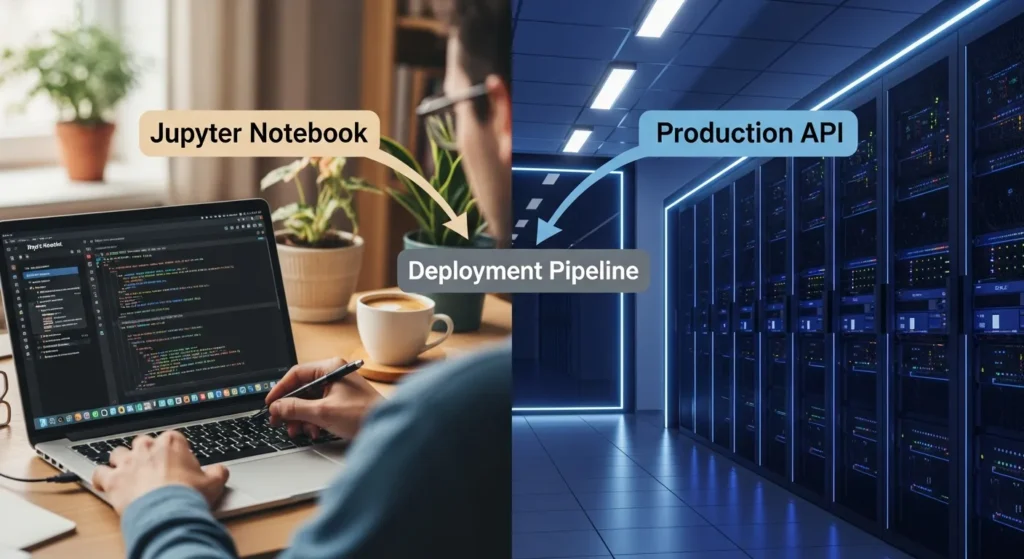
How to Deploy an ML Model: From Jupyter  Notebook to Production API Introduction: No one tells you this when you’re learning machine learning: building a model and deploying it are two very different things. You can make a great model in your Jupyter notebook that works 95% of the time, but if you can’t get it to work in the real world, where real people can use it, it’s just an expensive homework assignment. I’ve been there. I worked on a model for weeks, ran it a thousand times on my own computer, and then realised I had no idea how to share it. That’s when the real learning started, and that’s what this post is about. By the end of this guide, you’ll know how to turn that beautifully trained model in your notebook into a live API that can handle real requests, grow with demand, and actually serve users. We’ll go over every step: serialisation, containerization, picking the right framework, picking a platform, and yes, even the monitoring part that everyone skips but shouldn’t. This guide covers everything from launching your first side project to shipping models for thousands of users. Why Deployment is Where the Real ML Work Happens Most data science courses end with “Congrats! Your model works!” But that’s not the finish line. That’s the starting gun. Everything changes when your model goes from your laptop to production. You are no longer working with a controlled dataset on your computer. Now you have real data, edge cases, different hardware, concurrency problems, and worst of all, users who really need your predictions to work. The biggest mistake I see beginners make is they train their model and then ask, “How do I put this on a website?” But that’s not the right question. The right question is, “How do I make my model a reliable service?” Deployment isn’t just about technology. It’s about being responsible, reliable, and able to reproduce. Your model needs to: Work the same way in different environments Handle errors well when something goes wrong Scale well when demand goes up Stay accurate as real-world data changes It is easy to monitor, so you know when it breaks This is why most companies spend 80% of their ML time on deployment and monitoring instead of building models. Welcome to the real world. Before we start coding, let’s figure out what we’re really doing with the Deployment Pipeline. This is the whole trip: You could say that your Jupyter notebook is the plan. The deployed model is the real building that thousands of people use every day. Each step is very important. Step 1: Getting Your Model Ready for Deployment Your Jupyter notebook isn’t meant for production. It has code for exploring, comments, and maybe even some debugging sessions that got pizza on them. We need to clean this up. Save Your Trained Model After training, your model is stored in memory. It’s gone as soon as you close your notebook. So first, we serialize it, which means turning it into a file that can be loaded and used later. For most sklearn and tree-based models, use joblib (which is faster than pickle for numpy arrays): code Python # After you train your model model = RandomForestClassifier() model.fit(X_train, y_train) # Keep it joblib.dump(model, ‘model.pkl’) For deep learning (TensorFlow, PyTorch), use formats that are specific to the framework, like: code Python # PyTorch torch.save(model.state_dict(), ‘model.pth’) # TensorFlow model.save(‘model.h5′) Why use joblib instead of pickle?Joblib is the industry standard for working with large numpy arrays because it works better. Pickle works too, but it’s slower for complicated models. Don’t just serialize the raw model; make a prediction function. Put it in a clean prediction function like this: code Python def predict(input_features): “”” Takes raw input, processes it, and makes a prediction. “”” # Preparing processed_features = preprocess(input_features) # Load the model (or think it’s already loaded) prediction = model.predict(processed_features) # After processing result = format_output(prediction) return result This is more important than you might think. In production, raw model predictions aren’t enough. You have to deal with missing values, make sure inputs are in the right format, and make sure outputs are always in the right format. Building this into one function keeps your API code clean. Step 2: Choose Your API Framework Now we need to make your model available as an API, which is a service that takes requests and gives predictions. Flask: The Classic Choice Best for: Traditional web apps, simple APIs, when you need full control Flask is lightweight, has massive community support, and feels familiar if you’ve done web development. Here’s a simple example: code Python from flask import Flask, request, jsonify import joblib app = Flask(__name__) model = joblib.load(‘model.pkl’) @app.route(‘/predict’, methods=[‘POST’]) def guess(): data = request.json input_features = [data[‘feature1’], data[‘feature2’]] prediction = model.predict([input_features])[0] return jsonify({‘prediction’: float(prediction)}) if __name__ == ‘__main__’: app.run(debug=False, port=5000) Simple. Reliable. Works everywhere. FastAPI: The Modern Alternative Best for: Building production APIs quickly, when you want auto-documentation and async support FastAPI is newer but it’s gaining fast adoption because it’s genuinely superior for APIs. It handles data validation automatically, generates documentation, and runs faster than Flask: code Python from fastapi import FastAPI from pydantic import BaseModel import joblib app = FastAPI() model = joblib.load(‘model.pkl’) class PredictionInput(BaseModel): feature1: float feature2: float @app.post(‘/predict’) def predict(input_data: PredictionInput): features = [input_data.feature1, input_data.feature2] prediction = model.predict([features])[0] return {‘prediction’: float(prediction)} The main difference is that FastAPI checks your input automatically and makes interactive API documentation available at /docs. You really do get Swagger UI for free. Streamlit: The Data Science Shortcut Best for: Interactive dashboards, demos, and when you want to avoid backend complexity. Streamlit is made for data scientists who don’t want to become full-stack developers. You don’t need an API backend; just: code Python import streamlit as st import joblib model = joblib.load(‘model.pkl’) st.title(‘ML Prediction App’) feature1 = st.slider(‘Feature 1’, 0.0, 10.0) feature2 = st.slider(‘Feature 2′, 0.0, 10.0) if st.button(“Predict”): prediction = model.predict([[feature1, feature2]])[0] st.success(f’Prediction: {prediction}’) Deploy to Streamlit Cloud

How to Deploy an ML Model: From Jupyter Notebook to Production API Read More »

mlflow

Introduction to MLflow: Tracking Your Experiments Like a Pro

MLflow: A Professional Way to Keep Track of Your Experiments   The Issue That No One Talks About (But Everyone Has) You spend weeks working on a model for machine learning. You change the hyperparameters. You try out different algorithms. You do 50, 100, or even 200 experiments. Then disaster strikes: you can’t remember which set of parameters gave you the best results. Your laptop has a lot of notebooks on it. The names of your CSV files are hard to understand, like model_v3_lr0.01_bs64_acc0.82.h5. Your team members don’t know which version of the model is actually being used. Welcome to the nightmare that is the chaos of tracking experiments. This is what most data scientists and ML engineers deal with every day. It’s possible to manage machine learning experiments without the right tools, but it’s very painful, like trying to keep a detailed lab notebook while wearing oven mitts. The best part is that most people don’t know that this problem can be fixed. And what is the answer? MLflow. An open-source platform that makes your messy experiment management into a system that is easy to use and repeat. This guide will teach you everything you need to know about MLflow, including how it works, why it’s important, and most importantly, how to use it to keep track of your ML experiments like a pro. Here’s a visual representation of the iterative machine learning lifecycle, highlighting the key steps from setting business goals to monitoring deployed models. What is MLflow, anyway? MLflow is a free platform that helps you manage the entire machine learning lifecycle. Think of it as a central place where all the parts of your ML projects come together and work well together. MLflow is the tool that data science teams all over the world use the most. It was made by the people at Databricks. MLflow makes it easy to organize, track, and deploy your models, whether you’re working on your own or with a team of 50 data scientists. What makes MLflow so great? It doesn’t care what language or framework you use. MLflow works well with all machine learning frameworks, including Python, R, TensorFlow, PyTorch, scikit-learn, and others. The Four Pillars of MLflow and Why They Are Important There are four main parts to MLflow, and each one solves a different problem in the ML lifecycle: 1. Tracking: Your own journal for experiments MLflow Tracking is where the magic happens. This part keeps track of everything you need to repeat your experiments: Parameters: Your hyperparameters, like the learning rate, batch size, number of layers, and so on. Metrics: measures of performance (accuracy, precision, recall, F1 score, and loss values) Artifacts are any files that your model makes, like saved models, plots, datasets, and images. Versions of the Source Code: The exact code that ran each test MLflow automatically collects all of this information instead of you having to write it down in a spreadsheet or make hundreds of file variations. In MLflow, every training run makes a “run,” which is a timestamped snapshot of your experiment and all of its data. 2. Projects: How to Make Your Code Work Again MLflow Projects is basically a standard way to put your ML code together. It says, “Hey, here’s how to run my project, what environment it needs, and what the entry points are.” Think about giving your project to a coworker and having them run it exactly how you wanted the first time, with no problems setting it up. That’s what Projects is all about. 3. Models: The Universal Format for Packaging MLflow Models gives your trained models a standard wrapper. This is a big deal because models come in a lot of different types, like TensorFlow SavedFormat, PyTorch .pth files, and scikit-learn pickles. MLflow says, “I don’t care what format your model is in. I’ll package it so that anyone can load and use it anywhere.” 4. Model Registry: Your Main Place for Versioning The Model Registry is the place where models that have been registered are stored. In short, it’s version control for your ML models. You can see all the versions of a model, move models from one stage to another (Development → Staging → Production), and keep track of each model version’s whole lifecycle. Here’s an infographic summarising the four main components of the MLflow platform: How MLflow Tracking Works (Without All the Boring Terms) Let’s say you’re using different hyperparameters to train a random forest model. This is what MLflow does: code Python import mlflow from sklearn.ensemble import RandomForestClassifier from sklearn.model_selection import train_test_split from sklearn.datasets import load_iris # Load the data iris = load_iris() X_train, X_test, y_train, y_test = train_test_split( iris.data, iris.target, test_size=0.2 ) # Start a run in MLflow with mlflow.start_run(): # Write down your parameters mlflow.log_param(“n_estimators”, 100) mlflow.log_param(“max_depth”, 10) # Teach the model model = RandomForestClassifier(n_estimators=100, max_depth=10) model.fit(X_train, y_train) # Keep track of your metrics accuracy = model.score(X_test, y_test) mlflow.log_metric(“accuracy”, accuracy) # Keep the model mlflow.sklearn.log_model(model, “model”) That’s all. MLflow automatically records everything and keeps it safe. No spreadsheets. No naming files by hand. Just tidy up and clean the experiment data. The Game-Changer: Autologging This is where MLflow starts to seem almost magical. You can turn on autologging for well-known frameworks. You don’t have to write any extra code for MLflow to automatically log parameters, metrics, and models. code Python import mlflow # Turn on autologging for your framework mlflow.autolog() # Now just train like normal model.fit(X_train, y_train) # Everything is automatically recorded! TensorFlow/Keras, PyTorch, scikit-learn, XGBoost, LightGBM, Spark MLlib, and many more frameworks are supported. This is huge because it makes things easier. You go from “I need to remember to log this” to “it just happens.” Most modern data scientists are already using these frameworks, so autologging feels like a cheat code. MLflow vs. Other Tools for Keeping Track of Experiments (The Real Talk) There are other tools on the market, such as Weights & Biases, Neptune, Comet, and more. So how does MLflow

Introduction to MLflow: Tracking Your Experiments Like a Pro Read More »