The Ethics of Generative Art : Who Owns What AI Creates?
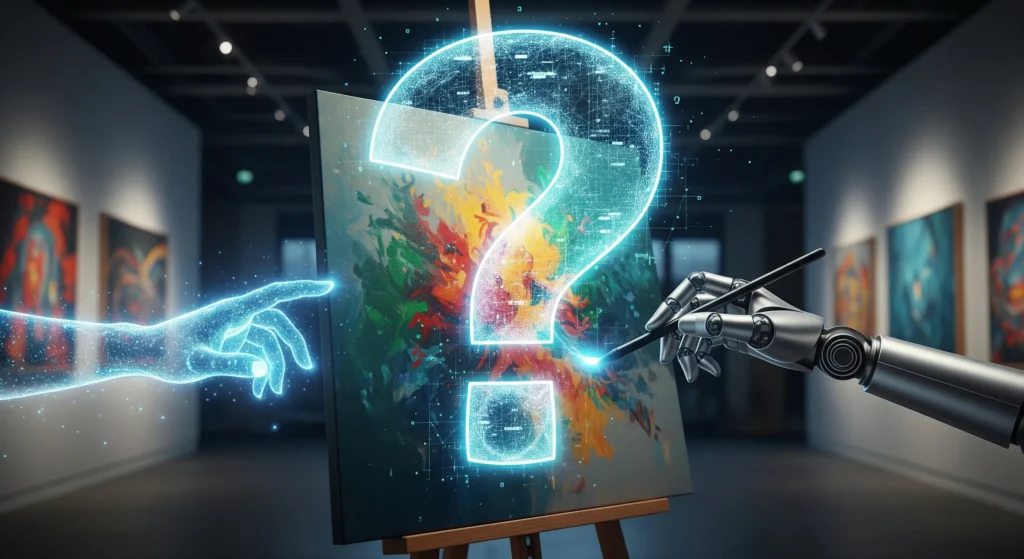
Introduction Of The Ethics of Generative Art Imagine the following: you feed an AI-based tool with a basic query and in a few seconds it generates a stunning digital masterpiece fit to be displayed in any gallery. But what is the million-dollar question–that is, in some instances, the million-dollar question–who is the owner of that creation? The artist, who created prompt? The artificial intelligence corporation that developed the algorithm? The system, which was trained by the thousands of artists? Or perhaps, nobody at all? It is the beginning of one of the most interesting and controversial debates of our technological era. With generative AI taking up a creative space, it is compelling us to reevaluate all that we think about authorship, creativity, and intellectual copyright. Digital artist producing generative artwork inspired by AI, and based on a drawing tablet, of a robotic head. Source: Nailsahota The New Creative Revolution: The Machines as Artists. Generative AI art is a seismic change to visual content creation and consumption. In contrast to conventional digital art tools, where the human hand and will are needed behind each brushstroke, generative AI systems such as DALL-E, Midjourney, and Stable Diffusion are capable of creating convincing-looking work with complex appearance without requiring the use of human skill or the human will behind each pixel. These systems read through huge amounts of data with millions of existing works, learn patterns of works, styles, and techniques, and then create completely new images. The effect of the technology is already tremendous. According to recent research, AI-assisted artists create 1.25 the number of works as compared to their conventional peers and get more audience attention. Nevertheless, there is a problematic fact behind this productivity boom the majority of artists are deeply worried about their employment stability because of AI development. The artistic community is at cross-roads. Some see AI as an effective partner that makes human creativity more creative, whereas others perceive it as a life-threatening force to the existence of art people. This is not merely a philosophical tension–this is being rewritten in some courtrooms of the globe, where the definition of creativity and ownership is being redefined. AI ethics framework describing ethics foundations, realisation, evaluation and assimilation of responsible AI operations. Source:MnpDigital The Legal Battlefield: Existing Structures and Case Law. The Human Authorship Prerequisite. The essence of the modern copyrighting remains as crystal clear as the fact that only humans can be authors. The U.S. Copyright Office has long-held this view, and in the most recent case to strengthen this opinion has been Thaler v., decided in March 2025 by the D.C. Circuit Court of Appeals. Perlmutter. The long-term struggle of Dr. Stephen Thaler to have his copyright on work produced by his “Creativity Machine” is an unequivocal demonstration of the fact that AI systems are not considered as authors in the existing legislation. The court decided that the text of the Copyright Act read as a whole is most appropriately interpreted to declare humanity as a pre-requisite to authorship. However, this is where it becomes interesting, as the ruling does not prohibit human beings to gain copyright protection of works made with the help of AI. The main difference is in the amount of human creative activity and control over the end output. The Training Data Dilemma Although it is not possible to have AI as an author, a more complicated question is the way in which these systems are trained. Generative AI models are mostly created based on enormous amounts of information that is scraped off the internet, and they are not always created under the explicit consent of original creators. The practice has been in a gray area that is yet to be tapped by courts. The report released by the U.S. Copyright Office in May 2025 on generative AI training offers essential information, as it implies that certain applications of copyrighted materials to train AI can be considered fair use, whereas others will not. The consideration relies on such factors as transformativeness, commercial purpose, and commercial impact on the market to a great extent. Trusted Site Data Screen Shot With Sources : U.S. Copyright Office Report on Generative AI Training (May 2025) Fight Back Artists: The Andersen Case. Artists Sarah Andersen, Kelly McKernan, and Karla Ortiz sued Stability AI, Midjourney, and DeviantArt in a class-action suit in 2023, alleging that the three companies violated all three prongs of the Lanham Act as well as the Fourteenth Amendment in their pursuit of AI art generation. A significant step in the case was made in August 2024, when the U.S. District Judge William Orrick authorized the infringement claims to move forward since the AI companies could have enabled the copying of the copyrighted content. The case is also important as it concerns the LAION dataset that is 5 billion images collected online and utilized to train various AI systems. This case has the potential to change the course of history by setting several groundbreaking precedents that would guide the interpretation of the connection between AI innovation and intellectual property rights in court. The hands of a robotic hand with a digital scale of justice, which is a representation of AI ethics and intellectual property rights. The Fair Use Doctrine Under Fire. The fair use has emerged as the major defense to AI companies against copyright problems. Nonetheless, the application of the doctrine to generative AI is not resolved. Two popular arguments in the Copyright Office 2025 report are explicitly dismissed, namely that AI training is transformative and that AI learning is comparable to human learning. The recent judicial rulings are an indication of a subtle treatment. Two major decisions in 2025 in favor of tech firms favored the debate that AI training is transformative fair use in case the purpose of the output is a purpose of the public interest. Nevertheless, such decisions were arrived at via various legal avenues meaning that the legal environment is yet to stabilize. Analysis of fair use is especially complicated
The Ethics of Generative Art : Who Owns What AI Creates? Read More »