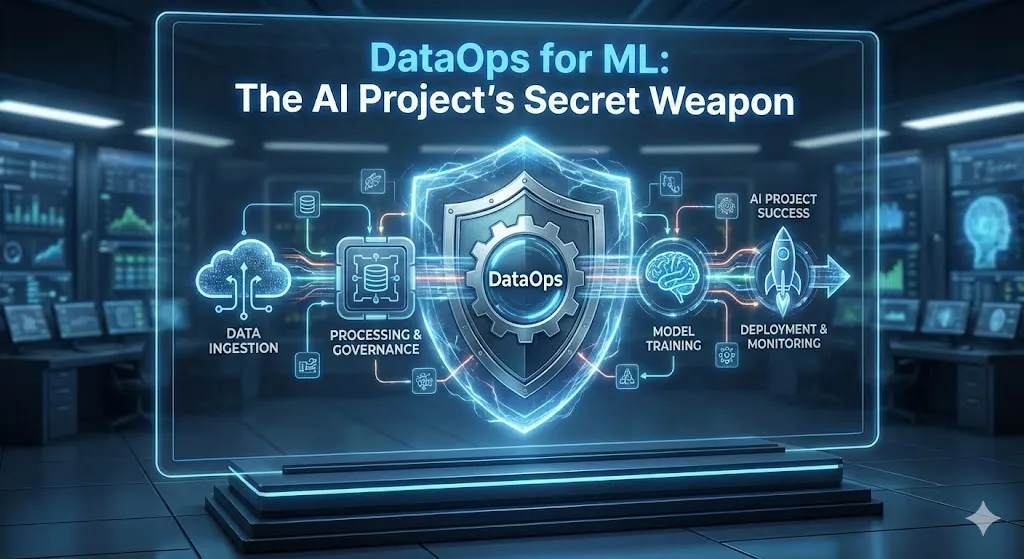
DataOps for ML: The AI Project’s Secret Weapon
The Beginning: The Dirty Truth About AI Projects That No One Talks About
I want to be clear with you. For the past 12 years, I’ve been working on AI tools in the trenches, and I’ve seen great machine learning teams make models that never get used. The data scientists? The best talent. What are the algorithms? The best of the best. But those projects still ended up in a Jupyter notebook folder that no one remembers, where they are gathering digital dust.
Here’s the gut punch: 95% of AI projects don’t really help businesses. That number comes from new research at MIT, and it didn’t blame complicated algorithms or not having enough computing power. No. It pointed straight to problems with data quality, broken pipelines, and the lack of proper data operations.
Give it some thought. You could make the smartest machine learning model in the world, but if you give it bad data—like missing values, inconsistent formats, biased samples, or just plain old information—it’s useless. Imagine that you are an F1 engineer putting your heart and soul into a Ferrari engine, only to put it in a rusty shopping cart. That’s what happens when you don’t use DataOps for ML.
DataOps isn’t the cool part of AI that gets a lot of attention at conferences and on LinkedIn. The pipelines, validation, monitoring, and collaboration that go on in the engine room are what really turn fragile experiments into production systems that make millions of dollars. And now that it’s December 2025 and AI is being used more and more in all kinds of businesses, ignoring DataOps is like building skyscrapers on sand.
Who This Is For (And What You’ll Get Out of It)
This is for data scientists who are tired of having to retrain models every time the data changes. Data engineers are having a hard time fixing pipelines by hand. ML leaders see 85% of projects fail to deploy. And business leaders who are confused about why their AI investments aren’t paying off.
You will understand by the time you finish reading:
How DataOps and MLOps turn AI that focuses on experiments into systems that are important to business.
Real-life examples that show the ROI.
A full 5-stage DataOps workflow with tools that will work in 2025.
The hard problems teams have to deal with (and how to solve them).
Trends in 2025 include pipelines powered by AI and DataOps that happen in real time.
The reward? You’ll see the holes in the data that are ruining your projects and know how to fix them. Let’s get started.

Image -“DataOps workflow pipeline showing five stages from data ingestion to monitoring”
What is DataOps? Breaking Down the Basics of ML Success
DataOps isn’t just a buzzword that people in Silicon Valley came up with. Let me put it this way: I’m getting coffee with you.
DataOps is the heart of your AI project. It’s a set of tools, processes, and best practices that make sure data flows from messy sources like APIs, databases, logs, and user events to your ML models quickly, cleanly, and reliably every time. It uses DevOps principles like automation, continuous testing, working together, and making things better over time to manage data.
The datasets that your models train on are owned by the data operations teams. They keep track of quality, lineage, versioning, and freshness. Your ML models would be learning from old news or broken files if you didn’t have them. Disaster.
Here’s what DataOps really does in real life:
Automated Pipelines: Data pipelines that run on their own without people having to watch over them all the time.
Real-time Validation: Catches mistakes before they ruin your training data.
Continuous Monitoring: Lets you know when data drift reaches production.
Collaboration: Teams (data engineers, scientists, and analysts) all speak the same language.
Version Control: See exactly what fed Model v2.3.
“Everyone wants to do the model work, not the data work.”
This quote from the ML community really hits home. Models get all the attention: cutting-edge transformers, hyperparameter tuning, and leaderboard rankings. Work with data? Fixing problems with CSV encoding at 2 AM. No one posts that on LinkedIn. But guess which one decides if your AI really ships?
DataOps, MLOps, and AI ML DevOps: What’s the Difference?
What are DataOps and MLOps? That’s a good question. People always get these mixed up.
Image – “Difference Between DataOps, MLOps, and AI ML DevOps”
MLOps stands for “Machine Learning Operations.” It focuses on the model’s lifecycle, which includes tracking experiments, training, versioning, deployment, A/B testing, and retraining when performance drops. Tools such as MLflow, Kubeflow, and Seldon. What is the goal of MLOps in AI projects? Get models from the notebook to production without fail.
DataOps is short for Data Operations. It takes care of everything that happens before the model gets to the data, like ingestion, cleaning, transformation, validation, feature stores, and lineage tracking. Airflow, dbt, and Great Expectations are some of the tools.
The combination is AI ML DevOps. DataOps sends MLOps pipelines clean, reliable data. They’re not competing; they’re working together. DataOps is the basis for solid MLOps.
Which ML project is the best? The one that has both. If you don’t use DataOps, your MLOps will fall apart when the quality of your data drops. If you don’t use MLOps, your clean data will never turn into useful models.
DataOps and MLops groups in the data science community agree that data is 80% of the work. If you don’t think about it, your AI dreams will die.
Why the Quality of Your Data is Your Best Weapon (And How It Gets Ruined)
Bad data quality costs companies $12.9 million a year in direct losses, like having to rewrite reports, losing sales, and making bad choices. That’s just the beginning. What are indirect costs? Lost chances, broken trust, and fines from regulators.
The Silent Killers I’ve Seen Ruin Projects
I’ve been through these disasters:
Missing values: All over the place. Training fails without a sound, and models learn bad patterns.
Different formats: “John Doe” in CRM turns into “DOE, JOHN” in the warehouse, and joins explode.
Outdated data: Models make predictions based on 2024 patterns in a world that will be 2025.
Hidden bias: Predictions for customer groups that aren’t well represented are bad.
Schema drift: Adding fields to a new API version breaks everything downstream.
Duplicate records: The same customer is counted 17 times, and revenue reports are wrong.
Each one seems small. Put together? Your model’s accuracy drops by 20 to 30% overnight. What effect will it have on business? Disastrous.
The 5 Dimensions of Data Quality (Check These)
Accuracy: Does the data match what really happened? Packages get lost when the address is wrong. Emails that aren’t valid bounce campaigns.
Completeness: Are all the required fields there? Segmentation is useless without demographics.
Consistency: Is it the same everywhere? Different ID formats break joins.
Timeliness: Is it fresh enough? Day-old stock data makes trading models useless.
Relevance: Does it help you reach your goal? It sounds great to have 500 variables, but 490 of them are noise.
The data repository for machine learning needs to keep track of all five all the time.
Pie Chart – “Why ML Projects Fail : Root Cause Analysis” Source – “amazonaws”
Why Machine Learning Projects Don’t Work: Finding the Root Cause Poor data quality is to blame for 40% of ML failures. 25% of DataOps/MLOps are missing. Always fix the data first. AI needs storage to work. Traditional systems can’t handle the growing amount of data and the complexity of models. DataOps makes it bigger.
Case Studies That Changed Everything: Proof in the Real World
Stats make sense. Results change. Here are some stories that show how DataOps for ML is the unsung hero of AI projects.
Case Study 1: HomeGoods Plus – Retail Revolution (Full Breakdown)
The Issue (Before DataOps): A chain of medium-sized stores. The marketing team had to wait a whole week for sales data from 200 stores to be put together. Couldn’t change direction on hot items. Campaigns were weeks behind the times.
Pipeline Nightmare:
40 hours of work by engineers each week for manual ETL.
No alerts for failures; problems were found when executives yelled.
Problems with data quality (duplicates, missing SKUs) were found after the analysis.
Engineers didn’t pay attention to business needs because they worked in silos.
Setting up DataOps (6 months):
Fivetran for automated integration from Salesforce to Snowflake.
dbt for tests and transformations (finding duplicates and checking schemas).
Orchestration of Airflow with retries and Slack alerts.
Great Expectations for more than 50 checks on data quality.
Dashboards in Tableau that update in real time.
Results (First Year):
They didn’t make new models. Data that was fixed. Business took off. DataRobot MLOps on top of it all did great.
Case Study 2: Netflix DataOps on a Petabyte Scale
Netflix handles petabytes every day from subscribers all over the world.
The machine they use for DataOps:
Airflow and Kafka run automated pipelines all the time.
Data versioning keeps track of every input to the recommendation model.
Real-time validation finds problems right away.
Mesh governance means that ownership is spread out but standards are set centrally.
What happened? Recommendations that bring in more than $1 billion a year. DataOps scale.
Case Study 3: Mastering the Airbnb Marketplace
Global listings, bookings, and reviews. DataOps does:
Freshness SLAs: listings are updated every five minutes.
Monitoring bias—fair pricing across regions.
Drift detection: demand patterns change with the seasons.
Dynamic pricing and other AIops projects work because the DataOps foundation is always strong. Ideas for MLOps projects? Use these patterns to start forecasting demand.

Bar Graph – “Impact of DataOps : Organizations with DataOps vs without DataOps”
Your Full DataOps Workflow: 5 Steps, Real Tools, and Ready for 2025
The unsung hero of data management is workflow. This is the plan.
Stage 1: Input and First Check (Don’t Let Junk In)
Data hits from more than 50 sources. Check right away.
Tools:
Apache Kafka / AWS Kinesis (streaming)
Fivetran and Airbyte (batch integration)
Great Expectations (validation)
Checks that were run:
Validation of the schema
Constraints on the range (prices > 0)
Null rates are less than 5%
Newness (data less than 24 hours old)
Tip: Fail quickly. Before storing, throw away bad batches.
Stage 2: Change and Clean (Get It Ready for the Model)
From raw to useful. Engineering-level SQL transformations.
The dbt core stack:
├── models/ (SQL changes)
├── tests/ (more than 400 automated checks)
├── macros/ (logic that can be used again)
└── docs/ (made automatically)
dbt wins:
Dependency graphs were automatically fixed.
Version control with Git.
Incremental models (only data that has changed).
Tracking the whole family tree.
For example, five teams used the same calculation to figure out the lifetime value of a customer.
Stage 3: Feature Engineering and Storage (This is where the ML magic begins)
Models don’t eat raw tables; they eat features. Feature stores fix this.
Tools:
Feast and Tecton are open-source feature stores.
Hopsworks (for businesses)
Custom Redis (for simple cases)
├── Hopsworks (for businesses)
└── Custom Redis (for simple cases)
Pros:
Same features for training and inference (no training/serving skew).
Versioned (Model v3 used featureset v2.1).
RFM scores can be used again (the marketing and pricing teams share them).
Unified online and offline storage.
Getting data ready for machine learning takes 60 to 80 percent of the time. Feature stores cut it in half.
Stage 4: Orchestration (The Conductor)
Everything works in order, with error handling.
An example of an Apache Airflow DAG:
dag/
├── extract_sales_data (2 AM every day)
├── transform_with_dbt
│   └── build features
└── check_quality
    └── tell the team (if it didn't work)
Airflow magic:
Finding dependencies
Retry logic (3x, back off)
Alerts for Slack and Teams
Dashboards with a lot of features
Scale to more than 10,000 tasks
Dagster (type safety) and Prefect (cloud-first) are two other options.
Stage 5: Keep an Eye on Production (Never Stop Watching)
Data drift quietly kills models. Keep an eye on it all the time.
Metrics that were tracked:
├── Statistical drift (KS test, PSI)
├── Spikes in the null rate
├── Business metric drift (average order value ±20%)
│   └── Decrease in freshness
└── Unusual volumes
Tools: EvidentlyAI, Arize, and a custom version of Prometheus and Grafana.
“Customer age distribution drifted 15%. Look into it now.”
 Image – “DataOps tech stack decision guide with four key categories and recommended tools.”
The Harsh Truth: 4 Problems and Proven Ways to Solve Them
It’s hard to do DataOps. Here’s why teams fail and how winners get around it.
Problem 1: The “Model Work” Glamor Issue
The Truth: Data scientists don’t like cleaning data. It is boring. Models are hot.
Fix: Show how clean data increased sales by 10%. Get data engineers on board. Celebrate wins in the pipeline.
Problem 2: Data Silos Hell
The Truth: 20 owners, 15 formats, and 12 systems. Integration takes up half of the time.
Fix: Fivetran self-service connectors, Schema registries (Confluent), Contracts for data (dbt + Great Expectations), Tools for cataloging (DataHub, Amundsen).
Problem 3: Speed vs. Governance
The Truth: Rules are needed for compliance. Teams need to be flexible.
Fix: Policy as code. Enforcement that happens automatically. Decentralized ownership with central standards (Netflix mesh).
Problem 4: Not enough skilled workers
The Truth: You need to know about data, software, the cloud, and machine learning.
Fix: Begin with the basics (dbt + Airflow). Training within the company (dbt Learn, Astronomer Academy). Managed services like Databricks and Snowflake. Hire people with the right attitude and teach them how to use the tools.
87% of ML deployments fail. DataOps brings it down to 15%.
Tools That Scale for Your 2025 DataOps Tech Stack
The market for data pipeline tools will be worth more than $15 billion by 2030, with a compound annual growth rate (CAGR) of 25%.
Many things come together in Databricks MLOps. Good for businesses.
Hard Numbers: The Case for DataOps in Business
Mature DataOps companies see significant improvements. Sources: Industry benchmarks for 2025.
More wins:
40% less fraud (ML detection)
25% faster customer service (predicting)
30% more productive engineers
In short, DataOps is a great partner for ML and AI projects. Managing data strategically gives your business an edge.
What’s Coming Quickly in DataOps in 2025
AI-Powered DataOps: LLMs make pipelines and fix quality problems on their own.
Unified Platforms: Databricks and Snowflake are taking over point solutions.
Everything in Real Time: Kafka and Flink for pipelines that take less than a second.
Edge DataOps: IoT and on-device ML need local pipelines.
Green DataOps: Schedule clean energy jobs and make the most of computing power.
Data Contracts: Formal agreements between producers and consumers.
The market for Industrial DataOps will be worth more than $8 billion by 2030.
Conclusion: Your Turn Now
DataOps won’t help you get famous. There are no TED talks about schema validation. There are no viral tweets about Airflow DAGs.
But it gives you AI that works in the real world. Models that make money. Pipelines that run all the time. Teams that move quickly. 95% of the time, they fail; 85% of the time, they succeed. Millions saved. Gained an edge over the competition.
Begin here today:
Choose the pipeline that hurts the most.
Add validation for Great Expectations.
Set up the scheduling for Airflow.
Keep an eye on one quality metric.
Make bigger what works.
DataOps for ML: the unsung hero of AI projects. Make the base. See how everything else works.
What’s wrong with your pipelines? Please share below. I read every comment.
FAQs
1. What is the difference between AI ML DevOps and just DevOps? DevOps is the process of delivering software. AI ML DevOps is made up of software, data, and models. DataOps takes care of data pipelines, and MLOps takes care of models. Together, AI delivery from start to finish.
2. Ideas for MLOps projects for beginners? Using dbt, Airflow, Feast, and a Streamlit dashboard to predict customer churn. Perfect introduction to DataOps and MLOps.
3. How to persuade leaders? Show the case study for HomeGoods. Find out how much your bad data costs you: $12.9 million. Promise insights that are 30% faster.
4. Paid tools vs. open source tools? Start with open source tools like Airflow, dbt core, and Great Expectations. Scale up when hiring slows down.