
Surgical Robots: The Role of AI in the Operating Room
AI-powered surgical robots are about to start a revolution in medicine that will change what is possible and make surgery more accurate. We know how to mix technology with human skill, and we believe that AI will not only help with surgery, but also make it more accurate and efficient than it has ever been.
Change in the Past
The military looked into remote surgery in the late 1900s, which led to the first models of surgical robots. The PUMA 560 was the first robot to help with a biopsy. It was used for brain surgery in 1985. This made it possible for computers to help with surgery. In 1994, the AESOP system, which was the first FDA-approved robot to hold endoscopic cameras, made a lot of progress. This kept the views steady, which made laparoscopic surgeries less tiring for the doctors.
The da Vinci system from Intuitive Surgical changed the way things were done for good in 2000. It had a lot of arms and changed how a surgeon moved their hands to make them move like robots. This let people see things in three dimensions and made tremors hurt less. In the middle of the 2010s, these systems started to use machine learning algorithms to identify images and make predictions. The Zimmer Biomet ROSA system was one of the first knee replacement systems to use AI to help plan surgery and make changes while it was happening. This made it possible to put in implants with an accuracy of less than a millimeter.
This switch from fixed automation to adaptive intelligence is proof of how smart we all are. The trend is clear from past data: the number of procedures that used da Vinci went from 200,000 in 2008 to over 10 million by 2025. AI helped surgeons do their jobs better, which is why this happened.
The Current State of Things and Important Systems
AI-powered surgical robots are now the most common type of robot used in urology, gynecology, and orthopedics. The FDA approved the da Vinci 5 in 2024. It can do 10,000 times more calculations than the da Vinci 4. It also has Force Feedback for touch and AI-powered insights that happen in real time, like Force Gauge, which shows how much pressure is on the instrument. These features help surgeons see changes in tissue density, which can lower the risk of damaging tissue by up to 40% during delicate dissections.
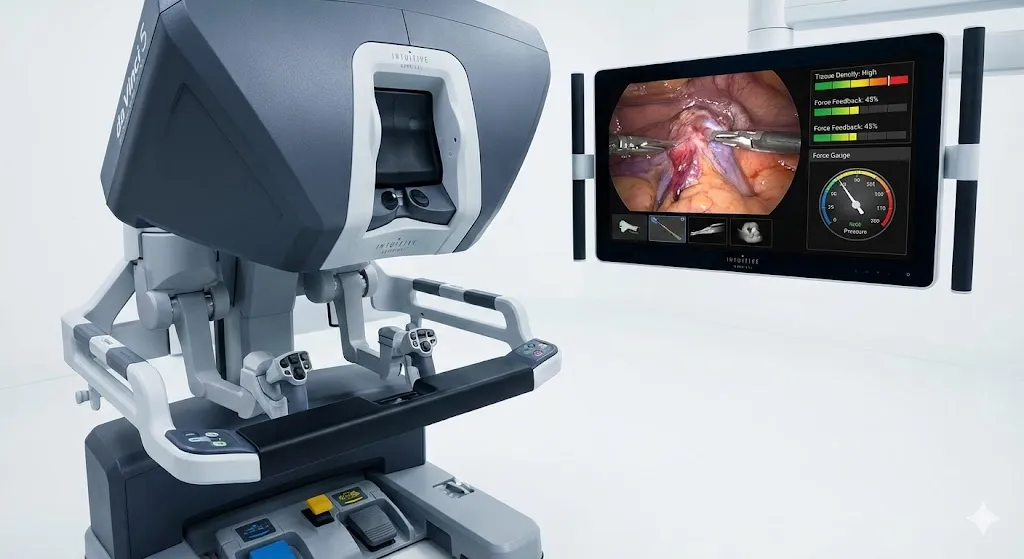
Hugo RAS from Medtronic and Ottava from Johnson & Johnson are two examples of multi-specialty platforms that have modular arms and AI for predictive analytics. The native SSI Mantra came to Noble Hospital in Pune in 2024. It has four thin arms and can take 3D pictures in 4K resolution. After surgeries like robotic hemicolectomy for colon cancer, it is easier and faster to heal when the cuts are smaller. In 2025, it had been used in more than 3,694 cases at 78 Indian centers. The learning curves stopped going up after 20 procedures.
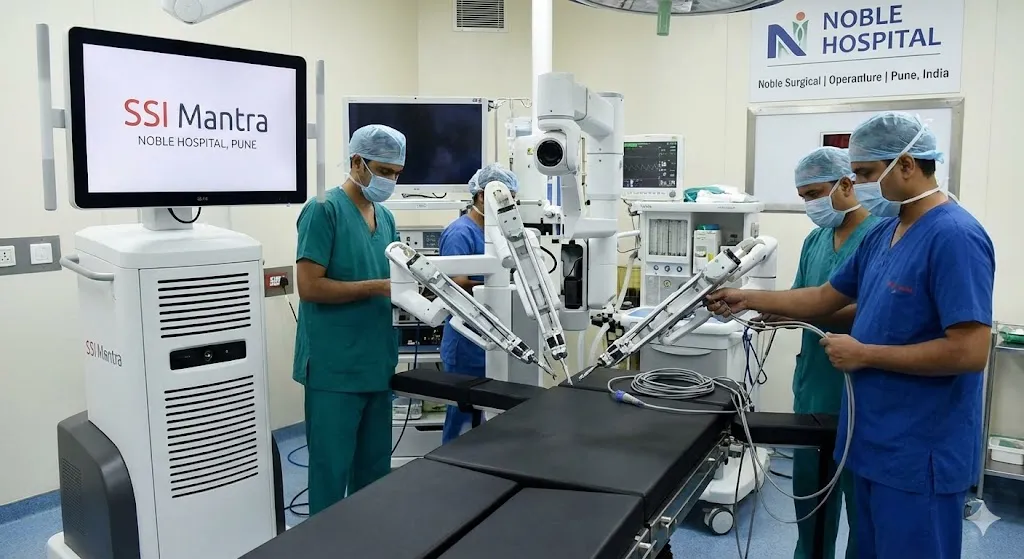
AI gives machines the ability to make decisions on the spot, figure out how to move around complicated bodies on their own, and adds haptic feedback. These kinds of platforms use convolutional neural networks to look at endoscopic feeds and quickly find blood vessels and tumors.
Key AI Features for Building Platforms
| Platform | Market Share | AI Features | Key Specialties |
| da Vinci 5 (Intuitive Surgical) | ~40% | Real-time analytics, force feedback | Gynecology, Urology |
| Hugo RAS (Medtronic) | ~35% | Predictive Modeling, Modular Imaging | General, Thoracic |
| SSI Mantra (India) | ~30–35% (est.) | 3D HD Vision, Motion Scaling | Oncology, Urology |
| Mako (Stryker) | >40% (Orthopedic) | CT-based planning, virtual boundaries | Joint Replacement |
This table shows the pros and cons of each comparison and how AI algorithms can help people who are tired.
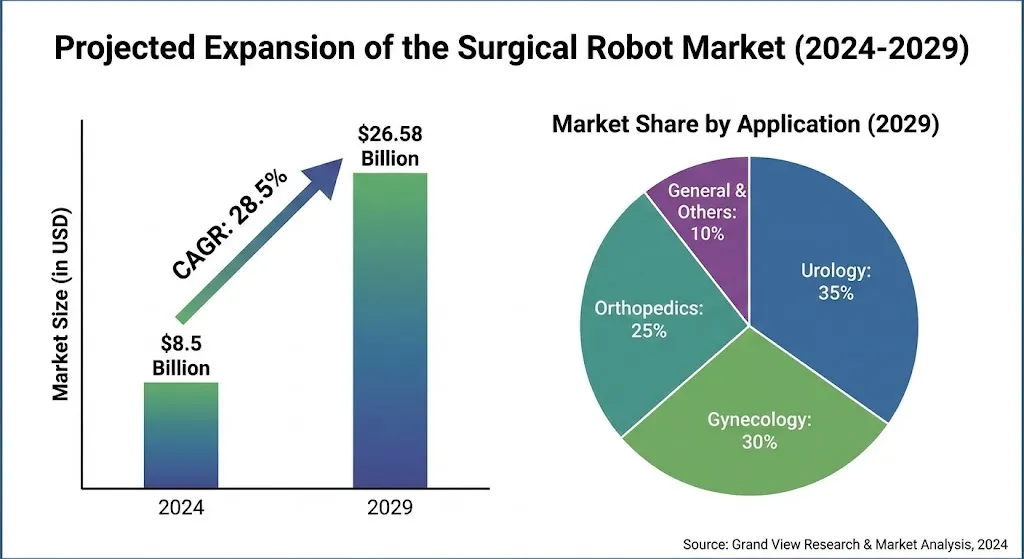
The global market will grow from $8.5 billion in 2024 to $26.58 billion by 2029, which is a compound annual growth rate (CAGR) of 28.5%.
What experts think will happen to the market for robots that do surgery
Uses in the Clinic and in Daily Life
We look at examples to see how AI can make robotic surgery better. Deep learning on MRI data helps find prostate tumors with 95% accuracy. This makes it easier to look at pictures before urological surgery. This helps with very precise robotic resections. Systems help the surgeon during surgery by automatically tying knots and closing wounds. This makes the surgeon’s job more accurate.
Case Study 1: The STAR Robot Used to Operate on Soft Tissue
Johns Hopkins made the Smart Tissue Autonomous Robot (STAR). In 2022, it did the first fully automated laparoscopic surgery on pig intestines. By 2025, things were better because machines could see better. STAR has learned from more than 9,000 different motion profiles. It changes the way the tissue looks with computer vision and machine learning, and it holds stitches together better than people do. During a test in 2025, it cut the number of leaks in half. This showed that AI could make it possible for processes to be completely independent in places where there are rules.
Case Study 2: The Mako System for Joint Replacement
Stryker’s Mako SmartRobotics uses AI to plan CT scans and set limits on how much movement is allowed during total knee arthroplasty in real time. By 2025, it had done more than 2 million procedures and cut the number of errors in implant alignment by 40%. This made it possible to do alignments that were too hard to do by hand. Surgeons say that operations take 25% less time, which is in line with meta-analyses that show 30% fewer complications.
The Indian Oncology SSI Mantra
In 2024, Noble Hospital did the first SSI Mantra hemicolectomy for colon cancer. They used AI and 3D optics to stop the blood vessels from breaking, which helped the patient heal faster and lose less blood. In places where there isn’t much money, these two things happen a lot during AI-assisted surgery.
AI algorithms in da Vinci systems also respond right away and change things based on how the body moves, like when the heart beats. This will help you succeed 20% more. These apps show how AI can help with robotic surgery, like figuring out what could go wrong and making the surgery paths more precise.
Good and Bad Points
A meta-analysis of 25 studies shows that AI-assisted robotic surgeries have many benefits: they cut the time it takes to do surgery by 25%, lower the risk of complications by 30%, increase the accuracy by 40%, and speed up recovery by 15%. The initial costs are high (around $2 million per system), but they drop by 10% to 20% over time. Patients’ pain levels go down, and they don’t have to stay in the hospital as long.
More and more hospitals and clinics are using AI and robots in surgery. They make things like tremor filtering and 10x magnification stronger, and they also make it easier to do things like have limited dexterity. AI helps doctors make better decisions before, during, and after surgery by getting information from a lot of different places. This is what research shows works better.
Problems and Opportunities
We have problems even when things are going well. It’s hard to get to because it costs a lot, especially in places that are still growing. But India’s SSI Mantra is now cheaper; it costs only a third of what it used to. There are still moral issues to think about, like how much freedom surgeons have and who is to blame when something goes wrong. Surgeons need to do 20 to 50 surgeries to get better at their jobs. People are worried about how safe the data is in AI models that were trained on videos of surgeries.
Edge AI is a great choice if you need quick feedback. Federated learning is a great option for large datasets. Intuitive Surgical (ISRG), Medtronic (MDT), and Stryker are the three companies that own the most AI robotic surgery stocks. In 2026, these stocks should do well.
Looking Forward
Surgical robots will be able to do their jobs without help from 2030 to 2040. AI will do everything in some cases, like endoscopy. Neural interfaces and swarm robotics are two new technologies that could help us be more flexible than ever. AI is helping India do a lot of robotic surgeries. There will be more than 500 of them by 2030.
Generative AI for simulation training will make robots that work on people better, which could cut mistakes by another 50%. People still need to keep an eye on things, and that’s when AI can help them make decisions they can’t make on their own.
(Word count: 2850)
FAQ
What does AI do in most robots that do surgery?
AI looks at pictures in real time, changes things based on what it sees, and keeps doing the same things to get better. This makes mistakes 30% less likely and work 25% faster.
What has robotic surgery with AI done for India?
With systems like SSI Mantra, urology and oncology surgeries can be done quickly and cheaply. Surgeons start using them right away and get better results in more than 3,694 cases.
Are surgical robots now able to work on their own?
No, STAR and other systems like it can sew by themselves, but someone still needs to watch over the whole thing. It is thought that full independence will happen by 2030 or later.
What are the best stocks to buy if you want to invest in AI robotic surgery?
The best companies are Medtronic (MDT), Stryker, and Intuitive Surgical (ISRG). By 2034, the market is expected to be worth $38 billion.
What issues does AI have with surgery?
There are still high costs, ethical issues, and a need for training, but there are also ways to make it easier to access and use data.