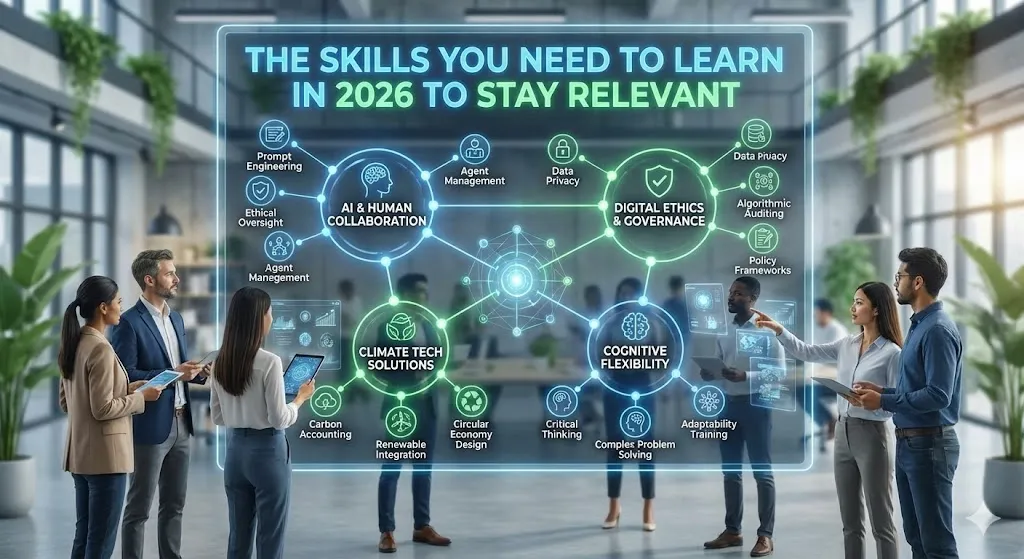
The Skills You Need to Learn in 2026 to Stay Relevant
Introduction: Welcome to the Future You Predicted
If you are reading this in January 2026, take a moment to open your LinkedIn feed or browse your company’s internal job board. Notice the silence? The frantic, desperate calls for “React Developers” and “SEO Copywriters” that defined the noise of 2023 and 2024 have largely vanished
In their place is a new lexicon that would have seemed alien just three years ago: “Agentic Fleet Commanders,” “Circular Economy Analysts,” and “Trust Architects.” The future has arrived, but it didn’t bring the Terminator. Instead, it brought an army of highly capable digital interns that are rapidly being promoted. The robots didn’t come to destroy us; they came to do our rote work—faster, cheaper, and increasingly, better than we ever could. This shift has fundamentally rewritten the definition of “employable.”
We are no longer in an economy where “good enough” is acceptable; “good enough” is now automated. The only standard left for high-value human labor is “exceptional.” This guide is your blueprint for becoming exceptional in the 2026 landscape.
The Technical Reality: The “Agentic” Tectonic Shift
To understand what skills matter right now, we must accept the technical reality of 2026. We used to live in the “Generative AI” era, where we treated AI like a talented parrot—we asked it to write an email or generate an image, and it complied. We are now firmly in the “Agentic AI” era.
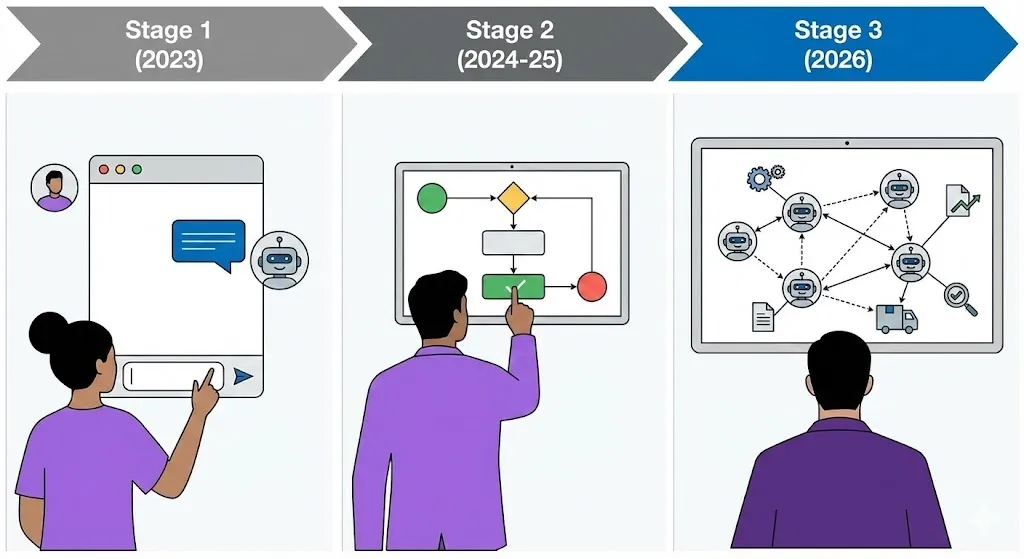 We no longer just talk to AI; we manage it. Agentic systems are autonomous software entities capable of planning, executing, and self-correcting complex workflows without constant human hand-holding. They don’t just write the marketing copy; they identify the target audience, buy the ad space, publish the campaign, and analyze the ROI. This shift has inverted the value of technical skills. As shown in recent market analyses, the demand for rote technical execution (syntax coding) is plateauing, while the demand for high-level oversight and complex system architecture is skyrocketing.
Skill Pillar 1: The New Technical Backbone — Orchestration Over Creation
When young professionals ask me today if they should learn C++ or Java to ensure their future, I tell them to study Agentic Orchestration. The ability to write syntax is becoming a commodity; the ability to direct digital labor is the new premium.

1. Management and Evaluation of Agentic AI Swarms
In 2026, being a “senior developer” or “project lead” often means managing a team of silicon workers rather than carbon ones. You need the skills to architect a solution where multiple specialized AI agents collaborate to solve a wicked problem. The core skill is setting rigid ethical boundaries, defining success metrics, and auditing the output of autonomous swarms to prevent “agent drift.” Companies are terrified of liability and pay a premium for humans who can prove they have these powerful systems under strict control.
2. Advanced Data Storytelling and Narrative Integration
Data analysis used to be a high-value skill. Today, an AI agent can clean and analyze a million-row spreadsheet in seconds. The bottleneck has moved from analysis to interpretation. The critical skill now is taking that AI-generated dashboard and translating it into a compelling narrative that a CEO can use to make a billion-dollar decision. You must bridge the gap between raw intelligence and human strategy.
3. Quantum-Ready Cybersecurity
As quantum computing pilot programs gain traction in late 2025, traditional encryption standards like RSA are showing cracks. You don’t need a Ph.D. in physics, but you must understand the fundamentals of “post-quantum cryptography.” The demand for security professionals who can shield data from both AI-driven social engineering and future quantum decryption is immense.
Skill Pillar 2: The Human Premium — Skills Machines Can’t Replicate
As the cost of artificial intelligence drops toward zero, the value of genuine human judgment, connection, and trust skyrockets. In 2026, the highest-paid skills are those that integrate technology with uniquely human traits.

1. Radical Cognitive Flexibility
The ability to unlearn what was vital yesterday and rapidly absorb what is necessary today is no longer an elective; it is survival. The tools change every quarter. The skill isn’t mastering the tool; the skill is the speed at which you can master new paradigms.
2. High-Fidelity Emotional Intelligence (EQ) and Negotiation
We are seeing a resurgence in high-paying roles that require zero coding but immense amounts of human empathy. Sales, high-stakes negotiation, and conflict resolution are premium skills. Why? Because when a $10 million B2B deal is on the line and something goes wrong, nobody wants to talk to an empathetic chatbot. They want a human who understands nuance, face-saving, and trust.
| Skill Category | 2026 Salary Premium vs. Average | The Human Requirement |
| High-Stakes Negotiation | +45% | Trust arbitrage in B2B deals. |
| Crisis Communication | +38% | Managing public perception when AI fails. |
| Elite Mentorship | +22% | Developing human talent and loyalty. |
| Rote Administration | -15% | Scheduling and basic data entry (Automated). |
Skill Pillar 3: The Green Economy — The Regulatory Growth Engine
If you want to know where the safe money is in 2026, look at global regulations. The “Green Economy” is no longer a PR side project. Thanks to strict global carbon taxation frameworks implemented around 2025, sustainability is now a central finance and operations issue.

1. ESG Reporting and Carbon Accounting
Just as every business needs a financial accountant to stop them from going broke, every business in 2026 needs a “Carbon Accountant” to stop them from getting taxed into oblivion. This is a prime area for high-income, remote-friendly work accessible through certification rather than four-year degrees.
2. Circular Supply Chain Management
The era of “Just-in-Time” efficiency is giving way to “Just-in-Case-Sustainable” resilience. Companies need experts who can redesign supply chains to be circular—reducing waste, reusing materials, and verifying ethical sourcing via blockchain.
The Definitive List: 14 High-ROI Skills for 2026-2030
Based on market analysis and salary trajectories, here is the consolidated list of skills that offer the highest return on investment in the current economy.
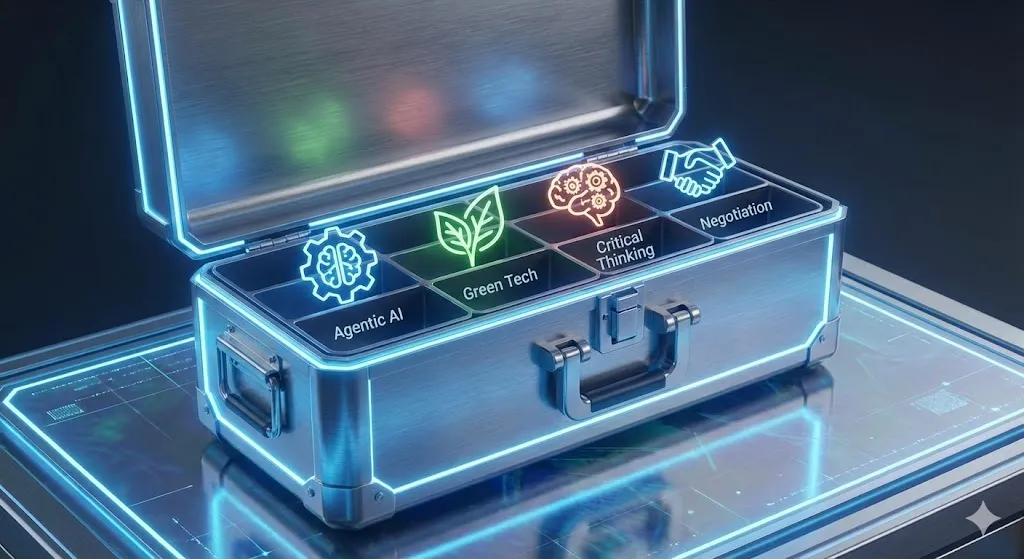
Agentic AI Supervision & Orchestration (The new technical leadership)
Prompt Engineering 2.0: System Architecture (Designing how AI thinks, not just asking it questions)
Green Tech Literacy & ESG Compliance (The regulatory must-have)
High-Stakes Human Negotiation (The trust premium)
Data Storytelling & Narrative Synthesis (Bridging AI analytics and human strategy)
Digital Ethics & Algorithmic Auditing (The “Human in the Loop” legal defense)
Spatial Computing UX (Designing for AR/VR interfaces, finally maturing post-2025)
Adaptive Critical Thinking & Meta-Learning (Learning how to learn)
Personal Brand Stewardship (Your verified human identity as a defensive moat against AI content)
Cybersecurity Awareness (Quantum & AI flavors) (Defense against spoofing and decryption)
Financial/DeFi Literacy (Bridging traditional finance with decentralized systems)
Supply Chain Resilience Planning (Circular economy logistics)
Biohacking & Personal Performance (Optimizing the human machine for longevity)
AI-Human Hybrid Content Strategy (Knowing which parts to automate and which parts require a human soul)
Real-World Reinvention: How Professionals Pivoted
These are not theoretical concepts. They are the lived reality of professionals who adapted before the wave crashed on them.
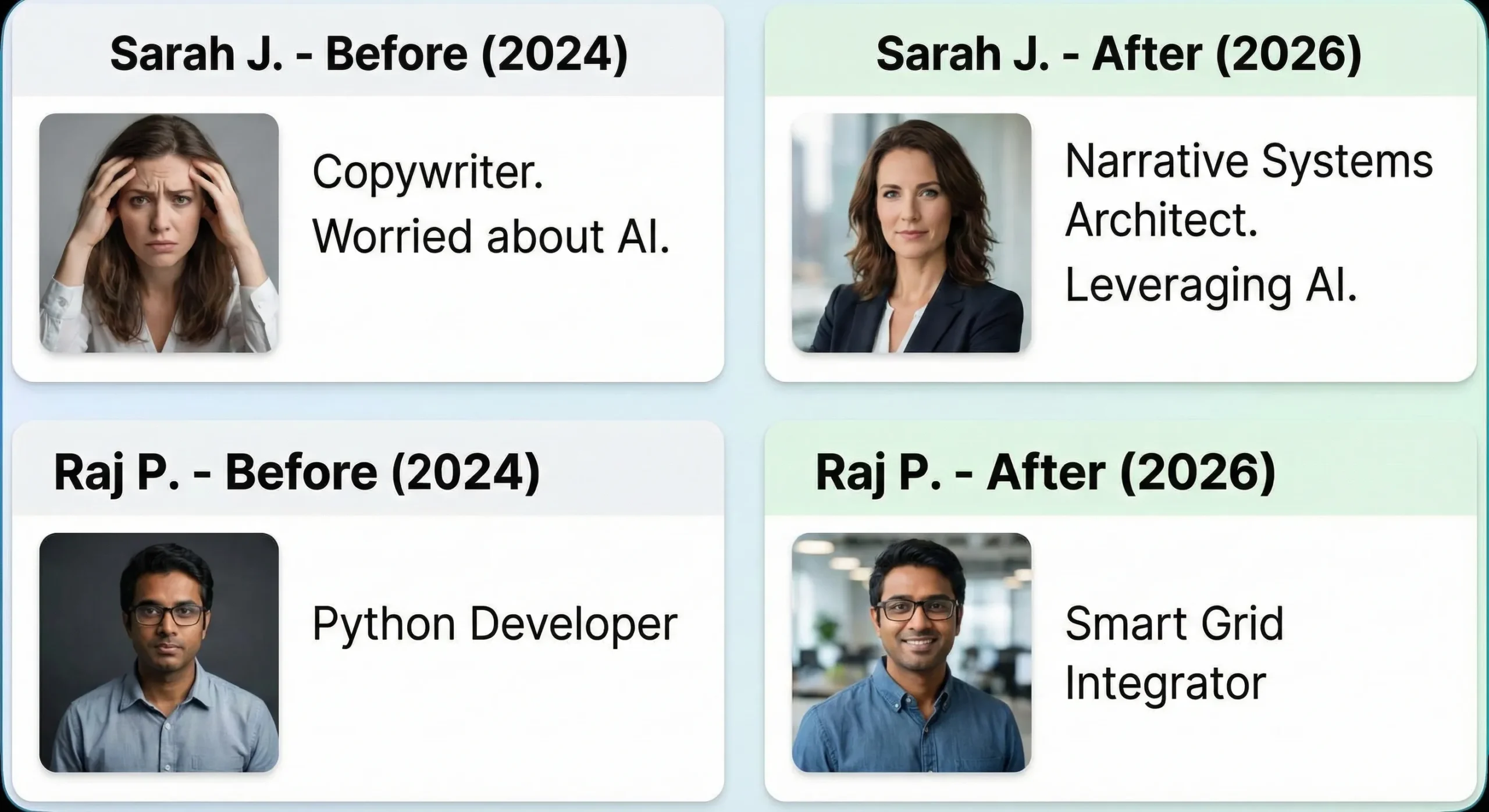
Case Study 1: The Creative Who Became an Architect
Sarah J., formerly a Copywriter.
The Crisis: By 2025, her freelance clients stopped paying for blog posts. AI could generate “good enough” copy instantly for free.
The Pivot: Sarah stopped writing and started architecting. She learned Agentic Workflows. Now, she builds bespoke “Brand Voice Engines” for clients—systems of agents that research, draft, edit, and publish content perfectly matched to the client’s tone.
The Outcome: She works fewer hours but charges $250/hr as a “Narrative Systems Architect.” She automated herself, then sold the machine.
Case Study 2: The Coder Who Went Green
Raj P., formerly a mid-level Python Developer.
The Crisis: Raj realized AI assistants were writing cleaner Python code faster than he could. He felt obsolete.
The Pivot: Living in India, he saw the massive government push for solar infrastructure. He took a three-month intensive certification in “Smart Grid IoT Integration.” He now focuses on the complex intersection of hardware and software, connecting massive solar arrays to the national grid.
The Outcome: He is in a high-demand, government-backed sector with job security for the next two decades.
FAQs
1. What skill will be most important in 2026?
AI literacy and orchestration is the most important skill to have. You can’t just use AI anymore; you also need to know how to direct, manage, and check the work of autonomous AI agents in a business workflow.
2. What skills will pay well in 2026 without a degree?
Sales and negotiating for high-priced items are still the best. Also, jobs like Carbon Accounting, AI Ethics Compliance, and Digital Content Strategy pay six figures and value portfolios and certifications more than college degrees.
3. Is it still a good idea to learn to code in 2026?
Yes, but the focus has shifted. “Rote coding” (syntax) isn’t as useful anymore because AI does it well. System Architecture and Debugging are now the most important skills. You need to know what to build and how to fix it when the AI makes a mistake.
4. What are the most important skills for 2030?
The path to 2030 puts the most important things first: Strategic Foresight, Emotional Intelligence, Sustainability Engineering, Knowledge of bio-tech, Advanced Robotics Management, Cyber-Physical Security, Cross-Cultural Competence, Cognitive Flexibility, Data Ethics, Designing a Virtual World, and Managing Energy.
5. How can I start learning these skills at home?
Use “Micro-learning” platforms like Coursera and specialised AI bootcamps. The only way to show that you are good at something in 2026 is to use it in real life.
Conclusion:
If you take only one thing from this guide, let it be this: The list of skills above is temporary. By 2028, this article will need another rewrite.
Therefore, the ultimate skill required for 2026 and beyond is Resilience grounded in Curiosity.
It is the ability to look at a constantly shifting landscape not with terror, but with interest. It is the mental fortitude to say, “Okay, the agents can do my old job now. Excellent. That frees me up to do something higher up the value chain.”
The future belongs to the curious. It belongs to those who view Agentic AI as a powerful partner rather than a replacement. It belongs to those who understand that in an increasingly digital and automated world, being uniquely, messily, strategically human is the ultimate competitive advantage.
Stay curious, stay human, and keep learning.