Introduction: The Best Free AI Tools for Beginners in 2025
The revolution of artificial intelligence is not coming anymore, but it is present, and more accessible than ever. The use of powerful AI tools that were formerly used only by tech giants and research institutions is now accessible to anyone with an internet connection in 2025. You are a student and need to be more productive, a professional and want to simplify your working process, or just want to know what AI can do. This detailed list is going to introduce you to the most useful free AI tools as a beginner in 2025.
Why the Year 2025 is Just the Right Moment to Start Using AI Tools.
The artificial intelligence environment has changed radically. The most promising aspect of 2025 as an amateur AI user is the combination of multiple factors: the enhanced user experiences, increased free plans, enhanced learning materials, and AI products that would have accessibility as a priority. In contrast to the AI tools that were complex and technical some years ago, current products focus on the user experience and do not need any knowledge of programming.
Firms such as Google, OpenAI, Anthropic, and others spent a lot of money in ensuring their AI-based technologies are available to regular users. The result? A gold rush of advanced applications that can assist you in writing better, researching quicker, and producing marvellous images, and automating routine duties- without investing a penny.
Introduction to AI Tools Categories: The Ideal Match.
However, first, it is important to know the various types of AI tools that exist before getting into more detail about them. This information will assist you in determining the tools that are suitable to your needs and objectives.
Classification of Free AI Tools by Distribution 2025.
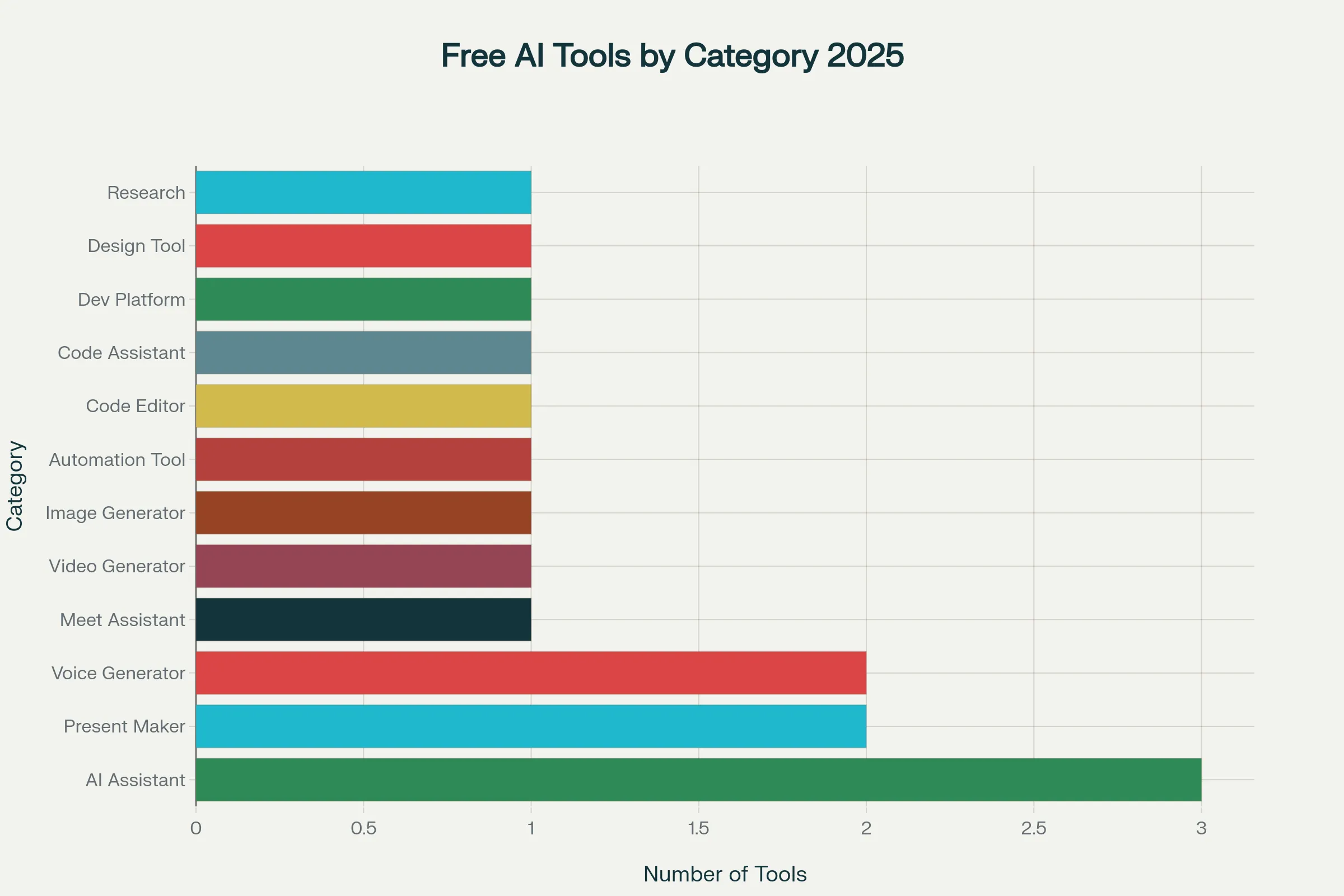
Distribution of Free AI Tools by Category in 2025
Artificial Intelligence Assistant: Your Virtual Friends.
Conversation AI assistants are now capable of aiding in a vast variety of tasks, such as answering questions, assisting with writing and solving problems. These presentations are usually the most optimal place to start when learning AI.
Imaginative Artificial Intelligence: Scratch Your Itch.
They consist of image generators, video creators, voice synthesizers, and design tools that can turn a plain text input into a professional-quality output.
Productivity Engines: Optimizing your Process.
These AI solutions are designed to help you be more productive in what you do every day; becoming the research assistant, the presentation maker, and the automation tool.
Developer Tools: AI-Assisted Coding.
These tools can assist anybody (even non-programmers) to learn how to code or develop simple applications with little technical expertise.
The Best Free AI Assistants to Start with.
1. ChatGPT: The Gateway to AI
Reasons why it is ideal as a first step: ChatGPT is the most beginner-friendly interface to the world of AI. Its natural conversational interface is natural and so can be easily experimented with and learnt.
Free features include:
Access to GPT-4o mini model
Internet search facilities for up-to-date information.
Analysis and generation of images.
Custom GPT creation (limited)
Mobile app access
Best use cases:
Editing and writing aid.
Conversational learning of new ideas.
Brainstorming and creativity.
Basic coding help
Travel reception and enquiry.
Handout tip: Begin with specific questions that are simple and not general. One example is that, rather than, “Help me write,” say, “Help me write a professional email to ask my manager to meet me.”
2. Claude: The Intelligent AI Helper.
What is special about it: Claude is an Anthropic creation that is geared towards safety and helpfulness, and he is a master of nuanced dialogues and moral arguments.
Free tier offerings:
Access to Claude 3 Haiku model
Multimedia abilities (text, pictures)
Longer conversation memory
Document analysis
Web app and mobile access
Ideal for:
Scholarly studies and writing.
Document summarization
Moral deliberations and argument.
Long-form content creation
Code review and explanation
3. Google Gemini: Real-Time Intelligence.
The strength: Gemini can use real-time information provided over the web, unlike other AI assistants, which makes it invaluable in current events and up-to-date research.
Free features:
Google integration services.
Real-time web access
Multimodal (text, images, video) inputs.
Google Workspace integration.
Mobile app availability
Perfect for:
Current events research
Planning of travel using real-time information.
Google workflow integration.
Checking of facts and verifying.
Market research
The tools of revolutionary research and learning.
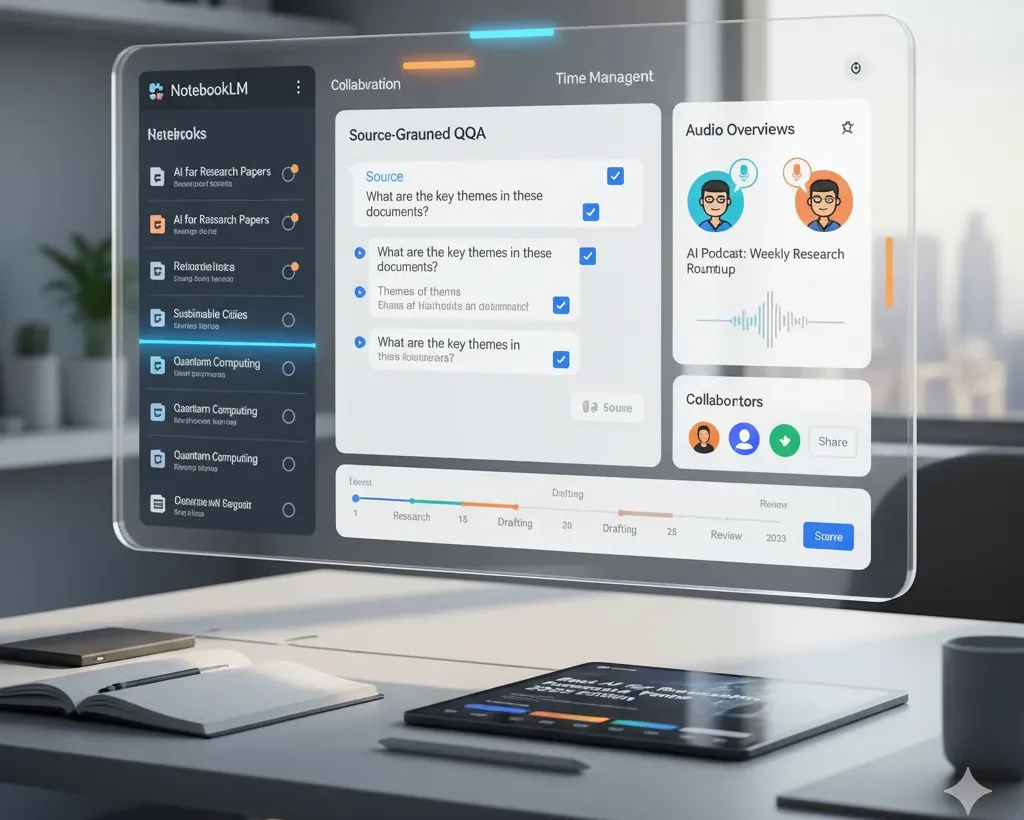
4. Google notebookLM Your AI Research Assistant.
Why it is game-changing: NotebookLM reinvents the interaction with documents and research materials. It does not rely on sources that it suggests to you and bases its answers solely on what you submit to it.
Free capabilities:
Add up to 50 sources on a single notebook.
Create unlimited notebooks
Create audio summaries (AI podcasts).
Document summarization
Source-grounded Q&A
Real-time collaboration
Revolutionary features:
Audio Overviews: The most efficient way to make your research interesting is to utilise these discussions as a podcast with AI hosts.
Source Grounding: All your answers will contain references to the uploaded documents.
Multimodal Support: PDF, Google Docs, web pages, videos and audio files.
Best practices:
 Begin with 3-5 good sources on your topic.
Ask certain questions relating to source relationships.
Watch audio previews to study complicated issues.
Make different notebooks in various projects.
5. Google AI Studio: Play With State-of-the-art Models.
To the would-be enthusiast: directly, AI Studio offers you access to the most recent AI models that Google has to offer, which means you can explore their more advanced capabilities without any technical limitations.
Free offerings:
Access to Gemini models
Code generation and export
Multimodal experimentation
Instructional customization of the systems.
API integration tutorials
Learning opportunities:
Knowing about timely engineering.
Testing various AI models.
The awareness of AI abilities and restrictions.
Developing rudimentary AI applications.
AI-Powered Creative Tools
6. Canva Magic Design: Instant Designs Professional.
Democratizing design: Magic Design: Magic Design is professional quality graphic design made available to anyone, whether artistic or not.
Free features:
10 generations of AI designing.
Thousands of templates are available.
Magic Write (AI copywriting)
Background removal
Brand kit creation
Creative possibilities:
Social media graphics
Infographics and presentations.
Logos and advertising materials.
Marketing materials
Educational content
7. Leonardo AI: Commercial Image Generator.
Freedom of art: Leonardo AI also has one of the most generous free options when it comes to AI image generation with 150 daily credits.
The free tier includes:
150 daily generation credits
Several models and styles of art.
High-resolution outputs
Commercial use rights
Community gallery access
Perfect for:
Blog post illustrations
Social media content
Concept art and ideation
Marketing visuals
Personal creative projects
8. ElevenLabs: Voice Generation: a Human-Like Interface.
The voice revolution: Turn text into unbelievable realistic speech with 10,000 characters/month free.
Free capabilities:
10,000 characters per month
Multiple voice options
Emotion and style control
Multiple languages
Commercial usage rights
Applications:
Podcast intros and outros
Narration of content of education.
Accessibility features
Content localization
Creative storytelling
Presentation and Communication Tools.
9. Gamma: Artificial Intelligence Presentations.
Presentation revolution: Intelligent design system: make professional presentations in minutes through Gamma.
Free tier benefits:
400 credits (sufficient to have 10 presentations)
Professional templates
Automated design optimisation.
Export to PDF and PowerPoint
Collaboration features
Use cases:
Academic presentations
Business pitches
Training materials
Portfolio showcases
Project reports
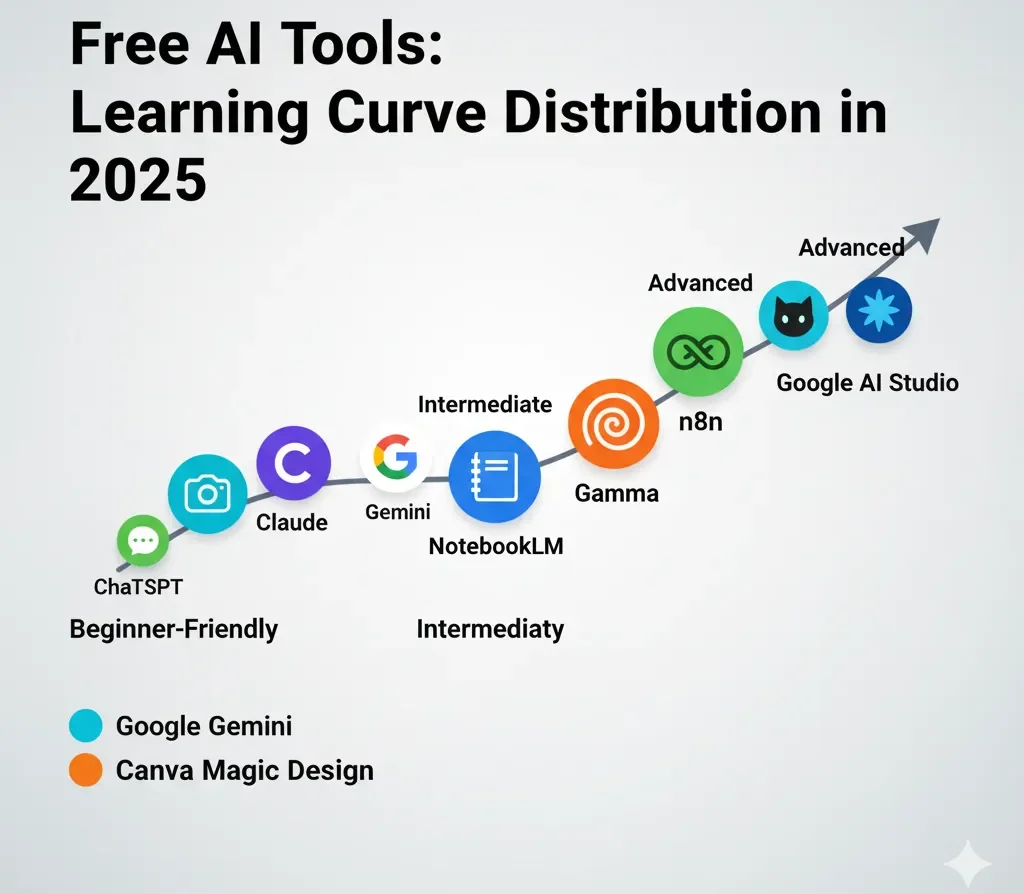
Free AI Tools: Learning Curve Distribution in 2025.
10. SlidesGo: Educational Focus
Most suitable to teachers and learners: SlidesGo provides educator-specific templates and tools to create educational materials.
Free features:
5 premium template uses
Educational-focused designs
Multiple export formats
Collaboration tools
Animation options
The development and automation tools are also called Automation Tools.
11. GitHub Copilot: Learn to Code with AI.
Free to students: One of the most powerful coding assistants is also made available to students who have confirmed academic email addresses.
Student benefits:
Full GitHub Copilot access
Support of major IDEs.
Suggestions and code completion.
Bug detection and fixes
Learning through examples
How to qualify:
Sign up for GitHub Education
Verify your student status
Native access to Copilot using IDE of choice.
12. Cursor: The Future of Coding
AI-first code editor: Cursor is an extension of VS Code that is powered by strong AI capabilities and is the future of programming.
Free for students:
One year of Cursor Pro
AI code completion
Chat with your codebase
Multi-file editing
Agent mode for complex tasks
Why it’s beginner-friendly:
Familiar VS Code interface
NLP programming Natural language programming
Contextual AI assistance
Interactive learning.
This is founded on the principle of meeting and productivity tools.
13. Fathom: Never miss meeting details.
Meeting intelligence: Automatic recording, transcribing, and summarising your meetings using AI-powered insights.
Free features:
Infinite recording on meetings.
AI-generated summaries
Action item extraction
Integration to reputed platforms.
Searchable transcripts
14. n8n: Workflow Automation
Advanced beginners: Although it is more complex to operate, n8n provides the workflow automation with 5,000 free executions each month.
Automation possibilities:
Social media posting
Email marketing workflows
Data synchronization
Content aggregation
Notification systems
Introduction to AI: My First Steps with Artificial Intelligence.
Week 1: Foundation Building
Day 1-2: Register with ChatGPT and have a few conversations.
Day 3-4: Research in Google NotebookLM.
Day 5-7: Check Canva Magic Design where basic graphics are made.
Week 2: Expanding Horizons
Day 8-10: Gamma experiment to create a presentation.
Day 11-12: Problem with Leonardo AI to generate images.
Day 13-14: Use ElevenLabs to create a voice.
Week 4: Diversification and Production Factor.
Day 15-17: Attend to tools that are of interest to you or your profession.
Day 18-20: Acquire techniques of prompt engineering.
Day 21: assess the most valuable tools.
Week 4: Advanced Applications
Day 22-24: Team up using a number of tools to work on complicated projects.
Day 25-27: API integrations and automation.
Day 28: Design your future AI tool strategy.
Best Practices for AI Tool Success.
Fast Track Engineering Essentials.
Make it specific and situational. It is best not to write a blog post, but rather a 500-word blog post about sustainable gardening of urban apartment residents, in which you emphasise a specific idea of small space practical tips.
Test and improve: AI technology is most effective over dialogue. Do not hope the best results the first time you make a request-optimize your requests depending on the early results.
Give examples, where you can give the AI what you want and how you want this by providing examples of what you seek or references to existing work.
Ethical Considerations
Honour copyright and attribution: Never use without permission and always check the terms of service use and make proper attribution where necessary.
Keep human control: AI solutions are support systems rather than substitutes of human judgment and creativity.
Guard privacy: Be very careful when providing sensitive data to AI applications, particularly those ones that archive conversations.
Productivity Optimization
Keep small: That is, you can start with small tasks and as you get accustomed to it, you can keep adding complexity.
Establish templates: Build templates and workflows to use on an ongoing basis.
Monitor your time savings: Keep the track of AI tools effect on your productivity to vindicate the time spent on studying them.
Time management: How to beat the beginners.
“I Don’t Know Where to Start”
Solution: Start with ChatGPT due to its generalised help and extend to your particular needs. The beginners begin with a single tool in each category.
The Results Aren’t what I Expected.
Recommendation: AI technologies need practice and experimentation. Take time to study prompt engineering and do not be disappointed at the first results.
“There Are Too Many Options”
Resolution: First, concentrate on 3-5 tools. Grasp these prior to adding to your repertoire of tools. It is quality, not quantity, that results in better.
I am Worried About Becoming Too Dependent.
Solution: Find uses of AI tools to complement and not to substitute your security. Keep the capability of working without the help of AI.
Making Your AI Knowledge Future-Proof.
Stay Updated
AI tools evolve rapidly. Subscribe to official blogs, subscribe to communities, and actively use new functions of the preferred tools.
Build Transferable Skills
Not memorising interfaces of particular AI tools but mastering concepts of learning (prompt engineering, workflow design) that will work with various AI tools.
Network with Other Users
Find Discord groups, SubReddits, and local gatherings to share experiences with other users of the AI tools and find new uses.
Experiment Regularly
Take the time to learn new features or tools every week. The field of AI is dynamic, and an early adopter can usually gain competitive benefits.
The Economic Impact: Versatile Investment of Time and Money.
The tools discussed in this guide have the potential to be very valuable:
Writing support: Save 2-3 hours a week on writing material.
Productivity of research: Halve or cut research time with such tools as NotebookLM.
Design work: There is no need to purchase costly design software or hire freelancers.
Voice production: Don’t pay too much money for a voice-over.
Coding support: Fast-track development and learning.
Free solutions are estimated to save beginners up to 200-500 monthly, than conventional solutions, with a significant boost in output quality.
Future Prospect: AI Tools by the end of 2025.
Emerging Developments
Multimodal integration: Multimodal tools that can conveniently manipulate text, images, audio and video.
Better customisation: Intelligence that gets to know you.
Improved collaboration: Improved team functionality and real-time working.
Mobile optimisation: Stronger mobile applications that are fully desktop.
Your AI Journey Starts Now
Yet, the opportunities provided by the world of AI tools in 2025 are unprecedented in terms of learning opportunities, creativity and productivity, without any financial constraints. The instruments discussed in this guide are only the tip of the iceberg of what you can achieve when you start treating AI as a companion, and not a substitute for human ingenuity.
It is important to remember that an ideal AI tool is the one you use regularly. Begin with one or two tools that are required at a particular time, master them, then slowly increase your repertoire. The learning curve may appear very steep at first, but the productivity benefits and creativity options justify the investment.
Be it a student who wants to excel in his/her Education, an employee who wants to enhance his/her power, or a mere individual who wants to know more about AI, all that you need to begin with AI in 2025 is provided by the following free tools.
Are you willing to change your workflow using AI? Choose one of these tools in this guide and use it now. Your future, more productive self will appreciate you.
FAQ’s
Q1: Do these AI tools require technical skills to be effective?
A: Absolutely not! The tools used in this guide are specifically selected due to their friendly interfaces to beginners. Though certain software, such as GitHub Copilot or n8n are more challenging to pick up, the majority of such software does not demand any technical expertise. The trick is that one should begin with conversational AI assistants such as ChatGPT or Claude, and they sound like a learned friend.
Q2: Are these free AI tools as free as they seem, or are they associated with some costs?
A: These tools have truly free levels with high levels of functionality. Most of the paid upgrades are available but with the free versions you can do a lot. In the case of ChatGPT, the free version comes with the GPT-4o mini access, NotebookLM can be fully free at the beta stage, and Canva provides 10 lifetime AI generations. Each tool has specific terms that should always be reviewed to know limitations.
Q3: What do I do to understand what AI tool is the most appropriate to my needs?
A: First, determine your most case usage: writing (ChatGPT, Claude), research (NotebookLM), design (Canva Magic Design), or presentations (Gamma). The majority of beginners can start with one AI assistant to perform general tasks and add specific tools when the need arises. The table of data provided in this article could assist you in the process of matching tools to your needs.
Q4: Do I think AI tools will reduce my creativity and skill?
A: AI tools increase and not eliminate human creativity and skills when used correctly. They can only be considered as cooperative colleagues who complete ordinary chores so that you can concentrate on the creative and strategic work that is of high level. The trick is to keep moving and AI should be viewed as a beginning instead of an endpoint.
Q5: Which are the ways I can keep up with the fast-evolving AI tools?
A: Subscribe to the official blogs and social media profiles of your selected tools, participate in corresponding communities in Reddit (r/ChatGPT, r/artificial), and pay a subscription to artificial intelligence newsletters such as The Batch or AI Breakfast. In addition to that, most of the tools have active Discord communities where users give tips and updates. Spending 30 minutes per week learning the new features is a guarantee that you are up to date.


Pingback: How to Use ChatGPT for Your Job: Game Changing Prompts for Marketers, Writers, and Developers - Bing Info
Pingback: AI for Music and Audio in 2025 : The Ultimate Guide Composing Songs and Cloning Voices - Bing Info
Pingback: 11 Real Business Applications and ROI of Generative AI - Bing Info