
Introduction To AI and Personalization:-
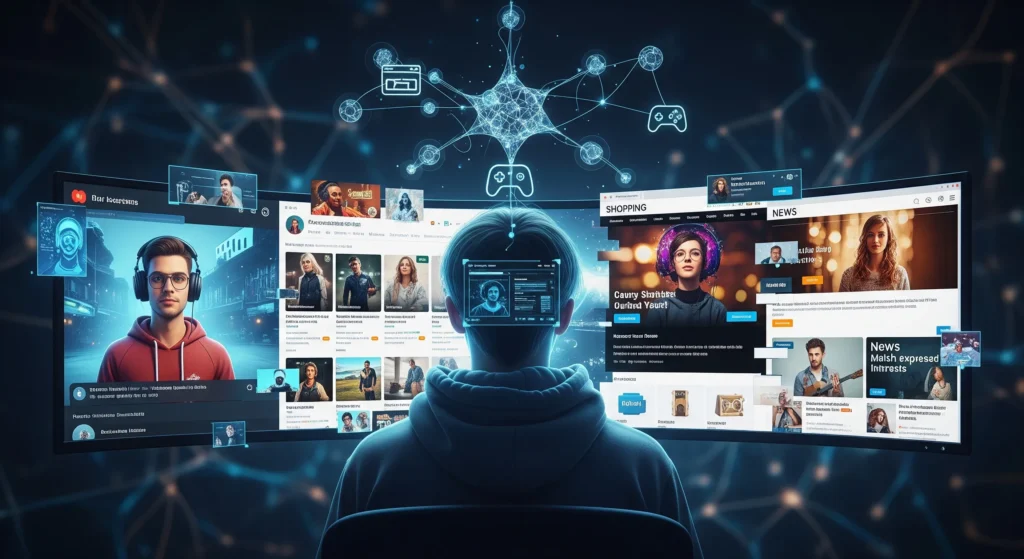
Imagine this: You open your favorite game, and the world within it isn’t randomly generated—it’s crafted specifically for you. The enemies are aware of your strategies. The story shifts based on your decisions. Even the difficulty adjusts to ensure you’re never bored. Then you hop onto a website, and it doesn’t resemble anyone else’s. The colours, products, and content morph as the site discerns your preferences, what you’ve engaged with, and perhaps even your current mood.
Sounds like science fiction, right? What if it’s already happening?
Personalization, powered by AI, is revolutionising how we interact with the digital world. From Netflix instinctively knowing your next binge-watch to video games evolving with your playstyle, we’re entering an era where systems learn from every click, pause, and interaction. The critical question, however, is whether this is the future where all websites and games become entirely individualised. And if so, what does that mean for us?
Let’s dive into how AI is making all this possible, why it’s so impactful, and whether we should be excited or a little apprehensive.
Why Personalization Is Taking Over
First, why is everyone so obsessed with personalization? The answer is simple: it works. And we’re not talking about a slight uptick in engagement. The numbers tell a compelling story.
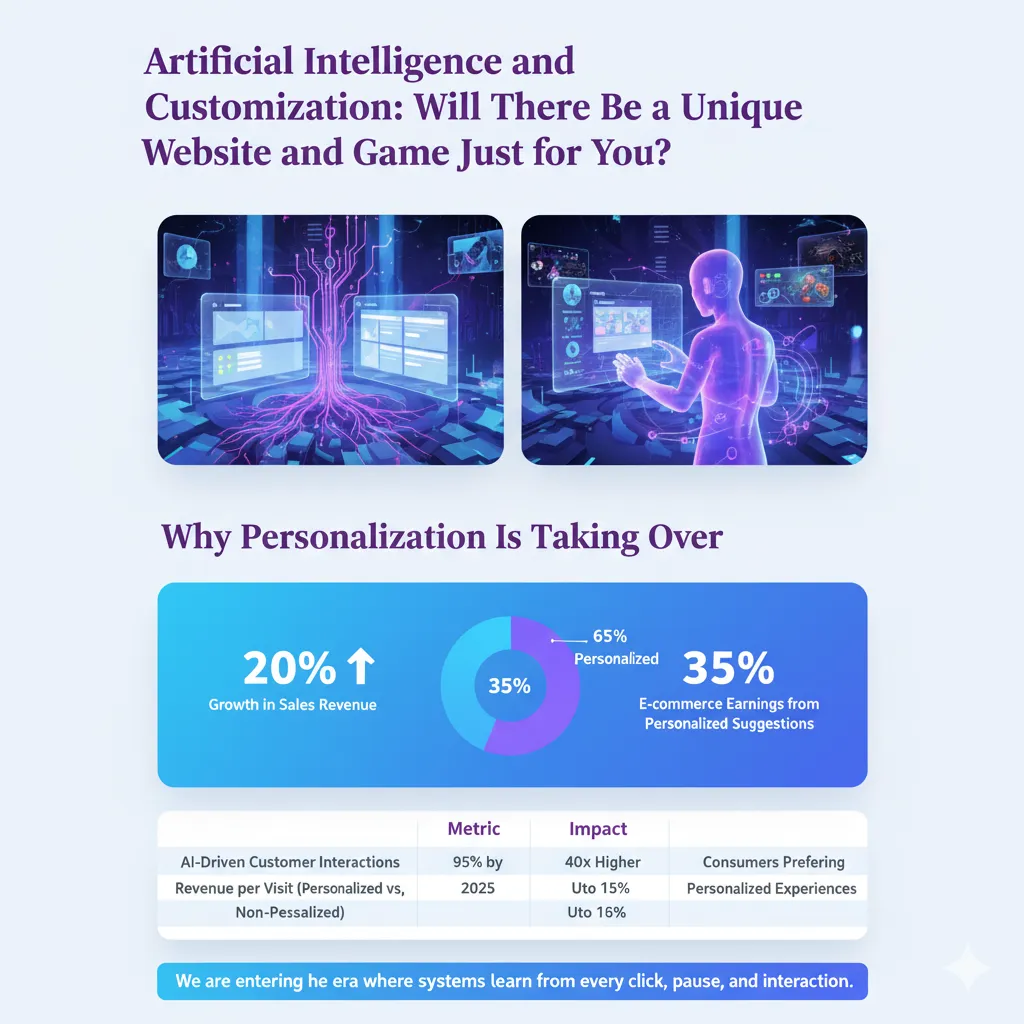
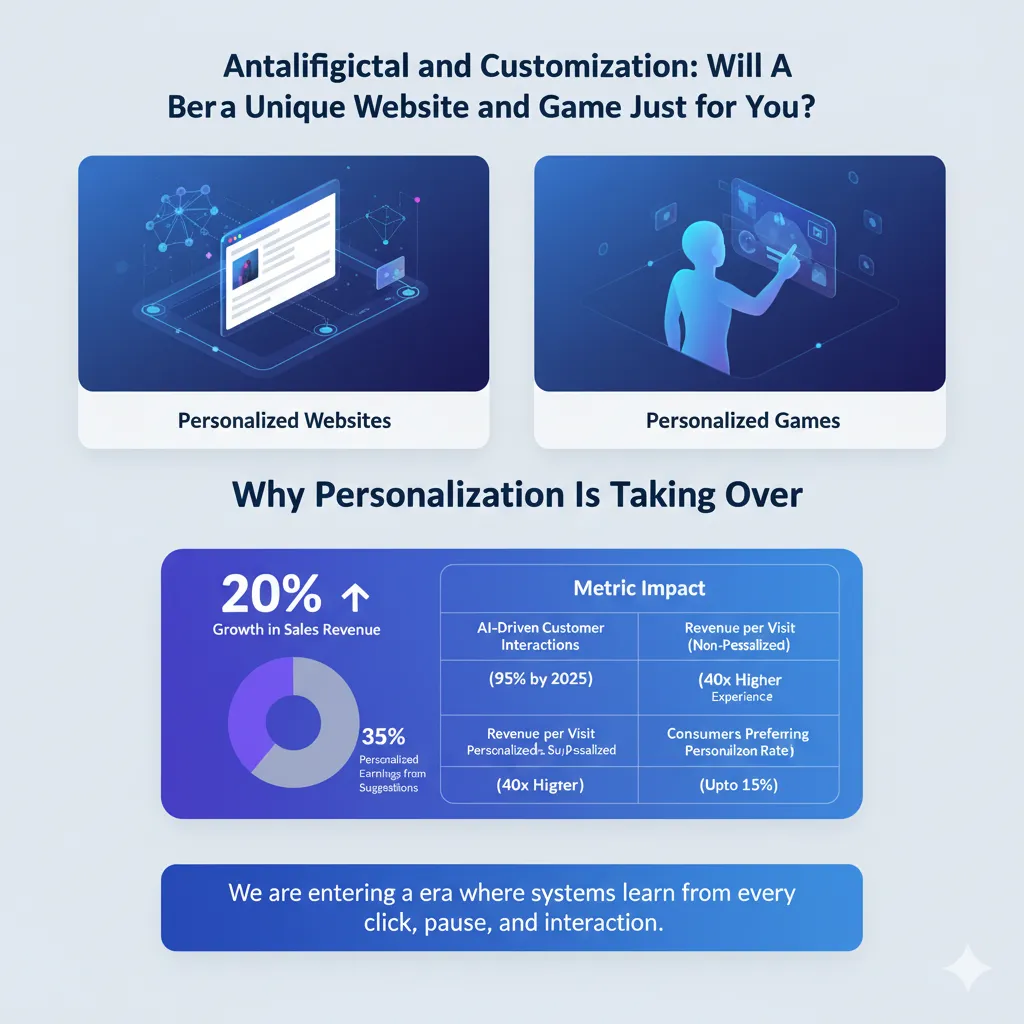
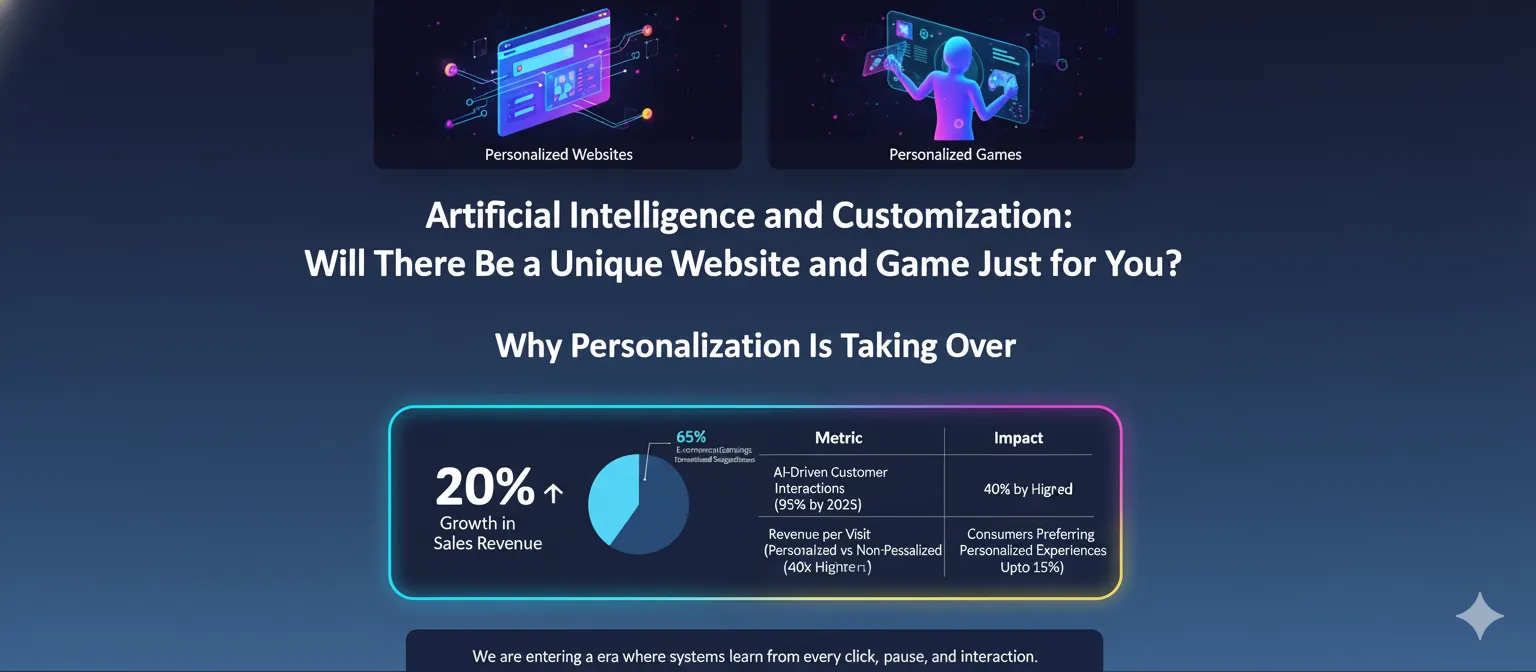
Companies leveraging AI-driven personalization report an average 20% growth in sales revenue. Individualized product recommendations now account for 35% of all e-commerce earnings. Think about that: one-third of your online shopping experiences are the result of an intelligent algorithm suggesting something you genuinely wanted. That’s not coincidental—that’s AI learning your online persona and making informed predictions about what you’ll love.
It’s more than just selling products. AI is projected to drive 95% of all customer interactions by 2025. We’re in an era where personalized websites generate 40 times more revenue per visit than non-personalized ones. Conversion rates can increase by up to 15% as AI subtly adjusts content, offers, and calls-to-action based on who’s viewing.
The ultimate twist is that 80% of consumers are more inclined to purchase from brands that offer personalized AI experiences. Businesses aren’t just willing to personalize; as consumers, we now demand it. Visiting a site that treats you as just another random visitor feels archaic. Netflix, Spotify, and Amazon have set the standard, and we expect that tailored experience everywhere.
The Personalizing of Websites
So, how are websites becoming a one-on-one affair? It works its magic through concepts like adaptive content and real-time personalization.
Think of adaptive content as a chameleon. The website’s “colors” shift, both literally and figuratively, depending on who’s viewing it. It’s not just about showing different products to different people. It involves tweaking headlines, images, layouts, CTAs (those “buy now” buttons), and even the subtle tone of the text. All of this happens in a flash, as you scroll.
The essence of real-time content adaptation is interpreting user behavior in the moment. If you linger on a particular product, the site takes notice. It might display different content if you visit late at night compared to midday. Secret Escapes, a travel company, exemplifies this brilliantly. If you search for “spa retreats” and click their ad, you’re directed to a spa-oriented page, not a generic travel deals page. This strategy led to a 26% increase in sign-ups.
Then there’s the data component. Websites collect data about your IP address (your location), cookies (your past visits and preferences), and your on-site behavior (how long you spend on pages, how far you scroll, what you click). All this data is fed into AI within milliseconds, determining which version of the site you should see.
Some businesses are pushing this to incredible extremes. AI platforms like Fibr AI can generate thousands of 1:1 personalized landing pages at scale. Imagine an ad campaign where every single person who clicks sees a completely different page, custom-designed to match them. This isn’t the future; this is happening today.
Playing Games Goes Personal (And Freaky Smart)
If websites are going personal, games are taking it to a whole new level. The role of AI in games has moved beyond enhanced graphics and smarter enemies. It’s about crafting experiences that literally evolve with you as a unique player.
Dynamic Difficulty Adjustment
Ever felt like some games get harder or easier when you’re doing well? That’s Dynamic Difficulty Adjustment (DDA) at work. Games like “Resident Evil 4” use this to track your performance in real-time. If you’re breezing through levels, the game cranks up the difficulty—more enemies, tougher battles, fewer resources. Struggling? The game might ease up a bit to keep you from getting frustrated.
This concept is pushed even further with the AI Director system in “Left 4 Dead.” This isn’t just difficulty adjustment; it orchestrates the entire pace of the game. It decides when to unleash hordes of zombies, where to place health packs, and how aggressive each encounter should be. The result? No two playthroughs are ever alike, keeping you on the edge of your seat.
In “Crash Bandicoot,” adaptive level design literally modifies level layouts based on whether you keep dying at a certain point. Fail too many times? The game might introduce extra checkpoints or reduce obstacles. Crushing it? Be ready for additional challenges.
Procedural Content Generation
Next up is procedural generation—where AI conjures worlds, levels, and storylines on the fly. The most famous example is probably “No Man’s Sky.” The game boasts billions of unique planets, each with diverse ecosystems, creatures, and challenges, all generated by AI algorithms. You could play for years and never encounter the same planet twice.
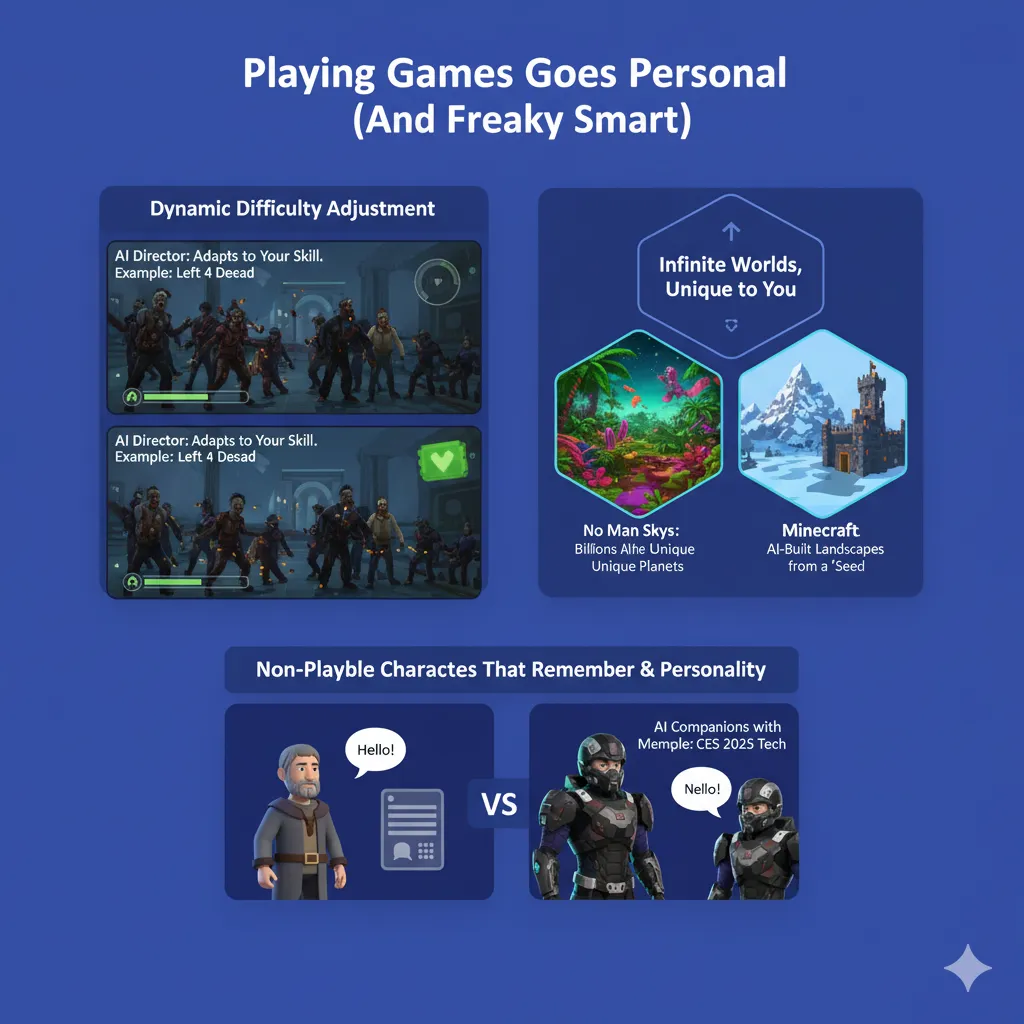
“Minecraft” operates on a similar principle. Every world starts with a “seed” (a random number), and AI uses this to generate the terrain, caves, biomes, and structures. The amazing part is that two players with the same seed will get virtually identical worlds, but change one number, and you’ll have something entirely different. It’s as if the game has an infinity of universes encoded within it, and AI is the key to unlocking them.
This path extends even further into the near future. Games are being developed where AI will generate content as you play and interact. Imagine traversing a game world where new locations, characters, and plot points are created in real-time based on your actions, not simply randomly, but intelligently responding to your presence.
Non-playable Characters That Remember You
In the past, NPCs (non-player characters) were often rather dim. They’d repeat the same three lines, bump into walls, and forget you existed the moment you left their vicinity. Not anymore.
NVIDIA’s ACE technology, showcased at CES 2025, is a game-changer. These AI-powered characters remember every interaction you’ve had with them. They infer your actions, your decision-making style, and even your emotional responses. In team-based games, AI companions will call you out for careless decisions, adjust their tactics to suit your playstyle, and might even develop a preference for you as a leader.
Actual conversations with these characters become possible, not by choosing from dialogue options, but by speaking naturally about anything. Feel like debating philosophy with a virtual friend? Go for it. Want to randomly question an NPC about their opinion of the game world? They’ll provide real, context-sensitive responses.
Real-World Success Stories
Now, let’s look at some companies that are absolutely crushing it with personalization.
Spotify Wrapped
Every December, the internet overflows with people sharing their Spotify Wrapped. It’s become a cultural phenomenon. But why does it work so well?
Spotify analyzes your entire year of listening—not just what songs you heard, but how and when you listened, how many artists you discovered, and even gives you fun persona titles like “Pop Princess” or “Nostalgic Nomad.” The genius lies in Spotify taking data (which can be dry) and transforming it into a highly shareable, deeply personal experience.
The result? In 2024, 2.2 million people were actively talking about their excitement for Wrapped almost two weeks before its release. That’s not paid advertising; that’s organic hype generated through personalization done right.
Spotify’s success offers a clear lesson: personalization works best when it makes users feel seen and understood. It’s not just about recommending the next song; it’s about reflecting who they are through the music they choose.
Netflix Recommendations
Netflix doesn’t just recommend shows; it anticipates what you’ll want to watch before you even realize you want to watch it. The platform collects vast amounts of data: viewing history, ratings, search queries, browsing patterns, even the time of day you watch content.
Using collaborative filtering and matrix factorization methods, Netflix analyzes patterns across millions of users. If User A and User B share similar tastes, content enjoyed by User A is recommended to User B. The system also employs item-based filtering, bundling together shows that are frequently watched together.
A Netflix study found that AI-generated recommendations increased viewing accuracy by up to 10%. VWO research indicates that AI video recommendations can boost engagement by 60%. This is why Netflix seems to “just get you”—because, in a very literal sense, it does.
The Amazon Recommendation Engine
Amazon pioneered the concept of collaborative filtering back in 2003, earning an IEEE award for it. Their A10 algorithm is now one of the most sophisticated recommendation systems in existence.
Amazon’s system examines product metadata, user engagement data (click-through rates, conversion rates, session time), and user behavior to predict what you’ll purchase next. This is why, when you look at a laptop, Amazon will suggest relevant and compatible accessories, an extended warranty, and other “frequently bought together” items.
The system relies on both content-based and collaborative filtering (recommending things you’ll like based on what you’ve already liked, as well as based on the purchasing patterns of millions of other users). This two-pronged approach ensures Amazon can suggest even complex products without needing a specialist to understand every item in their catalog.
The Dark Side: Privacy, Ethics, and Filter Bubbles
Okay, AI customization sounds amazing, right? Perfectly tailored websites and games. But hold on, there’s a dark side we need to address.
Privacy Concerns
AI personalization requires data. Lots of it. And that brings up some serious privacy issues.
Laws like GDPR mandate that companies disclose how they collect and use personal data. This includes clear consent, data minimization (only collecting what’s necessary), and allowing users to access, delete, or port their data. The challenge? Many AI systems are “black boxes”—you don’t always know how decisions are made or what information is being processed.
Unauthorized data usage is a massive concern. Many AI technologies utilize personal information without users’ explicit knowledge or agreement. This can lead to privacy invasion, unwanted advertising, unsolicited profiling, and even identity theft.
Key privacy concerns include the use of biometric data for collection, pervasive surveillance, algorithmic bias, and large-scale data breaches affecting millions. The increasing use of granular behavioral data must be balanced with respect for consumer privacy and rights.
Filter Bubbles and Echo Chambers
This is where personalization gets particularly tricky: filter bubbles.
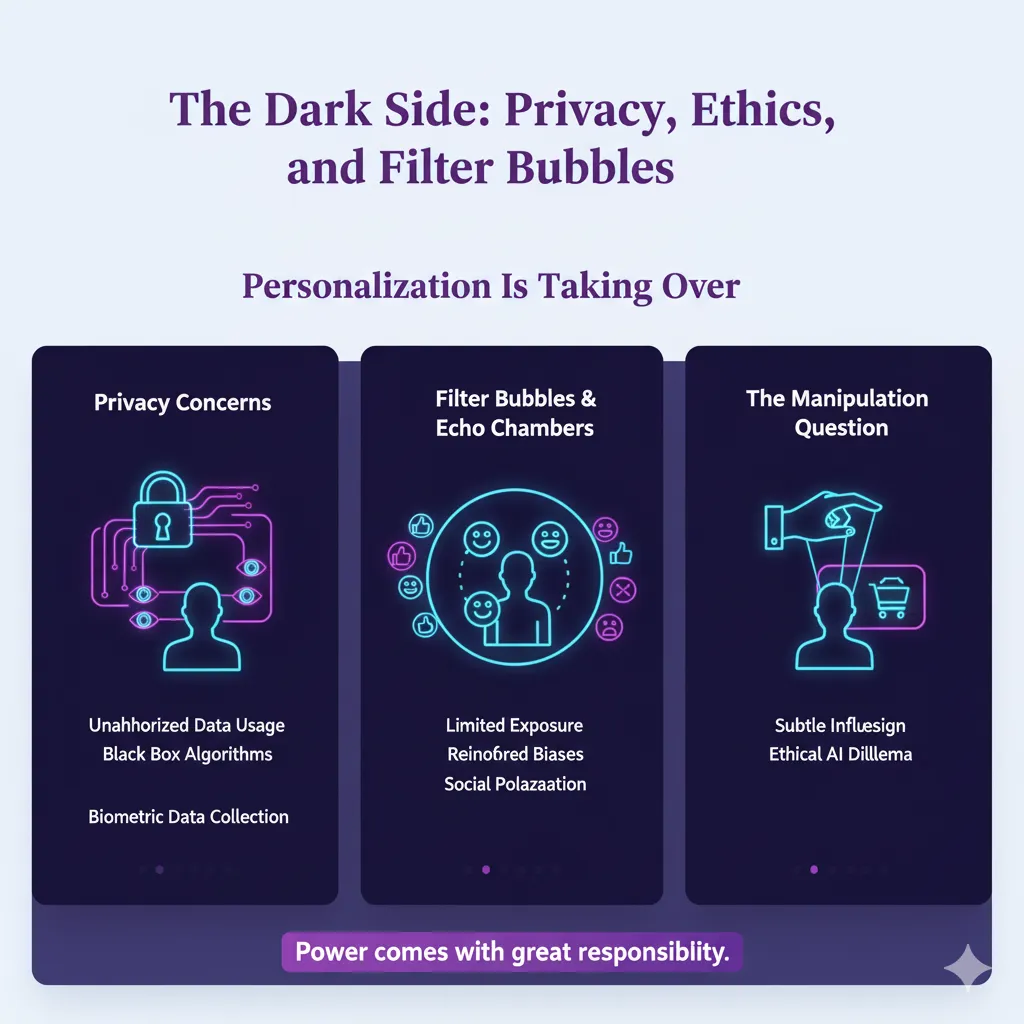
If AI only shows you content based on what you’ve already liked, you end up in an echo chamber. You only see opinions that confirm your existing beliefs and rarely encounter dissenting viewpoints. This isn’t just annoying; it can be incredibly damaging to democracy and social discourse.
Mark Zuckerberg himself has voiced concerns about information polarization, as has Eli Pariser, who literally wrote the book “The Filter Bubble.” When everything you see online reinforces what you already think, you lose the ability to form a nuanced understanding of the world.
Excessive content customization leads to limited exposure to diverse content, creating echo chambers that reinforce existing biases. This means consumers are only presented with information similar to their own, which may create an illusion of agreement within a group—even when that agreement doesn’t reflect reality.
The Manipulation Question
Then there’s the issue of manipulation. AI can subtly influence consumer behavior in ways that can feel manipulative rather than helpful. It doesn’t take long for algorithms to learn which buttons to push to keep you clicking, buying, and engaged. At what point do algorithms cross the line from helpful personalization to psychological manipulation?
To avoid manipulative behavior, brands must establish transparency, provide users with control over their data, and create ethical AI guidelines. Without these safeguards, the line between personalized and creepy can quickly blur.
Control What Can (and Should) Be
Despite these concerns, it’s not all doom and gloom. The most effective implementations of personalization empower users with control.
Customization puts the power in your hands. Reddit, for example, allows you to customize your “Feed Settings” to select what you want to see (or not). During sign-up, Reddit asks, “What are you into?” and personalizes your initial feed. You are actively involved in crafting your experience rather than being automatically categorized.
Spotify allows users to opt out of certain personalization features. Another way to customize recommendations is by “liking” and “disliking” songs to train the algorithm to your preferences.
The key distinction: customization puts power in the user’s hands, while personalization puts it in the site’s hands. The most enjoyable experiences involve a blend of both, where AI does the heavy lifting but leaves users the freedom to adjust, override, or decline when they wish.
The Future: Where Are We Going With This?
So, what’s next? What does the future of personalization look like?
Personalization in the coming years will move beyond simply recommending products because you bought a similar one. We’re looking at real-time, hyper-personalized experiences, curated by signals across social media, wearables, smart home devices, and even biometric data.
Websites will become dynamic entities, serving the specific context of each visitor. Imagine a site that adapts to your local weather, your mood (inferred from interaction patterns), your location, and your purchasing habits. The layout, colors, messaging, and products all shift for you. With massive AI systems crunching huge databases, they’ll be able to create a truly one-of-a-kind experience for every visitor.
In gaming, fully procedural games will become a reality, where AI not only generates content but entire game systems, mechanics, and rules based on your specifications. Instead of playing games developed months ago, you’ll be playing games that are being made for you, live, and constantly evolving based on your interests and skill level.
The global AI in games market is projected to grow to $27.47 billion by 2029. By then, AI will be an inherent part of every aspect of game creation—helping games become more alive, unpredictable, and personal than ever before.
VR and AR experiences will become far more intelligent and immersive. Instead of manually developing every detail, AI will automatically generate environments with stunning detail and consistency, customizing them to a user’s behavior.
The Human Factor: The AI and Creativity Balance
Here’s one thing we can’t overlook: AI personalization is powerful, but it has boundaries.
Human creativity brings emotional intelligence, the ability to make “beautiful mistakes,” and the capacity to perceive context and subtext that AI simply cannot replicate. Our emotions, personal experiences, and the societies we live in all influence creative thought in ways AI lacks.
A threat of over-reliance on AI is homogenization. A recent study found that while generative AI helps individual stories become more creative (especially for less creative writers), AI-generated stories are more alike than human-only generated stories. We gain individual creative power at the cost of collective innovation.
The best personalization uses AI to do the heavy lifting while ensuring humans remain squarely in the creative driver’s seat. AI can automate data analysis, automation, and optimization of experiences, but the emotional, strategic, and storytelling elements remain under human control.
Will all Websites and Games Be Unique?
So, back to our initial question: Will every website and game be unique to you?
The honest answer? We’re already pretty close.
Websites can now offer personalized landing pages at scale, real-time content adjustments, and custom experiences tailored to individual preferences. Games are adaptive, procedurally generated, and feature AI characters with memory that learns how you play. The technology is here; it’s just a matter of scale and responsible implementation.
However, “unique” doesn’t automatically mean “better.” Personalization must be implemented thoughtfully. This involves transparency about data usage, giving users control over their experiences, adhering to privacy regulations, and providing experiences that aren’t manipulative.
The future we’re building is one where AI and personalization are ubiquitous. Websites that flex and reshape themselves. Games that evolve with your playstyle. Entire digital experiences designed explicitly for you.
Will it be perfect? Probably not. The concerns about privacy, filter bubbles, and the loss of serendipity are genuine. But if businesses focus on ethical practices, transparent data use, and user control, we could be headed toward a digital world that is more engaging, helpful, and genuinely useful than anything we’ve experienced before.
The trick is striking the right balance: leveraging AI’s capabilities to make things personal while still respecting what makes us human: our privacy, our autonomy, and our need for genuine connection.
Wrapping It Up
AI and personalization are reshaping the digital world in ways that seemed impossible just a few years ago. We’re living in an era where every click, every pause, every interaction feeds into a system that learns about us and becomes more us. Websites become reflections of our tastes. Games become playgrounds molded by how we play.
The statistics don’t lie—personalization works. Businesses see massive returns. Users report higher satisfaction. When experiences are custom-made instead of generic, engagement skyrockets.
But with great power comes great responsibility (we had to go there). The companies building these systems have a duty to do so ethically. That means transparency, user control, privacy protection, and avoiding the trap of manipulative design.
So, yes, every website and game can be unique to you. The technology is here. The question isn’t whether we can do it, but whether we should. And if the answer is yes, then how do we do it in a way that respects users, protects privacy, and makes the digital world a better place for everyone?
That’s what we’re building, one customized experience at a time.
Call to Action
How do you feel about AI personalization? Are you excited about websites and games that customize to you, or do you find it a bit too intrusive? Have you noticed personalization at work in your favorite apps or games? Share your thoughts in the comments below, and let’s discuss where we’re all headed! And if you found this post insightful, share it with a friend interested in the future of AI and personalization!
FAQs
1. What is AI personalization and what makes it unique?
AI personalization is a type of artificial intelligence that analyzes user behavior, preferences, and data trends to create unique, tailored experiences for individuals. What makes it unique is its ability to process vast amounts of data on the fly and make intelligent predictions about what users desire before they even realize it themselves. Unlike traditional systems that treat everyone uniformly, AI personalization is dynamic and adaptive, creating an evolving experience that improves as it learns.
2. How does AI apply to personalization?
To personalize experiences, AI utilizes techniques such as collaborative filtering, content-based filtering, machine learning, and natural language processing. It examines browsing history, purchase behavior, clicks, page views, location data, and device information to build comprehensive user profiles. It then serves customized content, product recommendations, dynamic pricing, automatically adjusts game difficulty, and modifies content to personal tastes in real-time.
3. What does personalization mean in gaming?
In gaming, personalization refers to the customization of the gameplay experience to suit individual players’ preferences, skill levels, and behaviors. This includes dynamic difficulty adjustment, which modifies a game’s challenge in real-time; procedural content generation, which creates unique worlds for each player; AI-powered NPCs that remember past interactions and respond to your playstyle; and customized narratives that branch based on your decisions. The goal is to ensure that every gaming session is exclusive to the player.
4. Can AI create a game for me?
Yes, AI is becoming increasingly capable of creating games customized to individual players through procedural content generation and adaptive systems. Modern AI can generate new levels, evolving storylines, challenges tailored to your skill level, and even entire gameplay systems that react to your preferences. Games like “No Man’s Sky” and “Minecraft” already leverage AI to create billions of unique worlds. The trend is moving toward fully procedural games where AI generates content specifically for you in real-time as you play.
5. What are the key ethical issues regarding AI personalization?
The most significant ethical concerns include privacy infringements (unauthorized data collection and use), filter bubbles (limited exposure to diverse viewpoints), inherent biases in algorithms, manipulative behavior, and a loss of user control. There’s also a risk that too much personalization can feel invasive rather than helpful, lead to content homogenization, and reinforce existing biases instead of challenging them. Responsible AI personalization requires transparency, user control, strong ethical guidelines, and adherence to privacy regulations like GDPR.

Pingback: The Amazing Concept of AI-Native Applications: What Does It Mean? - Bing Info