Bing Info

Tech Insights & Digital Innovation
Header Mobile Fix

Bing Info

AI-ML-DL

AI vs. ML vs. DL: Clear Differences Between AI, Machine Learning, and Deep Learning in 2025-26

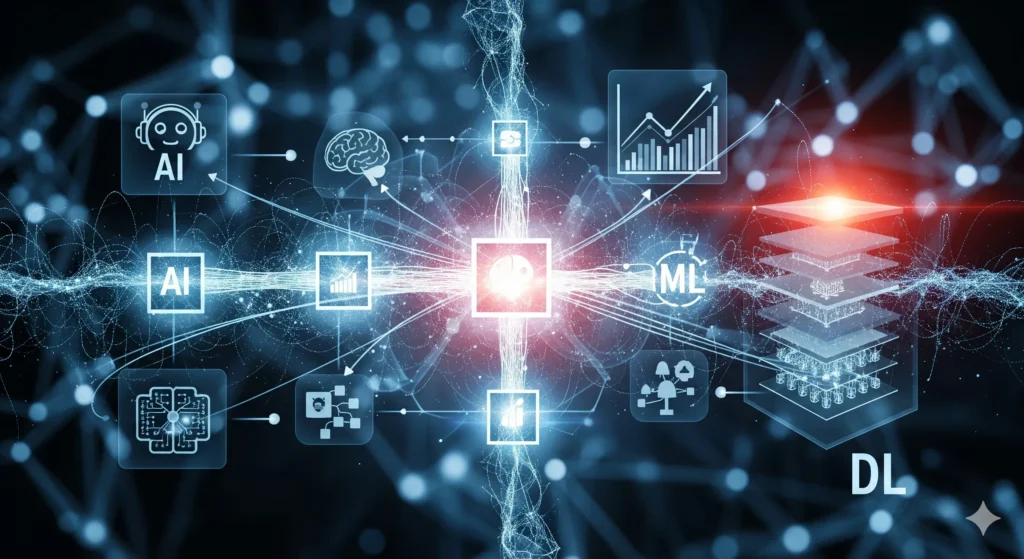
Introduction: The Age of AI ML DL—Why Clarity Matters “Artificial Intelligence vs. Machine Learning vs. Deep Learning” can seem confusing, especially for beginners. As we move into the era of AI vs. ML vs. DL, these distinctions are influencing technology careers and everyday products—from voice assistants to medical diagnostics.            In this guide, discover how Artificial Intelligence, Machine learning , and Deep learning  form the foundation of today’s fastest-growing technologies. By addressing common questions like “AI vs. machine learning vs deep learning: which is better”, and highlighting the differences between machine learning and deep learning with examples, this post will help clarify confusion.   AI: The Overarching System Artificial Intelligence is at the center of automation and thinking software. It covers everything from rules-based expert systems to advanced analytics that mimic human-like decisions. AI continues to evolve—from early chess engines to modern Artificial Intelligence-driven predictions in ridesharing apps and smart city planning. Machine Learning: Learning Without Explicit Programming ML is a part of Artificial Intelligence that focuses on adaptation. Unlike traditional Artificial Intelligence, machine learning systems get better as they process more data. This makes ML ideal for dynamic applications such as recommendation engines, fraud detection, and virtual personal assistants. Deep Learning: Complexity Unlocked with Neural Networks Deep Learning, a more specialised branch of ML, imitates how the human brain learns. It uses layered neural networks to tackle complex tasks that involve large amounts of data, such as face recognition, speech-to-text, and autonomous vehicles. DL excels in high-volume, high-dimensional, or unstructured data scenarios, like medical imaging and driverless cars. Difference Between AI ML and DL (Tabular Form for Clarity) Aspect Artificial Intelligence Machine Learning Deep Learning             Scope Broadest, includes all intelligent systems Subset of AI, data-driven learning Subset of ML using layered neural networks Learning Method Logic, rules, reasoning Data-driven adaptation Deep neural network feature learning Data Needs Ranges from minimal to moderate Moderate, mostly structured High, especially unstructured data Hardware Low to moderate Moderate High (often needs GPUs/TPUs) Examples Chess engine, chatbots, autopilot Email spam filter, language prediction Self-driving cars, voice assistants, image captioning Human Intervention Often required Some (feature selection, tweaking) Minimal—automated feature discovery Focus Performing human-like tasks Improving with data Handling complex, nonlinear, big data problems Best For Any intelligent automation Data-based predictions, classification Vision, speech, text, sequential data issues Efficiency Varies Can be less efficient on unstructured data Highly efficient for high-volume tasks Artificial Intelligence vs. Machine Learning vs. Deep Learning: Which Is Better? This is one of the most frequently asked questions. The ideal approach depends on the task: Artificial Intelligence vs Machine Learning vs Deep Learning Example: Real-World Scenarios Deep Learning vs. Machine Learning: When Does DL Outperform ML? Deep Learning vs Neural Network: What’s the Subtle Distinction? A neural network is the basic mathematical model in ML that learns patterns by simulating interconnected neurons. Deep learning simply means these networks are “deep”—consisting of many layers, allowing for the detection of complex patterns that shallow (2-3 layer) neural networks cannot uncover. Diagram Imagine three concentric circles: Project Distribution in 2025: Where Are Artificial Intelligence, ML, and DL Used Most? Deep learning is now leading in project share due to advancements in computation and the surge of unstructured data sources. Key Insights & 2025 Trends As of 2025, over half of enterprise projects utilize deep learning, especially for imaging, language, and pattern recognition—mainly due to the availability of GPUs and extensive data streams. Difference Between Machine Learning and Deep Learning (With Examples) Conclusion: Mastering AI vs. ML vs. DL—A Roadmap for 2025 and Beyond Recognize the basic differences: Artificial Intelligence is the broad vision, ML is the practical engine, and DL is the cutting-edge method for handling scale and complexity. Call to Action Share your thoughts in the comments: which of these techniques has changed your workflow or industry?  
AI vs. ML vs. DL: Clear Differences Between AI, Machine Learning, and Deep Learning in 2025-26 Read More »

AI-ML Guide In 2025-26

AI-ML Guide In 2025-26

    The AI-ML Guide In 2025-26 starts with a simple question: have you ever wondered how Netflix seems to know what you want to watch next or how your smartphone unlocks just by looking at it? The hidden forces behind these actions are Artificial Intelligence and Machine Learning (AI & ML), the two engines powering our increasingly smart world. From predicting market trends to transforming healthcare, AI and ML are not just popular terms; they represent real changes in how we interact with technology and the vast amounts of data around us. This guide will explore the fascinating world of AI & ML, break down their main ideas, clarify their roles, and highlight their effects. Whether you’re thinking about taking courses in AI & ML to start a new career or are just curious about the basics, you’ll gain valuable insights into the digital brain shaping our future. AI vs. ML: Unpacking the Relationship –     AI & ML Guide in 2025-26 starts with an important distinction: AI and ML are often used interchangeably, but they are different yet closely related. Think of AI as the bigger goal, while ML is an important method to achieve it. What is Artificial Intelligence (AI)? –      At its heart, artificial intelligence involves creating machines that can do tasks typically needing human intelligence. This includes solving problems, learning, making decisions, sensing the environment, and even understanding language. The ultimate goal of strong AI is to fully mimic human thinking, but most of what we encounter today is “narrow AI” that excels at specific tasks. What is Machine Learning (ML)? –     Machine learning, a part of AI, centers on helping systems learn from data without direct programming. Rather than receiving step-by-step instructions, ML algorithms analyze large datasets, allowing them to recognize patterns, make predictions, and improve their performance over time. This learning process is ongoing and self-adjusting. The Synergy –      How ML Powers AI Machine learning is the main way modern AI systems learn and change. When an AI system shows “intelligence”—like recommending a product or recognizing a face—it’s often an ML algorithm working in the background, having learned from massive amounts of data. Without ML, AI would be a fixed set of rules; with it, AI becomes active and evolving. Key AI & ML Concepts You Need to Know – It’s essential to understand the different ways ML algorithms learn. Here are the main types: Supervised Learning –     This is the most common form of ML. Algorithms are trained on labeled datasets, meaning each piece of data has an associated “answer.” For example, an algorithm learning to identify cats would see thousands of images, each marked as “cat” or “not cat”. Example: Spam detection (emails marked as spam or not), image classification. Unsupervised Learning –      In contrast, unsupervised learning uses unlabeled data. The algorithm’s job is to find hidden patterns, structures, or relationships in the data independently. It’s like discovering clusters in data without prior knowledge of what those clusters mean. Example: Customer segmentation (grouping similar customers based on their buying habits) and anomaly detection. Reinforcement Learning –      Inspired by behavioral psychology, reinforcement learning involves an agent learning to decide by taking actions in an environment and receiving rewards or penalties. The aim is to maximize the total reward. Example: Training AI to play games (AlphaGo), autonomous navigation for robots. Deep Learning –     A Specialized Form of ML Deep learning is a powerful branch of machine learning that uses artificial neural networks with multiple layers to learn complex patterns from large amounts of data. These networks mimic how the human brain works. Deep learning has led to breakthroughs in fields like image recognition, natural language processing, and speech recognition. Real-World Applications –    Where AI & ML Shine AI & ML impact nearly every industry. Healthcare Innovations –     AI and ML are transforming healthcare by helping with disease diagnosis, drug discovery, and personalized treatment plans. For example, ML algorithms can analyze medical images (like X-rays or MRIs) with remarkable accuracy, often finding issues that a human might miss. Google Health and DeepMind are making notable progress in this field. Financial Forecasting –     In finance, AI & ML support algorithmic trading, fraud detection, and risk evaluation. Machine learning models can analyze vast amounts of market data to predict stock movements or spot suspicious transactions in real-time. J.P. Morgan and other major firms heavily use AI in their operations. Personalized Experiences –     Think about the recommendations you see on Amazon, Spotify, or Netflix. These are driven by ML algorithms that learn your preferences and suggest content tailored for you, boosting user engagement and satisfaction. Expect even more tailored, individual experiences by 2025. Autonomous Systems –     From self-driving cars to robotic process automation (RPA), AI & ML are central to autonomous systems that perceive their surroundings, make choices, and perform tasks without human help. Companies like Tesla and Cruise are constantly improving autonomous driving technology. The Current & Future Landscape –     Trends and 2025 Projections The growth of Artificial Intelligence and Machine Learning is impressive. Projections for 2025 suggest this trend will continue. According to Statista, the global AI market revenue is expected to reach roughly USD 300 billion in 2025, growing at a significant annual rate. AI & ML Guide in 2025-26 projects, this momentum will only accelerate, powered by big data, advanced computing, and continuous investment. This rapid growth is driven by the increasing availability of data, improved computing power, and consistent investment across various sectors. Let’s visualize key areas of AI investment and adoption as we approach 2025. Projected Global AI Market by Technology (2025):-  Machine Learning: 48% Natural Language Processing: 22% Computer Vision: 20% Robotics & Other AI: 10%                                                        

AI-ML Guide In 2025-26 Read More »