
Building Your 2026 AI Learning Plan: The Complete Roadmap for Career Transformation
The AI revolution isn’t coming; it’s already here. A lot has changed in the world since we last saw it in 2026. This skill set used to be useful only to PhD researchers and the best tech companies. Now, it’s the most sought-after skill in every field. Now the question is not “Should I learn AI?” but “Which AI skills should I focus on first, and how do I make a learning plan that works?” This is true for students, working professionals, entrepreneurs, and anyone who wants to change careers.
This is why I’m writing this guide: I’ve seen the big change happen in real time. Companies are really looking for people who know how to use AI. Companies are spending billions on the infrastructure that generative AI needs. The starting salaries for AI professionals have gone up 50% in just a year. But there still aren’t enough qualified people who can do the job. This gives people a unique chance, but only those who plan ahead and stick to their plans will get it.
AI Learner Dashboard: Your Journey of Learning Starts Now in 2026
Why This Moment Is Important: The AI Opportunity of 2026
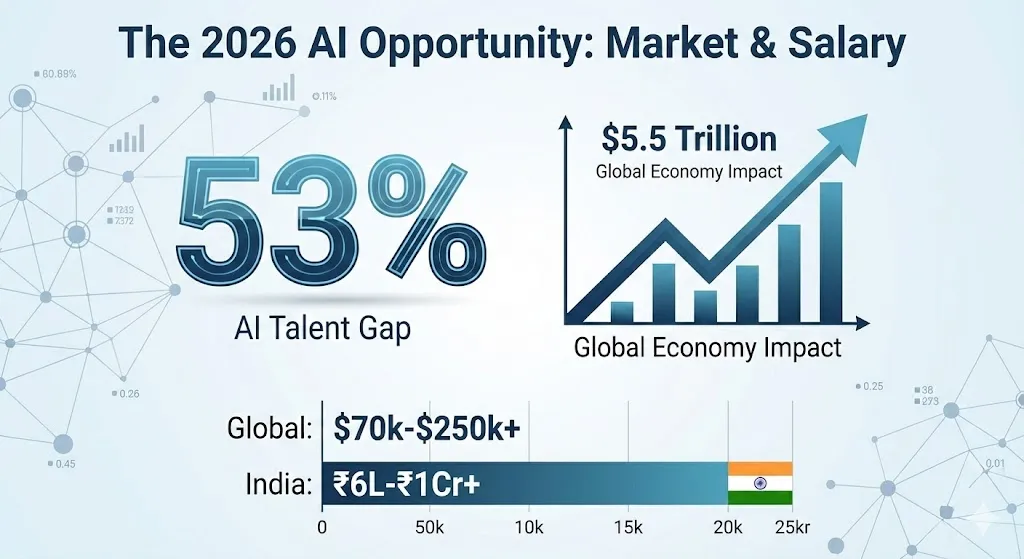
These are the hard numbers that should help you decide. According to TeamLease Digital, India will have a 53% AI talent gap by 2026, with only one qualified engineer for every ten open generative AI jobs. IDC says that a lack of skilled workers could cost the world economy up to $5.5 trillion by 2026. The numbers are just as shocking around the world.
What does this mean for you? When something is hard to find, it means there is a chance. Entry-level AI workers in global markets make between $70,000 and $90,000 a year, while senior specialists make between $150,000 and $250,000 or more. New AI workers in India can expect to make between ₹6 LPA and ₹12 LPA. Experienced workers can make between ₹35 LPA and ₹60 LPA or more. The best professionals can earn ₹1 Cr or more.
The AI market is growing at a rate of 46.47% per year, and by 2030, it is expected to be worth $356.10 billion. This is more important than information about salaries. This isn’t a bubble; it’s a big shift in how people work in the arts, healthcare, finance, manufacturing, and education.
But the challenge is real. It’s not always easy to remember everything you know about AI, such as prompt engineering, machine learning, and agentic systems. A lot of students either give up after three months or spend years getting credentials without learning useful skills that will help them get a job.
This guide solves that problem. I’m going to show you a plan that has been tested in battle and will get you ready for AI in 12 months. It has clear goals, time frames that make sense, and things you can do right away.
What Employers Really Want in the AI Skills Landscape 2026
Before we talk about learning, we need to talk about what skills are actually getting people jobs and high pay right now.
The Top AI Skills for 2026
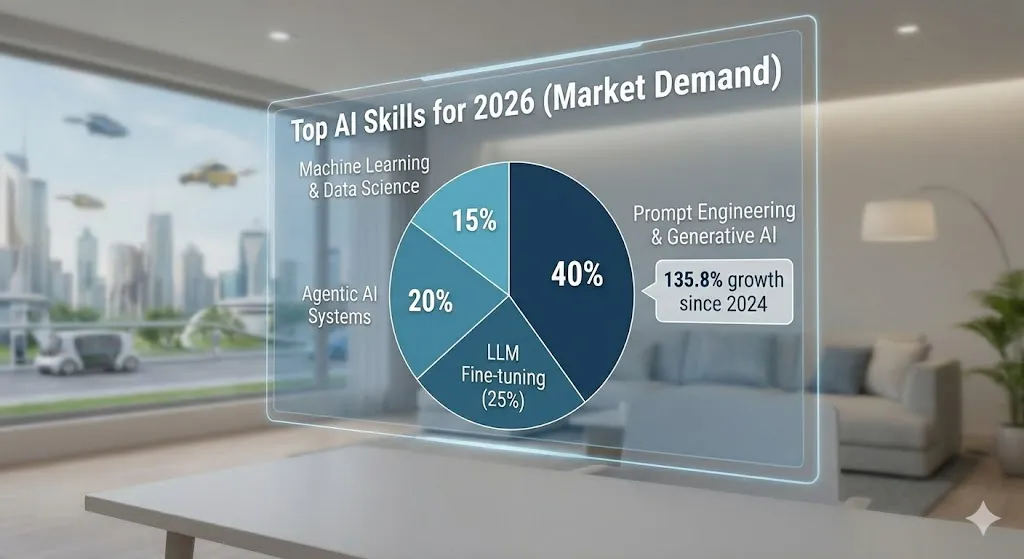
Job postings for prompt engineering have gone up by an amazing 135.8% since 2024, making it the most in-demand AI skill in 2026. It makes sense that prompt engineering is what makes AI available to everyone. You don’t need to know a lot about neural networks or have a PhD in computer science. To get good results from large language models, you need to be able to think clearly, talk clearly, and write clear instructions.
Fine-tuning skills for LLM come in second place. With these skills, businesses can change foundation models to fit certain tasks in areas like predicting the future of finance or diagnosing health problems. The next big thing is agentic AI systems. They are autonomous agents that plan and complete difficult jobs. They already have a lot of money.
You should know that these skills are all connected to each other. In 2026, the best AI experts will have what I call “T-shaped” skills. This means they will know a lot about many different areas of AI and be very good at one or two of them.
This is how it works in real life:
The basics of AI, how different models work, ethical issues, the importance of data quality, and how AI fits into business processes are all things you should know about breadth.
Depth (your area of expertise): You should know enough about edge AI, prompt engineering, LLM fine-tuning, machine learning, or data science to be able to come up with your own complicated solutions.
What good news? If you set things up right, you can do this in a year.
Your 12-Month AI Learning Plan: Six Steps to Becoming an Expert
I’ve made a plan that is both aggressive and realistic by looking at the best AI education sites, hiring reports from the industry, and talking to people who work in the field. This isn’t just a theory; it’s based on what people are doing right now to get ready for AI jobs.
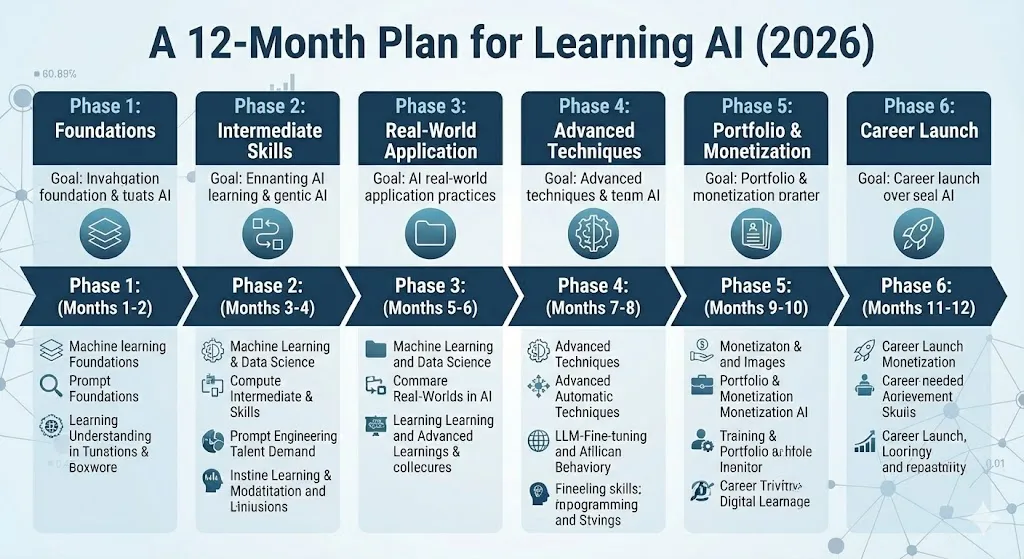
A 12-Month Plan for Learning AI: From Beginner to Expert
Phase 1: Foundations (Months 1–2)—Build Your Base Your goal is to show yourself that you can learn AI and build strong foundations.
The first two months are all about getting used to things and learning how AI works. You’ll spend 5 to 7 hours a week practicing what you’ve learned and 8 to 10 hours a week learning in a structured way.
What you’ll learn: How big language models work, 12 basic types of prompts, Basic Python, Basic linear algebra and probability.
Things to do: Use ChatGPT daily to write prompts, keep a “prompt journal”, take one free online class.
Milestone: By the end of the second month, you should be able to write prompts that always get good results.
Step 2: Intermediate Skills (Months 3–4)—Learn how to make workflows Your goal is to move from simple prompts to making complicated AI workflows.
What you’ll learn: Multi-step prompting architecture, Role and persona prompts, Context engineering, Basic AI steps.
Things to do: Create three to five multi-step workflows for real tasks, try out different role prompts, use AI to make simple automations.
Milestone: You should now be able to take a difficult, unclear request and figure out a way to combine multiple AI calls.
Phase 3: Real-World Application (Months 5–6) — Start Working on Real Problems Your goal is to go from doing learning activities to making things that can be sold or used in production.
What you will learn: Content creation systems, Automating tasks, How to set up projects for freelance work, MLOps and model evaluation.
Things to do: Make three to five small projects that could be useful, keep a record of your work, create a portfolio on GitHub or Notion, start freelancing.
Milestone: You should have three to five documented projects that you can show to potential employers or clients.
Phase 4: Advanced Techniques (Months 7–8) — Take Your Craft to the Next Level You want to learn the skills that make experienced professionals different from less experienced ones.
What you’ll learn: System prompts, Few-shot prompting, Chain-of-thought prompting, Frameworks for testing and improving prompts, Multiple agents working together.
Things to do: Come up with three to five advanced workflows, set up systems with more than one agent, regularly make your best prompts better, help with open-source AI projects.
Milestone: You’ve built advanced AI systems that can handle edge cases and work in real-world settings.
Phase 5: Portfolio and Monetization (Months 9–10)—From Learning to Earning You want to make money with your skills and build a portfolio that gets you jobs.
What you will learn: How to create and sell AI services, How to make a website for your work portfolio, Strategies for freelance platforms, Talking to clients.
Things to do: Build 5 to 10 more portfolio projects, create a business website, do freelance work, keep track of your results, start looking for entry-level AI jobs.
Milestone: You have a professional portfolio, you’re working as a freelancer, and you’re looking for full-time work.
Phase 6: Specialization and Career Launch (Months 11–12) — Become an Expert Your goal is to improve your skills in one area of AI and start your career in AI.
What you’ll find out: Your area of expertise, Automation platforms and tool integration, Business skills, Being a thought leader.
What to do: Improve your skills in your field, create automation systems that can grow, build or give away open-source tools, give a talk at a meetup.
Milestone: You have successfully started a career in AI, either by getting a full-time job or by starting a freelance business.
AI Career Progression: How to Get a Raise and Move Up in Your Career in 2026
Choosing Your Specialty: Which Way Should You Go?
You should know what specialization is right for you by the eighth to tenth month of this plan. These are the main paths:
Prompt Engineering & Generative AI: Best for writers, marketers, content creators. (Time to first income: 4-6 months)
Machine Learning and Data Science: Best for programmers and mathematicians. (Time to first income: 8-10 months)
LLM Fine-tuning and Model Engineering: Best for developers who are good at the basics. (Time to first income: 6-8 months)
Agentic AI & Autonomous Systems: Best for people who think about systems. (Time to first income: 8-12 months)
Edge AI and Small Language Models: Best for engineers who work with hardware and IoT. (Time to first income: 9-12 months)
The Best Free and Paid Places to Learn
Things That Cost Nothing: Google AI Essentials, AI for Everyone (Coursera), University of Helsinki AI course, YouTube channels.
Paid Courses (₹5,000–₹25,000): Coursera Machine Learning Specialization, DataCamp AI Fundamentals, Udacity AI Programming.
Premium Programs (₹100,000–₹500,000): IIT Kanpur e-Masters, BITS Pilani PG AI/ML, Scaler AI & ML Bootcamp.
Building Your Portfolio: The Money That Matters
Over and over, employers told me that they don’t care about your Coursera certificate. They want to know what you can really do. By the end of the tenth month, your portfolio should have 10 to 15 projects that show different levels of skill.
The Future-Proof Mindset: Skills That Will Be Important After 2026
It’s not the same to learn AI in 2026 as it is to learn it in 2024. The field has matured. Systems thinking is just as important as technical skills these days:
Responsible AI and Ethics: Be fair, spot bias, keep people’s privacy safe.
Edge AI and Privacy: Learn about edge deployment, quantization, and small language models.
Agentic AI and Autonomy: Make systems that can work on their own.
Domain Expertise Integration: Combine AI skills with domain knowledge.
AI Specializations 2026: There Are Many Ways to Do Well
What Your Real Life Could Be Like in 12 Months
Based on following hundreds of students through similar roadmaps, these are the most likely outcomes:
Scenario 1: 8-10 hours a week of commitment. First freelance job in month 6, applying for entry-level jobs in month 10.
Scenario 2: 5-6 hours a week. First small freelance job in month 9, strong foundation for year 2 in month 12.
Scenario 3: Already know how to do things. Using AI at work in month 3, working on AI projects in month 5, raise or new job in month 8.
A Lot of People Ask These Questions
Q1: Can I really learn AI in a year if I’m not a programmer? Yes. Start with prompt engineering.
Q2: Should I go to bootcamp or get a degree instead of studying on my own? Structured roadmaps and projects are better than most degrees. Bootcamps are a good middle ground.
Q3: What if I’m over 40 and want to know if it’s too late? Not a chance. Being mature and patient is a good thing.
Q4: Is prompt engineering a type of “real” AI? Yes, and it’s even better when combined with other AI skills.
Q5: How do I know if I’m on the right path? Red flag: Not making anything for more than three months. Green flag: You are able to try out freelance work by the fifth month.


Pingback: How Your Business Should Prepare for AI Trends in 2026: A Comprehensive Transformation Roadmap - Bing Info