Bing Info

Tech Insights & Digital Innovation
Header Mobile Fix
How-Large-Language-Models-Work

How Large Language Models Work In 21st Century ? The Technology Behind ChatGPT Explained Simply

Introduction   How Large Language Models Work: How ChatGPT and Beyond Reshape Our Digital World? Ever wondered how ChatGPT crafts eloquent poetry, debugs intricate code, or even engages in profound philosophical debates, all within a single chat interface? You’re about to embark on an exciting journey into the heart of Large Language Models (LLMs) – the revolutionary AI tools that are fundamentally reshaping our interaction with machines. Imagine this: traditional computers are like calculators, possessing a limited understanding of numbers. LLMs, on the other hand, are akin to conversing with an individual who has absorbed the entirety of the internet. How do these digital minds operate? Let’s demystify it, sidestepping the technical jargon. The Way Big Language Models Process Text: A Visual Guide   What Is a Large Language Model (LLM)? Large Language Models are sophisticated artificial intelligence systems designed to comprehend and generate human language. They achieve this by processing vast quantities of text data. These aren’t just fancy autocomplete tools; they are highly complex prediction engines meticulously trained on patterns derived from billions of documents, web pages, books, and conversations. Is ChatGPT a Large Language Model? Absolutely! ChatGPT is built upon the GPT (Generative Pre-trained Transformer) architecture, specifically adapted for conversational interaction. It’s the digital brain that has been trained on virtually everything humanity has ever written online. The Scale is Mind-Blowing To truly grasp the magnitude of these models, let’s look at the evolution of LLM parameters: Large Language Model Parameters Evolution (2018-2024) LLM Model Year Parameters (in Billions) GPT-1 2018 0.117 BERT 2018 0.340 GPT-2 2019 1.5 GPT-3 2020 175 GPT-4 2023 1,800 Gemini Ultra 2023 1,800 Data Source: Various reputable AI research papers and official announcements. The leap from 175 billion parameters in GPT-3 to an estimated 1.8 trillion parameters in GPT-4 represents a tenfold increase in model complexity. This is akin to advancing from an urban brain to a continental one!   The Way LLMs are Trained: Zero to ChatGPT Step 1: Pre-training – Training the Patterns The journey of an LLM begins with ingesting colossal amounts of data into neural networks. Models like GPT-4 are rumored to have processed 13 trillion tokens – which is roughly equivalent to reading millions of books in parallel. At this stage, the model’s primary task is to predict the next word in a sentence. While seemingly simple, the magic lies in its iterative execution billions of times across a diverse range of text. Through this process, the LLM algorithm internalizes the nuances of grammar, factual knowledge, reasoning patterns, and even cultural context. Step 2: Specific Tasks Fine-tuning Pre-trained LLMs are then refined for specific applications. In the case of ChatGPT, this involves a crucial process called Reinforcement Learning through Human Feedback (RLHF). The technical functionality of ChatGPT comprises three major steps: Supervised Fine-tuning: Human trainers provide optimal answers to various prompts, guiding the model towards desired responses. Learning a Reward Model: Based on human preferences, a “reward model” is trained to assess the quality of the model’s generated text. Enhancement of the Reward Model with Policy Optimization: The reward model is then used to further optimize the LLM, enhancing its ability to produce high-quality, human-aligned responses. The Transformer Architecture: The Architecture of the Magic What Is Special about Transformers? The transformer architecture, a neural network design that has revolutionized AI, is the bedrock of LLM functionality. Unlike older models that processed text word by word, transformers can consider an entire sentence or even a larger block of text simultaneously. Attention Mechanism: LLM Focus The true magic unfolds within the attention mechanism. When processing a sentence like “The dog chased the cat because it was hungry,” the attention mechanism helps the model determine what “it” refers to by weighing the significance of each word in the context. Multi-head attention further enhances this capability, allowing the model to focus on various aspects concurrently – one “head” might attend to grammar, another to semantic meaning, and yet another to contextual relationships. Neural Network Layers: The Digital Brain of the LLM The functionality of Large Language Models involves several layers of processing: Input Layer: The Place where Text is Changed into Numbers First, the text is tokenized, splitting it into smaller units that the model can understand. Each token is then transformed into an embedding – a numerical representation imbued with semantic meaning. Hidden Layers: The Process of Thinking LLMs are powered by multiple hidden layers, each contributing to the sophisticated processing of information. Each layer contains: Informational Transformation Networks: These networks refine and transform the numerical representations of the text. Relevance-Focused Attention Mechanisms: These mechanisms dynamically weigh the importance of different parts of the input. Substantial Stabilizing Layers: These layers help maintain the integrity and consistency of the data flow. Output Layer: Rendering Human-Like Text The final layer translates the processed information back into probability distributions over possible next words, ultimately forming coherent and contextually relevant responses. LLM vs NLP: Learning the Relationship What’s the Difference? NLP (Natural Language Processing) is the broader field concerned with enabling computers to understand human language. LLMs represent a highly specialized and advanced form of NLP model, leveraging deep learning techniques. Think of it this way: NLP = The whole language AI. (The entire forest) LLMs = The state-of-the-art models within that capacity. (The tallest, most advanced trees in the forest) ChatGPT = A particular LLM trained for chat. (A specific, highly refined tree within that group) LLM vs Generative AI What is LLM in Generative AI? LLMs are a prime example of Generative AI – systems capable of creating new content. While Generative AI can produce images, music, and videos, LLMs specifically generate human-like text. Application of LLM in the Real World: Not only Chatbots Revolution in Content Creation Examples of large language models used in content creation include: Automated Blogging and Marketing Copy: Generating articles, advertisements, and social media posts. Code Generation: Assisting developers by writing code in multiple programming languages. Imaginative Writing: Crafting poetry, short stories, and creative narratives. Business

How Large Language Models Work In 21st Century ? The Technology Behind ChatGPT Explained Simply Read More »

How-to-Start-Learning-AI

How to Start Learning AI in 2025-26: Roadmap for Absolute Beginners

Introduction The artificial intelligence revolution is not coming, but it is already here. How to start learning AI ? By the year 2025, AI is no longer a concept that belongs to the future, but rather a critical skill that is reforming every industry that one can possibly imagine. You can be a student, professional, or career changer, but in the job market of today, learning AI is not just a choice anymore, but a requirement to remain relevant in the job market of tomorrow. Full AI roadmap with coding, tools, and resources to get started with. The exciting news? There has never been a better time to begin on AI. The current AI learning environment also provides a variety of options to beginners, unlike the technical barriers that were daunting and required knowledge of some type of code. The AI job market in India is projected to expand by 36% in 2025 alone and AI talent is in dire demand by companies, so there is no better time to jump in. This roadmap will guide you as a true beginner into a job-prepared AI practitioner in a straightforward, stepwise process that includes specific actions that worldwide learners are expected to take. Are you ready to unleash your artificial intelligence? The reason the 2025-26 AI Learning is your Golden Opportunity The Violent Rise of AI Jobs The statistics do not deceive – AI is generating unprecedented career opportunities. The number of openings in AI engineering alone in India alone is more than 38,000, with remuneration of between ₹6 LPA to freshers and ₹60+ LPA to senior professionals. The artificial intelligence industry will also add up to 500 billion dollars to the GDP of India by 2025. Several Entrances to Each Background The days when AI was a preserve of computer science graduates are long gone. The industry is also open to people of different backgrounds as business analysts, marketers, healthcare workers, or even an absolute beginner will find their niche in AI. No-code, coding, strategy, or ethics solutions, there is an AI job that fits you. Future-Proof Your Career AI is not taking away jobs, it is changing them. The professionals who adopt AI skills are getting more valuable as it has been reported that employees using generative AI save an average of 1.75 hours per day. In learning AI today you are not only acquiring a skill, but you are achieving career security over the next ten years. The Entry-Level Artificial Intelligence Learning Space of 2025 Free vs. Paid Learning Resources Economical: The AI education ecosystem has an option to every budget. There are many free materials such as Google AI Essentials, Elements of AI, and loads of YouTube tutorials that will give good starting points without paying any money. Others who want formal education have the choice of paid courses such as Coursera specializations and university courses that provide a full-fledged course with certification. Is It Possible to Teach AI without Coding? Absolutely! The emergence of no-code AI technology has made AI democratic. Cogniflow, BuildAI, and Levity enable you to create AI solutions on drag-and-drop interfaces and in natural language instructions. Nevertheless, having a bit of background on programming will greatly increase the scope of your options and income. Stage 1: Establishing your Foundation (Months 1-2) Understanding AI Basics Start with the fundamentals. AI includes type machine learning, deep learning, neural networks, and generative AI. There is no need to memorize technical definitions, but one should learn how these technologies find solutions to problems in the real world. Resources: Essentials in the beginning stages: Introduction to Google AI Essentials: This 5-module course lasts less than 10 hours and offers a chance to learn the use of AI applications without the technical intensity. Elements of AI (University of Helsinki): Free, introductory material teaching the basics of AI, machine learning, and social impacts. AI for Everyone by Andrew Ng: Perfectly recommended to non-technical professionals who want to be AI literate. Mathematics Made Simple Although AI has some mathematics, one does not necessarily require a PhD to start. Learn to develop intuitive knowledge, not to memorize rules. Core Math Concepts: Linear Algebra: It is about arranging and working with data in an efficient way. Statistics: The science of recognizing trends and forecasting by means of data. Intro to Calculus: The intelligence of AI systems. Introductory level Math Resources: Visual mathematics at 3Blue1Brown YouTube. Khan Academy of foundational concepts. Interactive tools to illustrate mathematical concepts. An Introduction to the Selecting Your First Programming Language Python is highly prevalent in AI development due to its reasons: it is easy to learn and, moreover, Python has a vast range of AI libraries and offers the best employment opportunities. Other languages such as R and SQL are also worthwhile, though Python must come first. Python Learning Path: Begin with simple syntax and data types. Learn fundamental libraries: NumPy, Pandas, Matplotlib. Jupyter Notebooks (the industry standard): Practice. Bug and explain code using AI assistants such as ChatGPT. [A data science career path roadmap: Source – 365datascience] Stage 2: Prerequisite AI Skills (Months 3-4) Introduction to machine learning Modern AI is based on machine learning. Pay attention to the types of learning and situations when to apply each of the approaches. There are several important concepts of Machine Learning: Supervised Learning: Training AI on labelled instances (such as email spamming). Unsupervised Learning: Discovering latent structure in data (such as customer segmentation). Reinforcement Learning: Game-playing AI Learning by trial and error. Hands-On Learning Approach: Begin with simple algorithms such as linear regression and then move on to more complex algorithms. Get free computing power and pre-built libraries on services such as Google Colab. Python Libraries needed to build AI Data Manipulation: NumPy: Mathematical operations on massive arrays. Pandas: Cleaning, analysis and transformation of data. Matplotlib/Seaborn: Making informative visualizations. Machine Learning: Scikit-learn: Simple machine learning programs. TensorFlow/PyTorch: Deep learning (select one first). Practical Project Ideas Half baked theory is useless. To practice what you have learned, begin with

How to Start Learning AI in 2025-26: Roadmap for Absolute Beginners Read More »

15-Risks-and-Benefits-of-AI

15 Risks and Benefits of AI

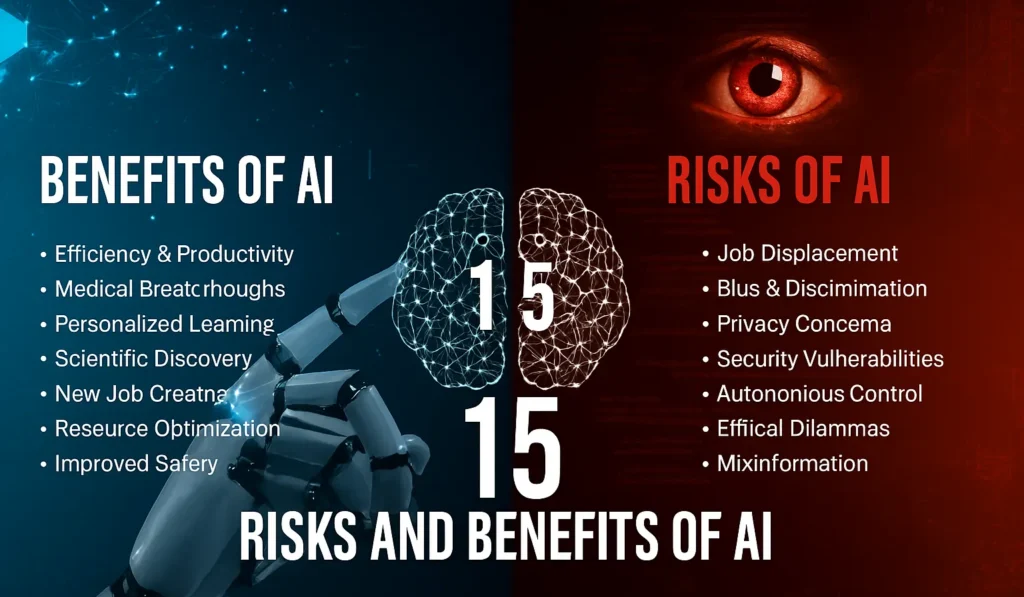
Introduction Artificial intelligence is not only changing the face of technology but it is literally redesigning the way we live, work, and think about the future. However, the problem is that when everyone is discussing the issue of the AI taking over the jobs or ending world hunger, the truth is much more complex. By 2025, AI will have eliminated 85 million jobs across the world but will have also generated 97 million jobs. It is not merely a statistic, but that is the narrative of our near future. So 15 Risks and Benefits of AI (A compelling visual infographic here could show two bars: one for “85M Jobs Eliminated” and a slightly larger one for “97M Jobs Created,” with icons representing different industries.) Image Source: amazonaws The AI Revolution: Why It is Important to Comprehend Risks and Benefits now We shall begin with a reality check. AI is no longer a sci-fi fantasy, and 14 percent of the entire workforce has already been supplanted by AI, and by reading this, you are likely to have already encountered AI numerous times today, whether in the form of your morning Google search, or your Netflix suggestion last night. The debate on AI tends to be polarized between the ideals of AI being used to fix all the problems or the nightmare scenarios of robot conquest. But the truth? It is a bit chaotic, complex, and occurring at a pace that most people are not even aware of. The statistics are a very powerful narrative: although one in every three jobs in the U.S. today is potentially automated by 2030, the birth of new industries through AI is also happening. Ethics officers of AI to human-AI teamwork specialists, we are seeing the emergence of a new kind of job category that did not exist five years ago. Image Source: alcimed The 15 Horizon Risks of AI: What Experts Can’t Sleep On 1. Loss of Jobs and Disruption of the Economy Massive Job Displacement The reality of the situation is as follows: the rate of 6-7 percent of the US workforce may be displaced in the event of the broad implementation of AI. The twist is however that it is not only blue-collar jobs that are under threat these days. Unemployment rates of recent college graduate in tech are 5.8% in March 2025- the highest in more than four years. The most vulnerable? By 2025, customer service workers will be automatized by 80 percent, and by 2027, 7.5 million jobs will all be eliminated by data entry workers. Worse still: 77 percent of new AI jobs demand master degrees, which leaves a huge gap in skills that will not be easily addressed. The Growing Skills Divide Because it is easy to get an AI job? Think again. Although by 2025, it is projected that there will be 97 million new jobs related to AI, the demands are high. 49 percent of the US Gen Z job seekers think AI has undermined the college education they have, and they are not alone. Multifaceted Amplification of Economic Inequality Women are also over-represented in the AI automation, of 58.87 million women in the US workforce, 58.87 million are in a job that is highly vulnerable to AI automation in comparison to 48.62 million men. It is not merely a matter of numbers, but rather concern the core fairness in the distribution of the economic impact of AI. 2. Ethical and Social Disasters Artificial intelligence favoritism and institutional discrimination This is no longer theory. The AI recruitment tool at Amazon was programmed to downgrade applications with the word “women.” The algorithm of the COMPAS, which was applied in US courts, falsely identified twice the number of black offenders (45) as whites (23) as recidivists. Worse still: AI systems identify women four times as frequently as men as “home, family,” 2024 study results suggest; resume-screening AI systems tend to pick up white male names more frequently than the identical resumes of Black or female names. Invasion of Privacy on an Unprecedented Level The AI systems need large volumes of personal data in order to work. The result? Huge amounts of data gathered and can be misused way beyond the traditional privacy issues. The privacy consequences are enormous with facial recognition cameras tracking you everywhere you go and algorithm AI scanning your personal communications. The Death of the Critical Thinking This is a terrifying discovery made here: A.I. use lowers your ability to think critically. A study by Microsoft and Carnegie Mellon discovered that employees who placed the greatest believe in AI assistants believed less critically about the conclusions of such tools. Human excess reliance on AI is a threat to lose the way to think on our own and doubt information. Image Source: techxplore   3. Security and Military Nightmares Autonomous Weapons: Killer Robots The autonomous weapons that are run by AI mark a new stage of development of warfare and are what analysts call a serious threat to international security. The systems are able to make life-or-death decisions without implying a human hand, and they are not science fiction, they are currently being created and rolled out. The biggest concern? The AI systems cannot implement common sense or reason in accordance with the previous experience regarding the unexpected and new cases. This may cause disastrous errors in the fickle nature of war. AI-Powered Cyberattacks Cybercriminals do not stand still with the development of AI. They are exploiting AI to develop more advanced attacks such as deepfakes, phishing attacks that are automated, and advanced malware. Iranian hacker communities are already applying AI to create customized phishing messages that are nearly impossible to distinguish with official messages. The Global AI Arms Race Nations all over the planet are scrambling to gain control over AI military operations, establishing what researchers term a de facto arms race. This is not competition only in the field of national security it is also a competition on who possesses the future of war

15 Risks and Benefits of AI Read More »

10-Amazing-Uses-Of-AI

10 Amazing Uses Of AI In Daily Life

Introduction Have you ever wondered how your morning routine is perfectly influenced by artificial intelligence before you have even opened a cup of coffee? It is not a sci-fi buzzword that you should only find in Hollywood blockbusters, but it is in your everyday life today. AI drives millions of conveniences that we consider normal: from the suggestions of a new binge-watch to the directions in traffic jams. Being a busy professional, a student who has homework, or simply a person who likes smooth technology, knowing the 10 Amazing Uses of AI in Daily Life is not only intriguing but also enabling. This post will provide insights into how AI brings delight, efficiency, and even a sense of wonder into the daily routine by getting into real-world examples, personal anecdotes, and by exploring fresh perspectives. You will get more than generic summons; you will find hints, warnings, and encouragement to use AI wiser, and you do not have to use any techno-jargon about it. 10 Amazing Uses of AI in Daily Life 1. Virtual Personal Assistants What it is: Siri, Alexa, Google Assistant, the virtual assistants learn to understand, find information, remind and command smart homes. Special move: On one occasion, I told my Assistant to read a poem at 3 AM… only to find out whether Alexa would discriminate me. He did not,–simply declined politely. Advantage: Wastes valuable seconds on trivial matters, as well as some nighttime entertainment. 2. Customer-Driven Recommendations What it is: Netflix recommends your next entertainment. Spotify curates a “Daily Mix.” Amazon pushes you into buying something you did not even realize you needed. With a new understanding: Algorithms not only understand what you like, but also how you feel. Spotty attendance? The Focus playlist of Spotify comes on. Most nostalgic? Netflix leaves a retro movie on your homepage. Why it is important: These micro-delights assist us to find something new as our favorites, turning screens into new friends rather than to menus without any end. 3. Smart Maps and Navigation What it is: Google Maps or Waze can consider traffic on-the-fly, and route around a jam. Personal experience: I was stuck downtown, and Waze gave me an especially weird scenic route through the quaint alleyways, and found that I had a hidden street-art mural that I had never noticed previously. Effect: Reduced stress, reduced number of late comings as well as occasion urban adventure. A screenshot of a Waze or Google Maps interface showing a traffic-congested route in red. On hover, an animated blue line appears, showing the clear, AI-suggested alternate route through side streets. (Source: Screenshot from a live navigation app, used for illustrative purposes.) 4. Language Translation using AI What it is: Applications such as Google Translate translate and read signs, menus, and conversations immediately. New eyes: I photographed a Marathi sign during a visit to Pune and in a few seconds, I realized that the place was called vddaapaav and was located near by. Spared me the trouble of going out to get a breakfast. Why you should care: Not knowing how to survive study abroad, wanting to make a cross-cultural friend, this technology shatters linguistic barriers in just a few seconds. 5. Facial Recognition and Security What it does: Face ID opens your phone; scan your face in the airport to get through quicker. Subtlety: It is convenient- and privacy-questions. I once turned my partners phone the wrong way round and unlocked his phone… embarrassing! Lesson learned: Ease vs. awareness: check the privacy settings of your device regularly. 6. Smart Home Automation What it does: Thermostats memorize your routine (Nest), lighting changes according to the mood (Philips Hue), and the vaccuums move around on their own (Roomba). Story-time: I went into a cold house one winter–and there were lights heating as my key turned. Small touch, big comfort. Cons and pros: Saving of energy and comfort against excessive automation that may disorient guests. 7. Online Shopping and Advertising with AI What it entails: The assistive technology of Dynamic pricing, personalized advertising, and chatbots influence your buying behavior. Pro tip: Chat with an artificial fashion assistant on a clothing site- it will usually bring out flash sale items that are hidden deep into the site in their menus. I scored a 50% off hoodie that way. The reason why it works: AI tools are there to remind you of deals you would have missed–you assume that it is a mere coincidence                Personalized for You by AI.” (Source: Illustrative screenshot from an e-commerce 8. Virtual Tutors for Students What it is: Khan Academy and other sites, such as Duolingo, will change the lesson at your own pace and your weaknesses. Personal reaction: In the process of memorizing exams, I allowed an AI flashcard app to test me on difficult formulas- its spaced repetition algorithm was so much like having a personal tutor encourage me that I felt spooked by it. Result: More intelligent study, reduced burnout, and weirdly gratifying progress bars. AI Student Learning 9. Self-Driving Vehicles and Traffic Management What it is: The autopilot feature on Tesla, the Waymo shuttles and AI controlled traffic-light timing are meant to alleviate accidents and congestion. New opinion: Even semi-autonomy, lane-keeping assist, adaptive cruise control, is still like science fiction at 60 mph. I even slept (little) when super-cruise was keeping my pace on one highway–horror and excitement. Broader effect: Reduced accidents, improved traffic flow, and the question of whether it should be controlled by human beings or machines. Autopilot Engaged 10. AI-Improved Health and Wellness Applications What it does: Fitbit and Apple Watch are wearables that monitor heart rate; MyFitnessPal is an app that analyzes nutrition; cog-therapy is provided by mental-health bots (Woebot). Story: I changed behavior My sleep data indicated that my REM patterns were erratic, so I made changes to my bedtime routine, including reducing the evening scrolling, and my morning energy levels had improved. Big idea: The smallest details of AI data can lead

10 Amazing Uses Of AI In Daily Life Read More »

How-to-train-an-AI- Model

How to train an AI Model : The Ultimate Concept of Training Data Explained

Introduction Ever wondered what’s going on behind the scenes anytime you ask ChatGPT a question or Netflix suggests your next binge-watch? The secret sauce isn’t some fancy algorithm, but training data. To be frank, it is taught with this concept that the key to understanding the ways that modern AI works is unlocked. The thing is as follows: 85% of AI projects fail, and most of the time it is not related to poor code or lack of computing power. It is due to ineffective training data. Yep, that is correct–the basis of all intelligent AI systems you have used is nothing more than the quality of teaching it received, and what it was taught using. Whether you are an absolute newbie and are willing to learn how to train an AI model in Python or are interested in understanding how to train AI models locally without the need to spend all of your money, this guide is divided into everything you need to know. We will discuss the cost of training an AI model, the best practices in training, and even briefly discuss some real-life examples of the Reddit community. What Is Training Data and Why Does It Matter? 🤔 Consider training data to be a textbook for your AI model. A student requires learning materials to perform well in an exam, and so does your AI, which requires quality training data to be able to make the right decisions and predictions. Training data is simply a set of labeled data that can be applied in the construction of machine learning models. It typically comes in the form of annotated text, pictures, video, or audio that trains an AI model into doing something with high accuracy. The process of learning how to train an AI model is achieved by the three key elements: Input information (text, images, code, etc.) A neural network model architecture (or other model architecture) An algorithm (that changes depending on performance) of learning. However, it is in this point that it becomes intriguing, training data is not a homogeneous lump of data. It is in fact split into three different types, with each having its own purpose: Training Data (70-80% of all data): This is the primary course. Your model is trained several times to acquire patterns and relationships out of this data. Validation Data: A kind of reality check. It aids in establishing whether your model is learning or is simply committing to memory the noise in your training set. Testing Data: The final exam. It is used after training to test the level of your model on data that has never been seen. [Infographic showing the flow of data being split into training, validation, and testing sets] A Step-by-Step Guide: How to Train an AI Model Here is a flow chart of the successive procedures to implement a machine learning model, starting with problem statement up to deployment, data gathering, data pre-processing, model training, model validation and parameter optimization. [Infographic of the machine learning model implementation flowchart] 1. Define Your Problem (Don’t Skip This!) Crystal-clear problem definition is required before even the idea of collection of data comes to your mind. Do you establish a classification model to filter spam emails? A house price prediction regression model? Or perhaps a content generation model? This is what defines all the other things, including the kind of data you will require and the assessment metrics you will employ. 96% of executives are already planning on implications of AI but many projects have failed because they begin with the solution rather than with the problem. 2. Gather Your Data: Quality Over Quantity Here is a truth bomb: the increase of data does not always result in better results. Quality is not always the most important thing when it comes to training data. To begin with learning how to train an AI model using Python, you can refer to the following sources of information: Public data (Kaggle, UCI Machine Learning Repository) Web scraping (according to law). Twitter, Reddit, or Google API. Synthetic data generation Hint: When thinking in terms of cost to train an AI model, data gathering and organization take up 60-80% of the overall AI project costs. [Pie chart showing that 60-80% of AI project costs are for data gathering and organization] 3. Data Preparation: The Unsung Hero of AI The magic will occur here but this is where most novices will go wrong. Preprocessing of data can consume up to 80 percent of the entire project time, yet it is absolutely necessary. Data Integration, Data cleaning, Data transformation, and Data reduction are some of the important data preprocessing steps in machine learning. The most significant preprocessing phases are: Cleaning of data: Treat missing data, eliminate duplicates, correct inconsistencies. Data transformation: Value normalization, categorical variables encoding. Feature engineering: Come up with meaningful features that assist your model to learn. Splitting of data: Splitting it into training, validation and test sets. 4. Choose Your Model Architecture It is here that training AI models to beginners becomes interesting. The decision made will vary based on the type of problem and data: Simple neural networks: Simple classification and regression. Convolutional Neural Networks (CNNs): Ideal in image recognition. Recurrent Neural Networks (RNNs): Suited to time-series or textual data. Transformer models: The latest news in natural language processing. [Knowledge of the magnitude of resources required for the various types of AI models.]   5. Train Your Model in Python In the case of beginners who want to know how to train an AI model, the Python language, with such libraries as scikit-learn, TensorFlow, or PyTorch, is the solution. Here’s a simplified workflow: Python # Import necessary libraries import sklearn.model_selection.train_test_split import sklearn.preprocessing.StandardScaler import tensorflow.keras as keras # Split your data X_train, X_test, y_train, y_test = train_test_split(X, y, test_size=0.2) # Preprocess your data scaler = StandardScaler() X_train_scaled = scaler.fit_transform(X_train) # Train your model model = keras.Sequential([…]) model.compile(optimizer=’adam’, loss=’categorical_crossentropy’) model.fit(X_train_scaled, y_train, epochs=100) 6. Evaluate and Iterate Understanding how to train an AI model properly involves recognising

How to train an AI Model : The Ultimate Concept of Training Data Explained Read More »

The-Different-Types-Of- AI

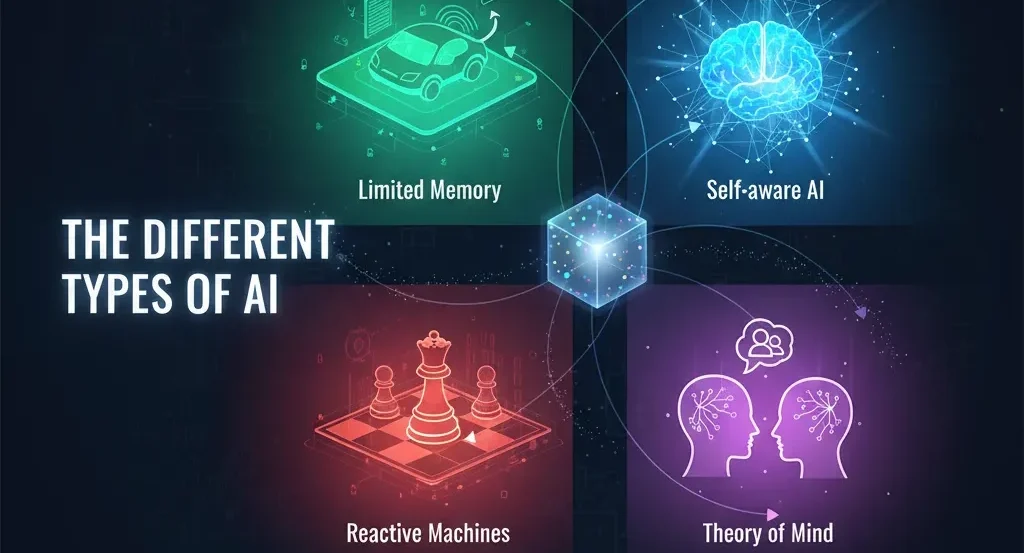
The Different Types of AI: From Narrow to General (and What’s Possible Now)

Intoduction Consider the world where machines not only defeat human beings on the chessboard but can also write poems, find the cure to illnesses, and resolve climate change all within the same afternoon. This is no longer science fiction, but the path we are taking with artificial intelligence.The Different Types of AI Artificial intelligence is also a broad field that is classified according to the potentials and functionalities of the AI systems. We may distinguish two main frameworks of AI, the first is based on the abilities of AI, the second one is based on the functionality of AI. By the year 2025, the concept of AI has changed to a more advanced technology that is transforming all spheres of our existence after being implemented in the year 2025 as a more advanced technology as compared to the simple rule-based systems. However, the thing that the majority of people are not aware of is that not all AI is created equal. Artificial intelligence is divided into separate types that possess various abilities, uses, and prospects of our future. Learning these differences is not an academic issue but a necessity to any one who wishes to know the direction we are moving and the way we should be ready to go with it. History of artificial intelligence (AI): Narrow AI to Artificial Superintelligence. AI Intelligence Spectrum: The 3 Key Intelligence Types. Essentially, discussing artificial intelligence, experts tend to divide it into three basic types in terms of capabilities and scope. Both are the levels of different sophistication and possible impact on society. Narrow AI (ANI): The Specialized Performers. The only form of artificial intelligence that exists currently is Narrow AI, or Artificial Narrow Intelligence (ANI) or Weak AI. The systems are specialized and are unable to perform in areas beyond their areas of operation. Alexander Narrow AI represents the best specialist–incredibly proficient at one thing but totally incapable outside of it. You get Narrow AI when you ask Siri to play your favorite song or when Netflix suggests a movie that is exactly what you are in the mood to watch. The use of narrow AI in practical examples of recommendation engines, speech recognition, predictive maintenance, self-driving cars, search engines, voice assistants, robots, and chatbots. How Narrow AI is Being Used in the Real World. The Narrow AI applications have gone viral in industrial applications, with 77 percent of devices already in use incorporating some type of AI technology: Healthcare Revolution: Medical scans are currently analyzed by AI machines with better accuracy than human physicians, in some cases. Firms such as DeepMind of Google have come up with AI that identifies more than 50 eye diseases with 94 percent accuracy. Financial Protection: Banks apply narrow AI to identify fraudulent transactions on the spot, analyzing their spending patterns and reporting suspicious behaviors within milliseconds. Transportation Innovation: Tesla and Waymo self-driving cars are among the most advanced narrow AI applications, which process millions of data points each second to resolve a complex traffic situation. E-commerce Personalization: Recommendation systems, such as Amazon, Netflix, and Spotify, operate based on the behavior of users to provide recommendations on products and content with unbelievable accuracy. A virtual assistant chatbot example of Narrow AI engaging in an order tracking conversation with a user    The Current Market Reality The small AI market is growing more than ever. By 2024, the global AI market size is estimated to be $279.22 billion and will rise to $1,811.75 billion by 2030, which is 35.9% as a compound annual growth rate (CAGR). The following is the way various industries are embracing narrow AI: Healthcare AI: Excitement with a 37.5% CAGR, between $15.1 billion in 2024 and $102.7 billion in 2030. Retail AI: Garnering 31.8 percent CAGR to hit $31.18 billion by 2030. Financial Services: The financial services are likely to increase to $130.1 billion by 2030. Table Placeholder: Table summarizing AI market growth by industry. Industry 2024 Market Size (Estimated) 2030 Forecast (Estimated) CAGR Healthcare AI $15.1 Billion $102.7 Billion 37.5% Retail AI N/A $31.18 Billion 31.8% Financial Services N/A $130.1 Billion N/A Artificial General: The Holy Grail of AI. The next phase, Artificial General Intelligence, is AI systems that are capable of comprehending, acquiring, and applying knowledge in any field, as humans do. As opposed to narrow AI, AGI would have the ability to apply learning in one field to the other and to be able to reason about things that are outside of this field and also it would be creative and have emotional awareness. A humanoid robot with a brain-like design, symbolizing artificial general intelligence and a combination of human thinking and AI technology. The AGI Development Status Quo. Although AGI is still very hypothetical, good progress is being made. New systems such as GPT-4 and multimodal AI are providing hints of more general intelligence. Controversial forecasts are all over the place: AI company founders: AGI is predicted by some to be in 2026. AI scientists: 2032 prediction Median. Superforecasters: 2027-2047. The difference in such predictions is due to the difficulty of the task and the divergent opinion regarding what is perceived as true AGI. A futuristic robot in a business model on a laptop with a holographic brain of AI and icons representing the different features of artificial intelligence. The Scaling Debate Two major directions are followed towards the goal of AGI: The Scaling Hypothesis: It is widely thought by many of the top AI laboratories that further scaling of the existing models based on transformers with more compute and data will one day reach AGI. The New Architecture Approach: Scholars such as Yann LeCun believe that the world requires new styles and methods of architecture because the existing models do not understand and reason. According to recent studies, the capabilities of AI to complete tasks are doubling about every seven months, which means that, assuming the current trends remain unchanged, in several years we might witness the systems that will be able to deal with complex

The Different Types of AI: From Narrow to General (and What’s Possible Now) Read More »

AI-ML-DL

AI vs. ML vs. DL: Clear Differences Between AI, Machine Learning, and Deep Learning in 2025-26

Introduction: The Age of AI ML DL—Why Clarity Matters “Artificial Intelligence vs. Machine Learning vs. Deep Learning” can seem confusing, especially for beginners. As we move into the era of AI vs. ML vs. DL, these distinctions are influencing technology careers and everyday products—from voice assistants to medical diagnostics.            In this guide, discover how Artificial Intelligence, Machine learning , and Deep learning  form the foundation of today’s fastest-growing technologies. By addressing common questions like “AI vs. machine learning vs deep learning: which is better”, and highlighting the differences between machine learning and deep learning with examples, this post will help clarify confusion.   AI: The Overarching System Artificial Intelligence is at the center of automation and thinking software. It covers everything from rules-based expert systems to advanced analytics that mimic human-like decisions. AI continues to evolve—from early chess engines to modern Artificial Intelligence-driven predictions in ridesharing apps and smart city planning. Machine Learning: Learning Without Explicit Programming ML is a part of Artificial Intelligence that focuses on adaptation. Unlike traditional Artificial Intelligence, machine learning systems get better as they process more data. This makes ML ideal for dynamic applications such as recommendation engines, fraud detection, and virtual personal assistants. Deep Learning: Complexity Unlocked with Neural Networks Deep Learning, a more specialised branch of ML, imitates how the human brain learns. It uses layered neural networks to tackle complex tasks that involve large amounts of data, such as face recognition, speech-to-text, and autonomous vehicles. DL excels in high-volume, high-dimensional, or unstructured data scenarios, like medical imaging and driverless cars. Difference Between AI ML and DL (Tabular Form for Clarity) Aspect Artificial Intelligence Machine Learning Deep Learning             Scope Broadest, includes all intelligent systems Subset of AI, data-driven learning Subset of ML using layered neural networks Learning Method Logic, rules, reasoning Data-driven adaptation Deep neural network feature learning Data Needs Ranges from minimal to moderate Moderate, mostly structured High, especially unstructured data Hardware Low to moderate Moderate High (often needs GPUs/TPUs) Examples Chess engine, chatbots, autopilot Email spam filter, language prediction Self-driving cars, voice assistants, image captioning Human Intervention Often required Some (feature selection, tweaking) Minimal—automated feature discovery Focus Performing human-like tasks Improving with data Handling complex, nonlinear, big data problems Best For Any intelligent automation Data-based predictions, classification Vision, speech, text, sequential data issues Efficiency Varies Can be less efficient on unstructured data Highly efficient for high-volume tasks Artificial Intelligence vs. Machine Learning vs. Deep Learning: Which Is Better? This is one of the most frequently asked questions. The ideal approach depends on the task: Artificial Intelligence vs Machine Learning vs Deep Learning Example: Real-World Scenarios Deep Learning vs. Machine Learning: When Does DL Outperform ML? Deep Learning vs Neural Network: What’s the Subtle Distinction? A neural network is the basic mathematical model in ML that learns patterns by simulating interconnected neurons. Deep learning simply means these networks are “deep”—consisting of many layers, allowing for the detection of complex patterns that shallow (2-3 layer) neural networks cannot uncover. Diagram Imagine three concentric circles: Project Distribution in 2025: Where Are Artificial Intelligence, ML, and DL Used Most? Deep learning is now leading in project share due to advancements in computation and the surge of unstructured data sources. Key Insights & 2025 Trends As of 2025, over half of enterprise projects utilize deep learning, especially for imaging, language, and pattern recognition—mainly due to the availability of GPUs and extensive data streams. Difference Between Machine Learning and Deep Learning (With Examples) Conclusion: Mastering AI vs. ML vs. DL—A Roadmap for 2025 and Beyond Recognize the basic differences: Artificial Intelligence is the broad vision, ML is the practical engine, and DL is the cutting-edge method for handling scale and complexity. Call to Action Share your thoughts in the comments: which of these techniques has changed your workflow or industry?  

AI vs. ML vs. DL: Clear Differences Between AI, Machine Learning, and Deep Learning in 2025-26 Read More »

AI-ML Guide In 2025-26

AI-ML Guide In 2025-26

    The AI-ML Guide In 2025-26 starts with a simple question: have you ever wondered how Netflix seems to know what you want to watch next or how your smartphone unlocks just by looking at it? The hidden forces behind these actions are Artificial Intelligence and Machine Learning (AI & ML), the two engines powering our increasingly smart world. From predicting market trends to transforming healthcare, AI and ML are not just popular terms; they represent real changes in how we interact with technology and the vast amounts of data around us. This guide will explore the fascinating world of AI & ML, break down their main ideas, clarify their roles, and highlight their effects. Whether you’re thinking about taking courses in AI & ML to start a new career or are just curious about the basics, you’ll gain valuable insights into the digital brain shaping our future. AI vs. ML: Unpacking the Relationship –     AI & ML Guide in 2025-26 starts with an important distinction: AI and ML are often used interchangeably, but they are different yet closely related. Think of AI as the bigger goal, while ML is an important method to achieve it. What is Artificial Intelligence (AI)? –      At its heart, artificial intelligence involves creating machines that can do tasks typically needing human intelligence. This includes solving problems, learning, making decisions, sensing the environment, and even understanding language. The ultimate goal of strong AI is to fully mimic human thinking, but most of what we encounter today is “narrow AI” that excels at specific tasks. What is Machine Learning (ML)? –     Machine learning, a part of AI, centers on helping systems learn from data without direct programming. Rather than receiving step-by-step instructions, ML algorithms analyze large datasets, allowing them to recognize patterns, make predictions, and improve their performance over time. This learning process is ongoing and self-adjusting. The Synergy –      How ML Powers AI Machine learning is the main way modern AI systems learn and change. When an AI system shows “intelligence”—like recommending a product or recognizing a face—it’s often an ML algorithm working in the background, having learned from massive amounts of data. Without ML, AI would be a fixed set of rules; with it, AI becomes active and evolving. Key AI & ML Concepts You Need to Know – It’s essential to understand the different ways ML algorithms learn. Here are the main types: Supervised Learning –     This is the most common form of ML. Algorithms are trained on labeled datasets, meaning each piece of data has an associated “answer.” For example, an algorithm learning to identify cats would see thousands of images, each marked as “cat” or “not cat”. Example: Spam detection (emails marked as spam or not), image classification. Unsupervised Learning –      In contrast, unsupervised learning uses unlabeled data. The algorithm’s job is to find hidden patterns, structures, or relationships in the data independently. It’s like discovering clusters in data without prior knowledge of what those clusters mean. Example: Customer segmentation (grouping similar customers based on their buying habits) and anomaly detection. Reinforcement Learning –      Inspired by behavioral psychology, reinforcement learning involves an agent learning to decide by taking actions in an environment and receiving rewards or penalties. The aim is to maximize the total reward. Example: Training AI to play games (AlphaGo), autonomous navigation for robots. Deep Learning –     A Specialized Form of ML Deep learning is a powerful branch of machine learning that uses artificial neural networks with multiple layers to learn complex patterns from large amounts of data. These networks mimic how the human brain works. Deep learning has led to breakthroughs in fields like image recognition, natural language processing, and speech recognition. Real-World Applications –    Where AI & ML Shine AI & ML impact nearly every industry. Healthcare Innovations –     AI and ML are transforming healthcare by helping with disease diagnosis, drug discovery, and personalized treatment plans. For example, ML algorithms can analyze medical images (like X-rays or MRIs) with remarkable accuracy, often finding issues that a human might miss. Google Health and DeepMind are making notable progress in this field. Financial Forecasting –     In finance, AI & ML support algorithmic trading, fraud detection, and risk evaluation. Machine learning models can analyze vast amounts of market data to predict stock movements or spot suspicious transactions in real-time. J.P. Morgan and other major firms heavily use AI in their operations. Personalized Experiences –     Think about the recommendations you see on Amazon, Spotify, or Netflix. These are driven by ML algorithms that learn your preferences and suggest content tailored for you, boosting user engagement and satisfaction. Expect even more tailored, individual experiences by 2025. Autonomous Systems –     From self-driving cars to robotic process automation (RPA), AI & ML are central to autonomous systems that perceive their surroundings, make choices, and perform tasks without human help. Companies like Tesla and Cruise are constantly improving autonomous driving technology. The Current & Future Landscape –     Trends and 2025 Projections The growth of Artificial Intelligence and Machine Learning is impressive. Projections for 2025 suggest this trend will continue. According to Statista, the global AI market revenue is expected to reach roughly USD 300 billion in 2025, growing at a significant annual rate. AI & ML Guide in 2025-26 projects, this momentum will only accelerate, powered by big data, advanced computing, and continuous investment. This rapid growth is driven by the increasing availability of data, improved computing power, and consistent investment across various sectors. Let’s visualize key areas of AI investment and adoption as we approach 2025. Projected Global AI Market by Technology (2025):-  Machine Learning: 48% Natural Language Processing: 22% Computer Vision: 20% Robotics & Other AI: 10%                                                        

AI-ML Guide In 2025-26 Read More »