
How Your Business Should Prepare for AI Trends in 2026: A Comprehensive Transformation Roadmap
The AI Tipping Point Has Arrived
We are at a critical juncture. The era of isolated AI pilots and test projects is drawing to a close. In 2026, the defining shift will be from “should we invest in AI?” to “how quickly can we deploy it at scale?” The numbers are stark: by 2026, 40% of business applications will use task-specific AI agents, up from less than 5% just a year ago. This isn’t mere growth; it’s an acceleration that will distinguish market leaders from those left behind.
For the last two years, most companies viewed AI as a long-term strategic goal. Today, it’s a survival imperative. Organizations that delayed investment are now facing a harsh reality: competitors have already integrated agentic AI into their core operations, and the productivity gaps are widening rapidly. The question is no longer if your business needs AI, but how fast you can move to stay ahead.
I’ve analyzed the most recent trends from PwC, Deloitte, Google Cloud, Microsoft, and industry-specific research firms. The data paints a clear picture of what successful businesses will be doing differently in 2026. This article translates that information into a practical roadmap for business leaders.
Part 1: Getting to Know the AI World in 2026—Beyond the Hype
The AI market has matured significantly by 2026. We’ve moved past the initial excitement of ChatGPT to a practical, measurable phase of business deployment. Three key shifts define this new landscape.
The Need for Productivity-at-Scale
53% of businesses report that AI agents make them more productive, and crucially, 38% say they save money. This indicates that the challenge isn’t just about adopting technology; it’s about re-engineering workflows to extract value. The companies achieving real results aren’t just buying the best AI tools; they’re fundamentally changing how they operate to leverage AI’s capabilities.
The numbers are compelling. AI can reduce the time required for knowledge work by 50 to 60%. In finance, invoice processing that once took days now takes hours. In customer service, AI handles issues that humans might miss, boosting resolution rates. In supply chain management, demand forecasting shifts from reactive to proactive.
The most critical takeaway is that the 15% of organizations achieving massive ROI all share a common trait: they started by redesigning their processes, not by selecting new technology. They mapped out where manual work created bottlenecks, where errors incurred costs, and where speed could provide a competitive edge. Only then did they introduce AI.
Part 2: The Growth of Agentic AI and Self-Directed Workflows
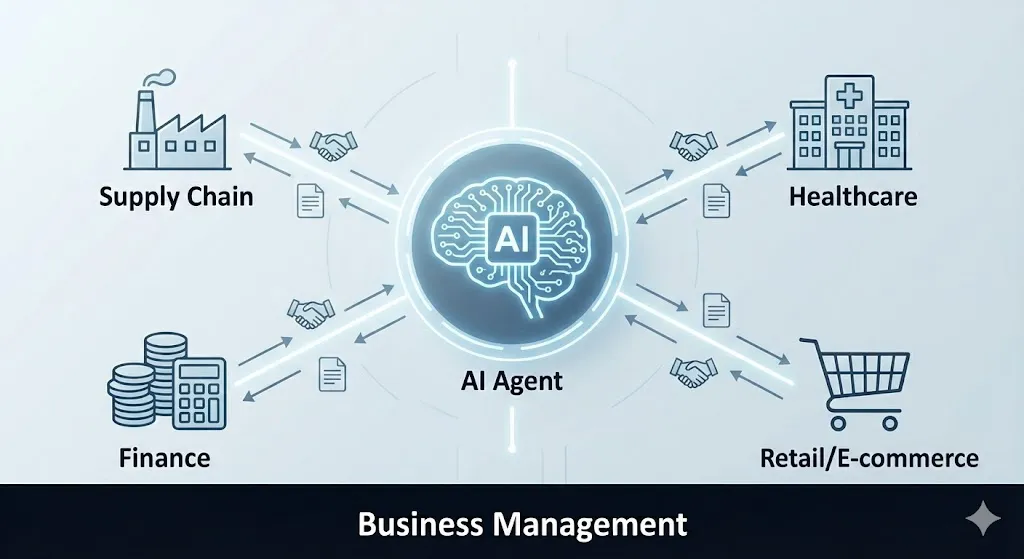
In 2026, agentic AI represents the next evolutionary step. These systems do far more than provide suggestions or summaries. They make decisions, execute workflows, and learn from outcomes.
What Agentic AI Really Does
Agentic systems differ from traditional automation in key ways:
Know the context: They don’t just follow rigid rules; they use business logic to process unstructured data.
Make decisions autonomously: They evaluate situations, operate within set boundaries, and choose actions without constant human intervention.
Adapt continuously: They learn from their actions, improving their performance over time.
Coordinate with other systems: Multiple agents can collaborate, breaking down complex workflows into smaller, manageable tasks.
Industry-Specific Apps That Make Money
Deloitte’s 2026 study shows manufacturers are doubling their use of physical AI, from 9% to 22% in two years. Leading businesses use agentic systems for predictive maintenance, using algorithms to foresee equipment failures. Siemens’ Industrial Copilot reduced maintenance time by 25% in pilots, translating to thousands of saved hours annually for mid-sized operations.
In financial services, JPMorgan Chase’s AI systems analyze contracts 85% faster than humans. This speed is a cumulative advantage. While competitors take days for due diligence, they are closing deals. Repeated hundreds of times a quarter, this speed becomes a life-or-death competitive edge.
In supply chain, DHL uses AI to find the best delivery routes in real time, saving 15% on fuel. Unilever’s “digital twin” of its supply chain cut inventory by 20% and improved service. These aren’t incremental gains; they are structural advantages that compound over time.
In healthcare, AI agents are accelerating appointment scheduling, patient communications, and coordination between clinical and billing systems. The result is fewer hours on paperwork and more time on patient care.
The Reality of Implementation: Where Most Projects Go Wrong
Executives often ask why their expensive AI pilots fail to reach production. The answer is rarely technical. It’s organizational. 70% of companies lack the infrastructure to connect AI agents to their legacy systems—a massive, often underestimated hurdle. Old ERP systems, disconnected data sources, and fragmented workflows make scaling impossible.
The solution? Organizations need a disciplined approach:
Find high-value, scoped workflows where AI provides a clear advantage.
Ensure data is ready before deploying agents (this is non-negotiable).
Start with low-risk automation in support functions before tackling core revenue processes.
Be disciplined about measurement from day one. You cannot improve what you do not measure.
Companies that skip these steps and jump straight to core process automation without the necessary data foundation almost always end up in “pilot purgatory”—their systems work in controlled tests but fail in production when faced with real-world data complexity.
Part 3: Cybersecurity as a Way to Stay Alive, Not Just a Box to Check
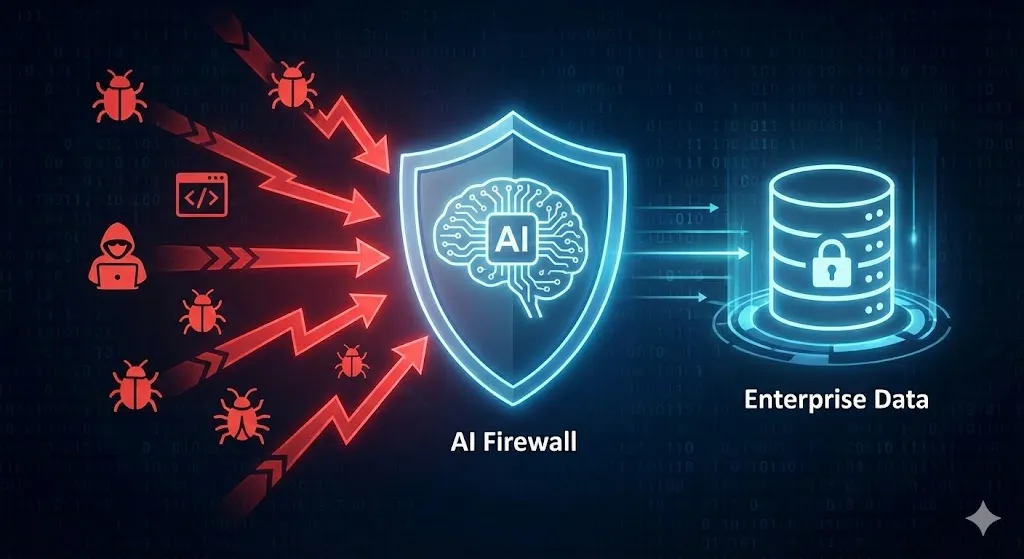
Agentic AI introduces security challenges that previous AI systems did not. Autonomous systems with access to sensitive data, databases, and financial systems are targets in ways chatbots never were.
The New Threat Landscape
Adversaries have discovered a worrying reality: hacking an AI agent provides them with an autonomous insider. A single, well-crafted prompt injection attack could allow bad actors to weaponize your organization’s most powerful system to execute unauthorized trades, delete backups, or steal customer data.
In the near future, 33% of enterprise-level apps will use agentic AI, significantly expanding the attack surface. Threat actors are adapting, shifting their focus from targeting people to targeting agents.
The AI-Powered Defense Need
The good news is that the technology creating new risks also enables new defenses. AI-driven threat detection now identifies threats in real-time by analyzing logs, network behavior, and user actions to find patterns human analysts might miss. At least 55% of businesses already use AI-powered cybersecurity tools, a number that is growing daily.
In 2026, security teams employ an “AI firewall“—a runtime governance layer that constantly monitors agentic systems and blocks prompt injections, malicious code, tool misuse, and agent identity impersonation as they occur. This isn’t reactive detection; it’s predictive threat modeling that tests your own agents before attackers do.
The economics are clear: preventing one major breach is far less expensive than dealing with the fallout of a compromised agent executing unauthorized actions at scale.
Part 4: Small Language Models—Enterprise’s Best-Kept Secret
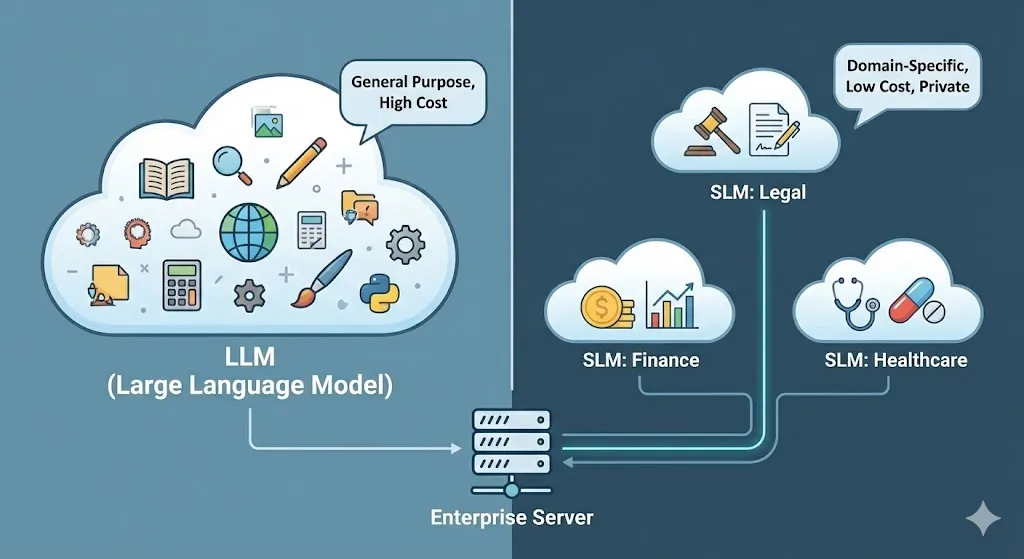
While the industry obsesses over GPT-scale models with hundreds of billions of parameters, Small Language Models (SLMs)—compact, domain-specific alternatives requiring a fraction of the computing power—will power 60% of enterprise AI tasks in 2026.
Why SLMs Are the Business’s Choice
The most obvious benefit is cost savings. A well-tuned SLM running on local infrastructure costs significantly less than API calls to a massive foundation model. But the real value extends beyond price:
Privacy and compliance: You can deploy SLMs on-premises or in a private cloud, keeping sensitive data within your own infrastructure.
Latency: Local inference is much faster, critical for customer-facing applications.
Easier to audit, test, and govern: Smaller models are more controllable and transparent.
Customization: SLMs trained on your specific industry data outperform generic large models for focused tasks.
SLM Performance in the Real World
A top bank used an SLM fine-tuned on regulatory documents to automate compliance checks. The results: 2.5 times faster processing, 88% accuracy in legal terms, and cloud costs for LLM integration that were only 20% of the original plan. This isn’t an isolated case. Organizations consistently report that domain-specific SLMs trained on their own data outperform both generic LLMs and traditional rule-based systems.
The enterprise AI stack of 2026 is a hybrid: large models for broad, creative tasks, and SLMs for focused, high-volume domain-specific work. Companies that balance these approaches achieve better economics and performance than those relying solely on one.
Part 5: Getting Your Employees Ready for AI—The Skills Reality
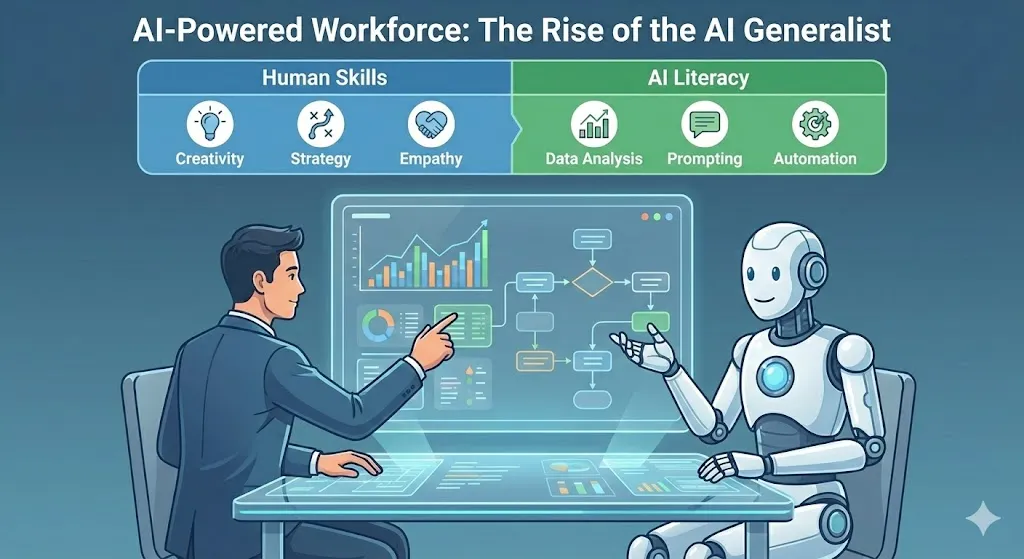
The numbers are clear: 94% of CEOs say AI is the most in-demand skill for 2025, but only 35% of leaders believe they’ve done a good job preparing employees for AI roles. This leads to the trillion-dollar question: how do you close the gap?
The Skills Gap Crisis and Its Cost
According to IDC research, the global economy will lose $5.5 trillion by 2026 due to a lack of skilled workers. This isn’t just lost productivity; it’s delayed digital transformation, failed AI projects, and lost competitive edge. The problem is structural: roles using AI are changing 66% faster than traditional roles, meaning the retraining task is continuous.
The wage premium paradox exacerbates this. AI-skilled workers earn 56% more than their peers, making it difficult for most companies to compete for talent. This forces a strategic choice: hire expensive specialized AI workers or invest heavily in training current employees.
The Workforce Transformation Strategy
In 2026, successful companies use a mixed approach:
Ensure company-wide AI literacy. Not everyone needs to be a machine learning engineer, but everyone should understand AI’s capabilities, how to use it, and their role in an AI-augmented workflow.
Create AI generalist roles. PwC predicts this will be a key trend in 2026. The most valuable employees aren’t just techies; they are hybrid professionals who can bridge the gap between business strategy and technical execution.
Invest in reskilling over hiring. By 2030, 85% of employers plan to make upskilling a top priority. Early movers will have an edge. Companies with strong reskilling programs report higher adoption of new ideas, better change management, and increased employee retention.
Focus on uniquely human skills. As AI takes over technical tasks, creative thinking, critical evaluation, strategic synthesis, and leadership become more valuable. In 2026, the best professionals will excel at both AI and human skills.
Measuring Workforce Readiness
Before deploying agentic systems, assess your organization’s readiness:
Companies that are honest about their weaknesses can make smart investment decisions. Attempting to use agentic AI without addressing these gaps usually leads to unused technology because the organization cannot figure out how to use it effectively.
Part 6: How to Measure AI ROI: From Tests to Business Value
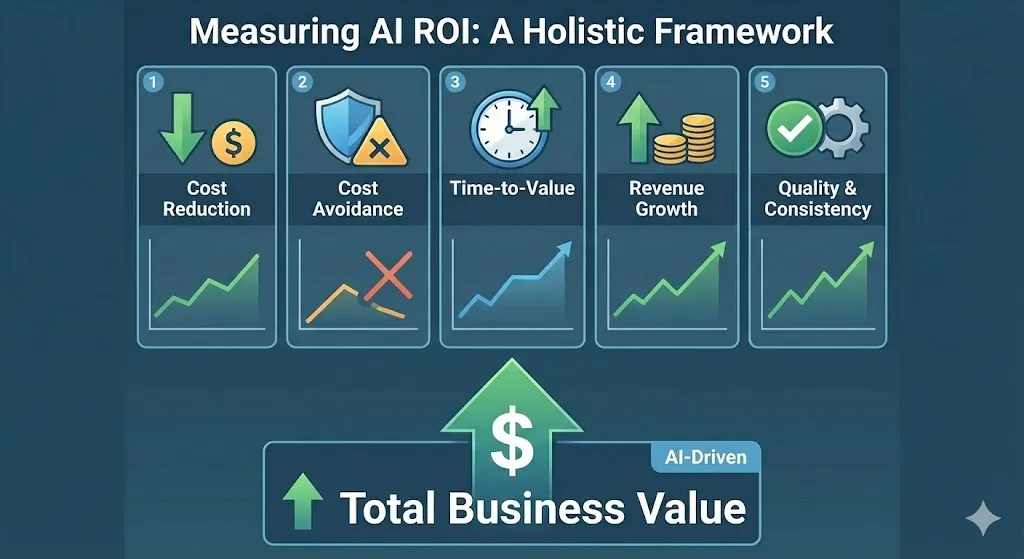
Deloitte reports that more than 40% of executives struggle to justify AI investments. Yet, organizations that succeed report amazing results. The bridge between these realities is knowing which ROI measurement frameworks work.
Proof Points of ROI in the Real World
The numbers are impressive for businesses that execute well:
2,100% ROI in a marketing case within the first year, with payback in four months.
$9.5 million business impact from two operational AI agents in year one.
$6.6 million in additional sales from a $200,000 investment in AI-targeted campaigns.
30% to 50% reduction in administrative operating costs through smart automation.
75% less time for financial professionals to create and review reports.
These aren’t outliers; they are what good execution looks like.
The ROI Framework That Works
Successful organizations measure AI’s impact across five dimensions:
Cost Reduction (Direct Labor Savings): Quantify saved hours. If AI allows one person to do the work of three, calculate the savings. This is the fastest, but often smallest, ROI.
Cost Avoidance: Count avoided fines, errors fixed before reaching customers, and prevented fraud. A compliance AI that stops one major violation pays for itself many times over.
Time-to-Value (Shortening Cycle Time): Measure how AI accelerates core business cycles. Faster invoice processing or quote generation, multiplied by thousands of transactions, significantly boosts competitiveness.
Revenue Growth & Optimization: This is harder to pin down but often the biggest opportunity. Hyper-personalization, predictive cross-selling, and recommendation systems that increase average order value all contribute.
Quality and Consistency: Measure reduction in errors, increased customer satisfaction, and better compliance. AI-driven processes are often more consistent, improving the customer experience.
Part 7: Governance and Responsible AI—The New Way to Get Ahead
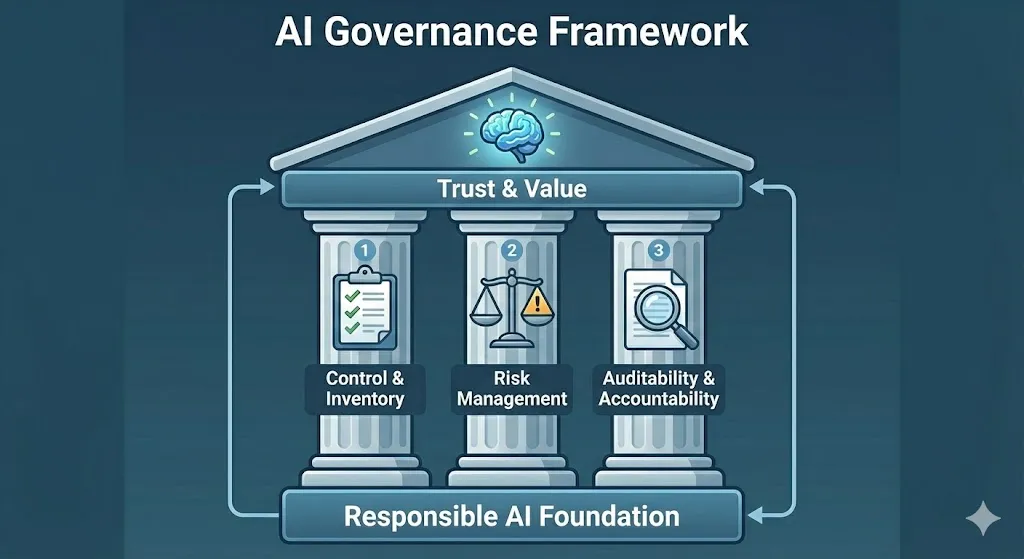
Responsible AI has moved from a moral aspiration to a business imperative. In 2026, companies with robust governance don’t just reduce risk; they move faster, build stakeholder trust, and achieve better business outcomes.
The Evolution of Governance
Two years ago, “Responsible AI” meant publishing ethical guidelines. Today, it means “show us,” not “trust us.” This requires measurable, verifiable proof that AI systems operate within legal and ethical boundaries.
Three forces are driving this change: regulatory pressure (like the EU AI Act), public distrust, and the simple fact that ungoverned AI systems produce unreliable results that destroy value.
The Governance Framework That Grows
In 2026, successful organizations build governance on three pillars:
Pillar 1: Control & Inventory: Maintain an up-to-date, official inventory of all AI systems, including agentic deployments. For each system, document data sources, decision impact, human oversight, and monitoring mechanisms. This brings “dark AI” into the light.
Pillar 2: Risk Management: Continuously test AI systems for bias, accuracy, and robustness. This isn’t a one-time compliance check. It involves ongoing fairness testing, accuracy monitoring, and robustness testing against adversarial inputs.
Pillar 3: Auditability & Accountability: Clearly define who is responsible for AI decisions. Create audit trails that document what data an agent considered, the decision it made, why it was compliant, and the outcome. This is operational intelligence, not just liability protection.
The Business Case for Governance
Companies with strong governance report:
60% increase in ROI from AI projects.
55% improvement in customer experience.
Faster production times because teams work with confidence.
Better model performance through continuous testing and feedback loops.
Governance doesn’t slow down innovation; it accelerates it by providing a safe foundation for growth.
Part 8: Strategies for Change in Specific Industries
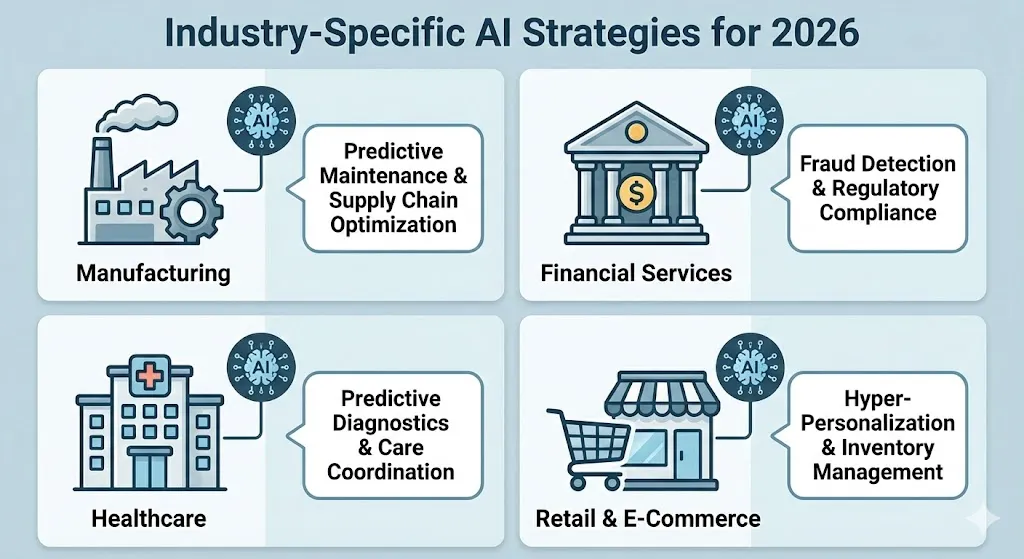
AI’s impact varies significantly by sector. Understanding your industry’s top priorities for 2026 is crucial for strategic focus.
Manufacturing: The Year of Production-Scale Deployment Manufacturers are moving from AI pilots to large-scale production. Deloitte predicts that in 2026, 80% of manufacturers plan to allocate at least 20% of their improvement budgets to smart manufacturing. Key areas include predictive maintenance to reduce unplanned downtime, production optimization, and real-time supply chain orchestration. The critical enabler is data quality; agentic systems require clean, standardized data to operate effectively across systems.
Financial Services: Speed and Risk Set Them Apart JPMorgan Chase’s ability to analyze contracts 85% faster than humans exemplifies the trend: AI provides a competitive edge through simultaneous speed and accuracy. Priorities for 2026 include using AI agents for trade compliance and fraud detection, deploying SLMs fine-tuned on regulatory documents, and developing predictive analytics for customer churn and market trends. Early investment in governance is a major advantage in this heavily regulated field.
Healthcare: Diagnosis, Efficiency, and Care Coordination By 2030, the healthcare AI market will reach $187.9 billion, driven by predictive diagnostics, personalized treatment, and administrative automation. 2026 goals include using AI for appointment scheduling and patient communication, employing predictive diagnostics to detect diseases earlier, and automating billing and compliance processes, all while strictly adhering to HIPAA regulations.
Retail and E-Commerce: Customization and the Supply Chain Retailers using AI for hyper-personalization report conversion rates three times higher than the industry average. Priorities for 2026 include using personalization engines to improve product discovery, implementing dynamic pricing based on real-time demand and inventory, and using AI to optimize supply chains and handle routine customer service inquiries.
Part 9: Your AI Transformation Plan for 2026
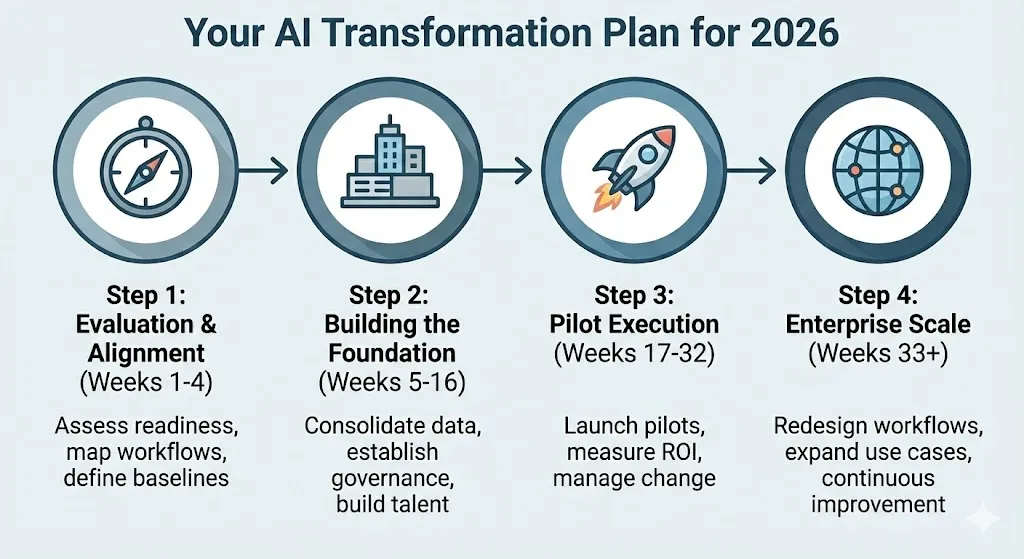
Moving from strategy to action requires careful planning. This roadmap provides the necessary discipline.
Step 1: Evaluation and Alignment (Weeks 1–4) Goal: Understand your current state and align leadership.
Assess technical infrastructure, data quality, and organizational capability.
Map current operating models to identify high-cost, error-prone, or slow processes.
Engage stakeholders across business, IT, and finance.
Establish baseline metrics for top priority workflows.
Deliverable: AI Readiness Assessment and Priority Opportunity Map.
Step 2: Building the Foundation (Weeks 5–16) Goal: Establish the infrastructure, governance, and skills for production deployment.
Consolidate data sources into a unified data lake or warehouse.
Implement data governance for quality, consistency, and security.
Establish an AI governance framework with clear roles and success metrics.
Hire or build hybrid talent (AI generalists).
Select 1-2 pilot workflows.
Deliverable: AI-ready data infrastructure, governance framework, and pilot scope.
Step 3: Pilot Execution (Weeks 17–32) Goal: Demonstrate ROI and build organizational capability.
Deploy AI or agentic systems on limited pilots.
Measure rigorously against success criteria.
Identify and resolve legacy system integration issues.
Build change management support.
Document learnings and success factors.
Deliverable: Measurable pilot results and a case study for scaling.
Step 4: Enterprise Scale (Weeks 33+) Goal: Expand successful solutions across the organization.
Redesign workflows to fully leverage AI capabilities.
Expand to additional departments, use cases, or geographies.
Institutionalize continuous monitoring and improvement.
Evolve governance, infrastructure, and skills as AI adoption grows.
Deliverable: AI integrated into core operations, measurable business impact, and established competitive advantage.
Conclusion: Time is running out to take action.
It is still possible to rationalize “not yet having started” as strategic patience. But by the middle of 2026, the gap between AI leaders and laggards will be so wide that catching up will be exponentially harder.
The companies that will define their industries over the next five years won’t be the ones with the flashiest AI models. They will be the ones that:
Understood that AI transformation is more about business process than technology.
Invested in the fundamentals of data, governance, and skills first.
Measured rigorously and adapted based on evidence.
Scaled deliberately, learning from pilots before going company-wide.
Treated their employees as partners in change, investing in their skills and addressing their fears.
The choices you make today will determine your competitive position in 2026. The execution discipline you establish now will decide whether AI becomes a source of long-term value or just another expensive technology experiment.
It’s time to get started.
FAQs
Q1: How long does it usually take for AI projects to pay off? A: Organizations usually see a good return on investment (ROI) within 6 to 18 months of starting a pilot project. But this assumes strict measurement discipline from the start, good foundational work (data quality, governance), and a clear scope. Bigger, messier projects take longer and often fail. The fastest ROI comes from starting small, measuring everything, and scaling only when results are proven.
Q2: How many people do you need on your team to start an AI transformation? A: A good starting team should have one executive sponsor (non-negotiable), one data engineer or architect, one AI engineer or data scientist, one domain expert (business process owner), and one change management resource. It’s a small team, but every role is critical. A common mistake is overemphasizing technical skills and underestimating the need for change management and domain expertise.
Q3: Should we put money into big or small language models for business use? A: Start with SLMs for most business tasks because they are faster, cheaper, and easier to manage. Use big models only for broad, creative tasks. In 2026, the best businesses will use a hybrid approach: SLMs for everyday tasks and LLMs for strategic analysis. This provides better performance and economics.
Q4: What is the most important thing for an AI project to be successful? A: The quality of the data. It’s not even close. Bad data defeats every AI system. Companies that consistently succeed spend significant time and money on data consolidation, quality validation, and governance before deploying advanced models. Those who skip this step always end up disappointed.
Q5: What can we do to calm employees who are worried that AI will take their jobs? A: Have a truthful conversation based on facts. Let employees know that AI is not taking their jobs, but augmenting them. Show through pilots how AI can handle mundane tasks, freeing up time for strategic and creative work. Invest visibly in their retraining. Companies that are open about AI’s impact and invest in their employees’ growth retain good workers and manage change more smoothly.


Pingback: The Skills You Need to Learn in 2026 to Stay Relevant - Bing Info
Pingback: Things you need to know to stay up to date in 2026 - Bing Info
Pingback: Long-Term Bets: Predictions for AI in 2030 and 2040 - Bing Info