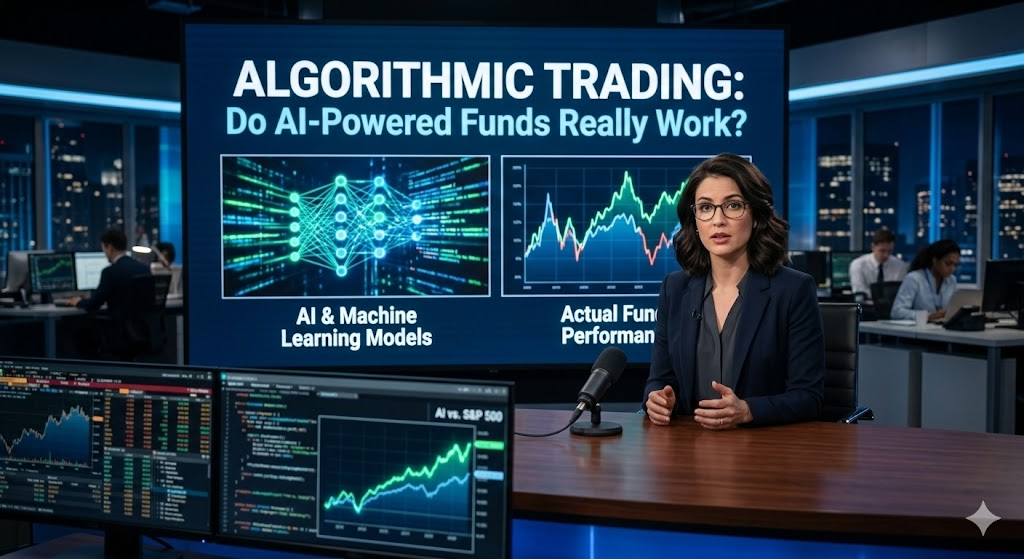
Algorithmic Trading: Do AI-Powered Funds Really Work?
Algorithmic Trading: Do AI-Powered Funds Really Work? For thirty years, I’ve worked in the tough field of AI and technology. I have seen revolutions happen in real life that I thought only happened in movies. AI and finance have changed everything, from the slow mainframes of the early 1990s that could only handle small amounts of data to today’s neural networks that can process petabytes of market signals in milliseconds. But in the middle of all the hype—headlines praising self-learning algorithms that promise to be better than human intuition—there is one important question: Do algorithmic trading funds really work? We’ll talk about how things work, look closely at the evidence, and look ahead using the most up-to-date information we have as of early 2026. This isn’t just an analysis; it’s a guide that you can use to weigh the pros and cons of AI-based stock trading in India. It’s for both new traders who are just starting out and experienced traders who want to get ahead. I’ve given ideas, made models, and worked as a consultant for funds where algorithms aren’t tools but guards that protect portfolios from the market’s whims. AI is also not a cure-all. It is a knife that can be very helpful or very harmful, depending on how you use it. The stakes couldn’t be higher; algorithmic trading is expected to bring in $10.4 billion in 2024 and $16 billion by 2030. Let’s pull this apart one thread at a time. The Evolution of Trading The Foundations: A Look Back at the Past of Algorithmic Trading We need to look at the history of algorithmic trading, which goes back decades before the AI boom, before we can say for sure if AI-powered funds work. In the early 1990s, only people with PhDs in quantitative finance were writing formulas on chalkboards. In the 1970s, electronic exchanges let people trade using algorithms. Algo trading is what this is called now. The New York Stock Exchange’s DOT system made it possible to route orders automatically in 1976. This was a big change from the open-outcry pits, where traders yelled out bids like auctioneers at a crazy auction. When personal computers became more common in the 1980s, simple rule-based algorithms like moving average crossovers and volume-weighted average price (VWAP) executions started to do trades on their own. They weren’t “smart” like we think of them now; they were just scripts that did what they were told to do. Latency became the new money when high-frequency trading (HFT) began in the 1990s. Companies like Citadel and Renaissance Technologies were the first to do this. They were able to cut execution times by microseconds by using servers that were only a few feet away from the data centers where exchanges were located. The Flash Crash of 2010 showed how dangerous algorithms can be: a flood of automated sell orders made the market lose a trillion dollars in just a few minutes. It was too late for regulators to put in place circuit breakers and checks. Algorithmic trading made up more than 80% of all U.S. equity volume in 2024. This shows how much it has become a part of the market. This historical background helps us understand why algorithmic trading is so popular: it’s fast and easy. It gets rid of human flaws like being tired and having feelings and replaces them with speed and accuracy. But these systems didn’t work very well without AI because they were based on rules that didn’t work well with how the market changes all the time. Algo trading goes from simple automation to smart automation thanks to artificial intelligence. Money Madness in Mumbai How to Trade with Algorithms When computers follow rules to make trades, that’s called algorithmic trading. Let’s look at this more closely. It sets the entry and exit points, position sizes, and risk levels for all kinds of assets, such as stocks, options, forex, and even cryptocurrencies. I often think of it as the person who leads a symphony. The most important parts are: Strategy Development: This is where the quants I’ve worked with use past data to build models that help them come up with new strategies. For instance, momentum strategies buy things that are going up, and mean-reversion bets on prices going back to their average. Execution Engines: These split up orders so that they don’t have as much of an effect on the market. Zerodha’s Streak and other platforms help new traders use AI by letting them make plans without having to learn how to code. Backtesting and optimization: Running a lot of tests on old data makes sure the system is strong, but overfitting, which is the worst thing that can happen to a trader, is a big problem. AI helps these things learn from their mistakes (ML). Supervised models look at data with labels to guess how prices will change. Unsupervised models, on the other hand, try to make money by putting together strange data points. Reinforcement learning is my favorite way to learn because it lets agents “learn” by making mistakes and getting rewards for trades that make money, just like AlphaGo learned how to play Go. A simple AI stock trading bot, for instance, gets real-time data from APIs like Alpha Vantage, processes it with neural networks, and then trades it with brokers like Groww. You can use TradingView’s Pine Script and other tools to get started with free AI for options trading in India, but professionals want tools that are made just for them. But do these machines get along with each other? The numbers speak for themselves: Sharpe ratios above 1.5, drawdowns below 10%, and alpha generation that beats benchmarks like the Nifty 50. The AI Infusion: Key Parts of Funds That Use AI Algo trading was the first step, and now AI makes it even better. In my talks with hedge funds, I’ve seen AI go from a small problem to a big one.
Algorithmic Trading: Do AI-Powered Funds Really Work? Read More »