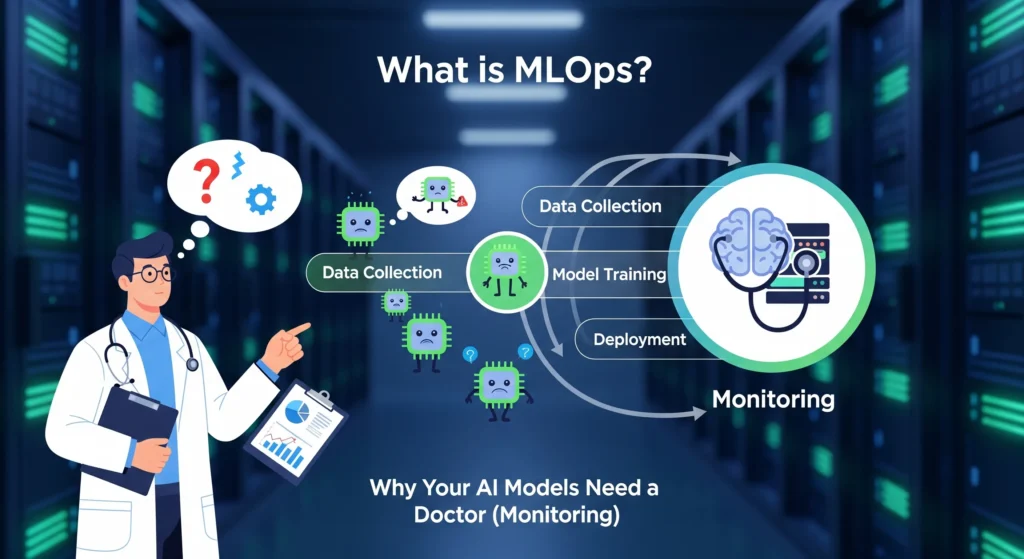
What is MLOps? Why Your AI Models Need a Doctor (Monitoring)
What is MLOps? Why Your AI Models Need a Doctor (Monitoring) You’ve built an incredible AI model. It predicts customer behavior with 94% accuracy. Your team celebrates. Six months later? That same model is making predictions so wild that your business team stopped trusting it completely. Sound familiar? You’re not alone. Here’s the kicker: 67% of AI models never even make it to production, and for those that do, 91% experience performance degradation over time. It’s like training a doctor who gradually forgets medicine. That’s where MLOps comes in—think of it as regular health checkups for your AI models. And trust me, your models need them. In this post, we’re diving deep into what MLOps actually is, why monitoring your models is non-negotiable, and how you can stop your AI from slowly losing its mind. By the end, you’ll understand exactly why your machine learning models need constant supervision (yes, just like toddlers) and what happens when they don’t get it. Let’s get started. Understanding MLOps: The Basics MLOps stands for Machine Learning Operations. If that sounds boring, stick with me—because what it does is anything but. Think of MLOps as the bridge between building cool AI models in notebooks and actually using them in real businesses. It’s what happens after the data scientist says “my model works!” and before customers actually benefit from it. Here’s the simple version: MLOps combines machine learning (the AI part), software engineering (the building part), and data engineering (the data part) into one smooth workflow. The term was actually coined back in 2015 in a research paper about “hidden technical debt in machine learning systems”. Turns out, building models is the easy part. Keeping them working? That’s the challenge. What MLOps Actually Does MLOps isn’t just one thing—it’s a whole set of practices that cover the entire life of your machine learning model. From the moment you collect data to train your model, all the way through deployment and continuous monitoring, MLOps keeps everything running smoothly. The ML lifecycle typically includes these stages: Data Collection and Preparation – Gathering and cleaning data so it’s actually usable Model Training and Testing – Building your model and making sure it works Model Deployment – Getting your model into production where real users interact with it Model Monitoring – Watching how your model performs over time (this is the crucial part everyone forgets) Model Updates and Improvements – Retraining and updating when performance drops ` Before MLOps existed, each of these steps was manual, slow, and prone to breaking. Data scientists would build amazing models on their laptops, then hand them off to engineering teams who had no idea how to deploy them. Weeks (or months) would pass before anything actually worked in production. MLOps automates all of this. It creates assembly lines for machine learning, turning what used to take months into days or even hours. MLOps vs DevOps: What’s the Difference? You’ve probably heard of DevOps. So is MLOps just DevOps with a fancy ML twist? Not quite. While MLOps builds on DevOps principles, they’re solving different problems. DevOps focuses on shipping software applications quickly and reliably. MLOps? It’s all about shipping and maintaining machine learning models, which are way more complicated. Here’s why ML models are different animals: They’re data-centric, not just code-centric. A software application is basically a set of instructions. An ML model is those instructions plus the data it learned from plus the statistical relationships it discovered. Change the data, and the whole model might need retraining. They drift over time. Your web application doesn’t suddenly start performing worse because the world changed. Your ML model absolutely does. Customer behavior shifts, markets evolve, and suddenly your fraud detection model is missing new types of fraud. Artifacts are dynamic, not static. In DevOps, you version your code and configuration files. In MLOps, you also need to version datasets, model parameters, experiment results, training configurations, and the actual trained models themselves. It’s version control on steroids. Testing is different. In DevOps, you test whether your code works. In MLOps, you test whether your model is accurate, whether it’s biased, whether the data has drifted, whether predictions are stable, and a dozen other things. Think of it this way: DevOps builds the car. MLOps builds the self-driving system inside the car—which needs constant updates as roads change, traffic patterns shift, and new obstacles appear. The good news? MLOps borrows the best practices from DevOps—like continuous integration, continuous deployment (CI/CD), and automated testing—then extends them to handle the unique challenges of machine learning. The MLOps Pipeline: How It All Works Okay, so how does this all fit together in practice? An MLOps pipeline is the automated workflow that takes your model from training to production. Instead of manually copying files and crossing your fingers, you build a system that handles everything automatically. Here’s what a typical MLOps pipeline looks like: Stage 1: Data Collection and Validation First, you need data. But not just any data—clean, validated, high-quality data. The pipeline automatically collects data from databases, APIs, or files. Then it runs validation checks: Are there missing values? Outliers? Does the data distribution look normal? If something’s wrong, the pipeline alerts you before wasting time training a bad model. Tools like Apache Airflow can schedule these data collection tasks to run automatically. Stage 2: Model Training and Experiment Tracking Once your data passes validation, the pipeline trains your model. But here’s where MLOps shines: it tracks everything. Every hyperparameter you tried. Every accuracy score. Every version of the model. Tools like MLflow and Neptune keep detailed logs so you can compare experiments and pick the best model. Stage 3: Model Testing and Validation Before deployment, automated tests check if the model meets your performance standards. Is accuracy above your threshold? Does it handle edge cases? Is there bias in predictions? If the model fails these tests, it doesn’t move forward. No more “oops, we deployed a broken model to production.” Stage 4: Automated Deployment Once
What is MLOps? Why Your AI Models Need a Doctor (Monitoring) Read More »